

47
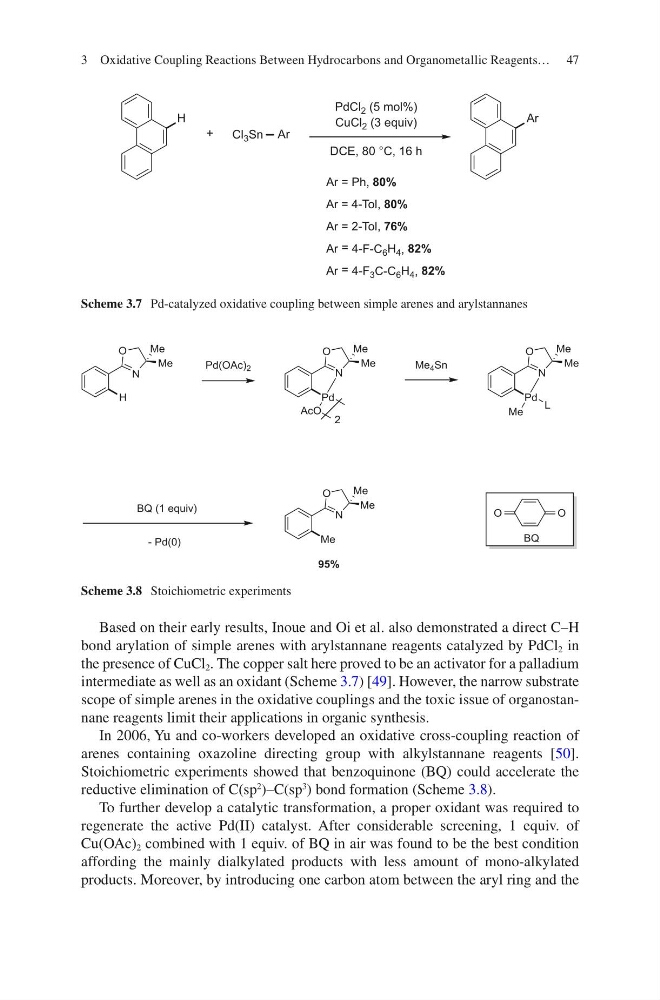
Based on their early results, Inoue and Oi et al. also demonstrated a direct C–H
bond arylation of simple arenes with arylstannane reagents catalyzed by PdCl 2 in
the presence of CuCl 2 . The copper salt here proved to be an activator for a palladium
intermediate as well as an oxidant (Scheme 3.7) [49]. However, the narrow substrate
scope of simple arenes in the oxidative couplings and the toxic issue of organostannane reagents limit their applications in organic synthesis.
In 2006, Yu and co-workers developed an oxidative cross-coupling reaction of
arenes containing oxazoline directing group with alkylstannane reagents [50].
Stoichiometric experiments showed that benzoquinone (BQ) could accelerate the
reductive elimination of C(sp
2
)–C(sp
3
) bond formation (Scheme 3.8).
To further develop a catalytic transformation, a proper oxidant was required to
regenerate the active Pd(II) catalyst. After considerable screening, 1 equiv. of
Cu(OAc) 2 combined with 1 equiv. of BQ in air was found to be the best condition
affording the mainly dialkylated products with less amount of mono-alkylated
products. Moreover, by introducing one carbon atom between the aryl ring and the
H
+
Cl 3 Sn Ar
PdCl 2 (5 mol%)
CuCl 2 (3 equiv)
DCE, 80 °C, 16 h
Ar
Ar = Ph, 80%
Ar = 4-Tol, 80%
Ar = 2-Tol, 76%
Ar = 4-F-C 6 H 4 , 82%
Ar = 4-F 3 C-C 6 H 4 , 82%
Scheme 3.7 Pd-catalyzed oxidative coupling between simple arenes and arylstannanes
Scheme 3.8 Stoichiometric experiments
3 Oxidative Coupling Reactions Between Hydrocarbons and Organometallic Reagents…
Based on their early results, Inoue and Oi et al. also demonstrated a direct C–H
bond arylation of simple arenes with arylstannane reagents catalyzed by PdCl 2 in
the presence of CuCl 2 . The copper salt here proved to be an activator for a palladium
intermediate as well as an oxidant (Scheme 3.7) [49]. However, the narrow substrate
scope of simple arenes in the oxidative couplings and the toxic issue of organostannane reagents limit their applications in organic synthesis.
In 2006, Yu and co-workers developed an oxidative cross-coupling reaction of
arenes containing oxazoline directing group with alkylstannane reagents [50].
Stoichiometric experiments showed that benzoquinone (BQ) could accelerate the
reductive elimination of C(sp
2
)–C(sp
3
) bond formation (Scheme 3.8).
To further develop a catalytic transformation, a proper oxidant was required to
regenerate the active Pd(II) catalyst. After considerable screening, 1 equiv. of
Cu(OAc) 2 combined with 1 equiv. of BQ in air was found to be the best condition
affording the mainly dialkylated products with less amount of mono-alkylated
products. Moreover, by introducing one carbon atom between the aryl ring and the
H
+
Cl 3 Sn Ar
PdCl 2 (5 mol%)
CuCl 2 (3 equiv)
DCE, 80 °C, 16 h
Ar
Ar = Ph, 80%
Ar = 4-Tol, 80%
Ar = 2-Tol, 76%
Ar = 4-F-C 6 H 4 , 82%
Ar = 4-F 3 C-C 6 H 4 , 82%
Scheme 3.7 Pd-catalyzed oxidative coupling between simple arenes and arylstannanes
Scheme 3.8 Stoichiometric experiments
3 Oxidative Coupling Reactions Between Hydrocarbons and Organometallic Reagents…