

46
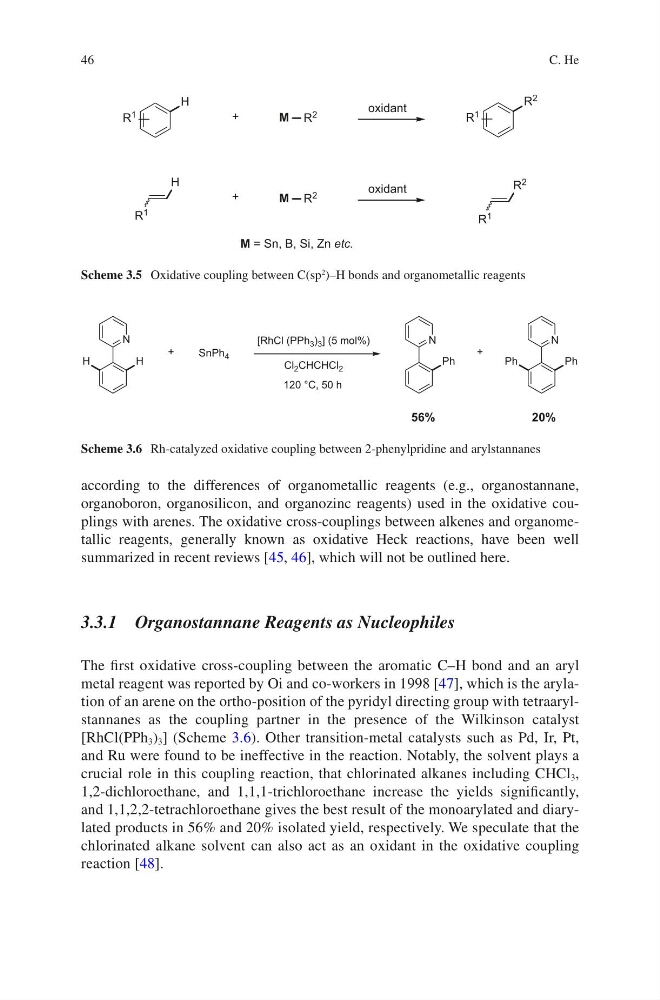
according to the differences of organometallic reagents (e.g., organostannane,
organoboron, organosilicon, and organozinc reagents) used in the oxidative couplings with arenes. The oxidative cross-couplings between alkenes and organometallic reagents, generally known as oxidative Heck reactions, have been well
summarized in recent reviews [45, 46], which will not be outlined here.
3.3.1 Organostannane Reagents as Nucleophiles
The first oxidative cross-coupling between the aromatic C–H bond and an aryl
metal reagent was reported by Oi and co-workers in 1998 [47], which is the arylation of an arene on the ortho-position of the pyridyl directing group with tetraarylstannanes as the coupling partner in the presence of the Wilkinson catalyst
[RhCl(PPh 3 ) 3 ] (Scheme 3.6). Other transition-metal catalysts such as Pd, Ir, Pt,
and Ru were found to be ineffective in the reaction. Notably, the solvent plays a
crucial role in this coupling reaction, that chlorinated alkanes including CHCl 3 ,
1,2- dichloroethane, and 1,1,1-trichloroethane increase the yields significantly,
and 1,1,2,2-tetrachloroethane gives the best result of the monoarylated and diarylated products in 56% and 20% isolated yield, respectively. We speculate that the
chlorinated alkane solvent can also act as an oxidant in the oxidative coupling
reaction [48].
R 1
H
H
R 1
+
+
M R 2
M R 2
oxidant
oxidant
R 1
R 2
R 2
R 1
M = Sn, B, Si, Zn etc.
Scheme 3.5 Oxidative coupling between C(sp
2 )–H bonds and organometallic reagents
N
H
SnPh 4
+
[RhCl (PPh 3 ) 3 ] (5 mol%)
N
Ph
56%
N
Ph
Ph
+
20%
Cl 2 CHCHCl 2
120 °C, 50 h
H
Scheme 3.6 Rh-catalyzed oxidative coupling between 2-phenylpridine and arylstannanes
C. He
according to the differences of organometallic reagents (e.g., organostannane,
organoboron, organosilicon, and organozinc reagents) used in the oxidative couplings with arenes. The oxidative cross-couplings between alkenes and organometallic reagents, generally known as oxidative Heck reactions, have been well
summarized in recent reviews [45, 46], which will not be outlined here.
3.3.1 Organostannane Reagents as Nucleophiles
The first oxidative cross-coupling between the aromatic C–H bond and an aryl
metal reagent was reported by Oi and co-workers in 1998 [47], which is the arylation of an arene on the ortho-position of the pyridyl directing group with tetraarylstannanes as the coupling partner in the presence of the Wilkinson catalyst
[RhCl(PPh 3 ) 3 ] (Scheme 3.6). Other transition-metal catalysts such as Pd, Ir, Pt,
and Ru were found to be ineffective in the reaction. Notably, the solvent plays a
crucial role in this coupling reaction, that chlorinated alkanes including CHCl 3 ,
1,2- dichloroethane, and 1,1,1-trichloroethane increase the yields significantly,
and 1,1,2,2-tetrachloroethane gives the best result of the monoarylated and diarylated products in 56% and 20% isolated yield, respectively. We speculate that the
chlorinated alkane solvent can also act as an oxidant in the oxidative coupling
reaction [48].
R 1
H
H
R 1
+
+
M R 2
M R 2
oxidant
oxidant
R 1
R 2
R 2
R 1
M = Sn, B, Si, Zn etc.
Scheme 3.5 Oxidative coupling between C(sp
2 )–H bonds and organometallic reagents
N
H
SnPh 4
+
[RhCl (PPh 3 ) 3 ] (5 mol%)
N
Ph
56%
N
Ph
Ph
+
20%
Cl 2 CHCHCl 2
120 °C, 50 h
H
Scheme 3.6 Rh-catalyzed oxidative coupling between 2-phenylpridine and arylstannanes
C. He