

184
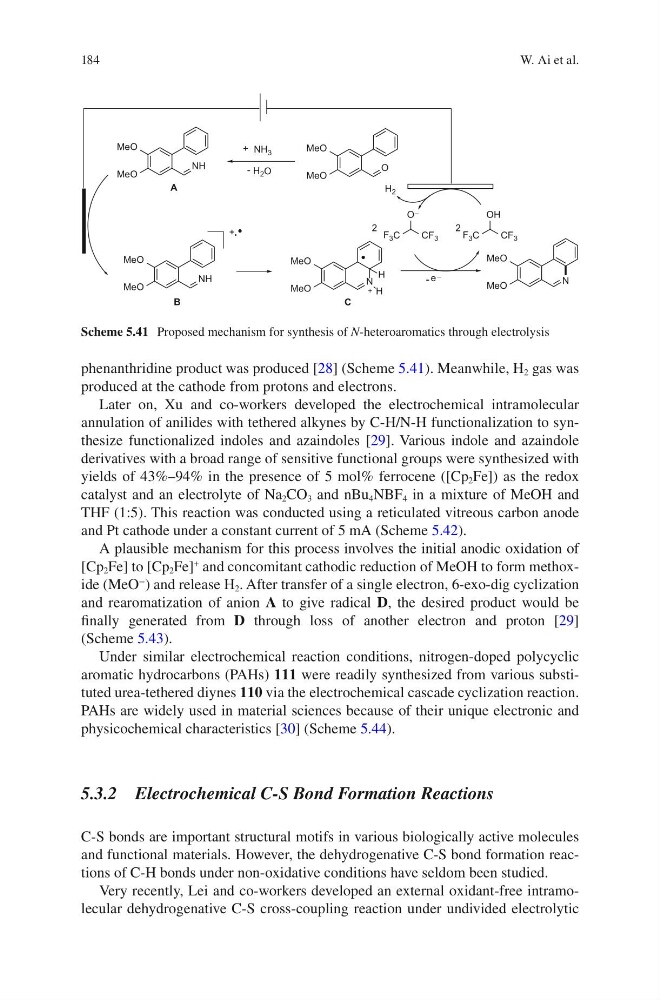
phenanthridine product was produced [28] (Scheme 5.41). Meanwhile, H 2 gas was
produced at the cathode from protons and electrons.
Later on, Xu and co-workers developed the electrochemical intramolecular
annulation of anilides with tethered alkynes by C-H/N-H functionalization to synthesize functionalized indoles and azaindoles [29]. Various indole and azaindole
derivatives with a broad range of sensitive functional groups were synthesized with
yields of 43%–94% in the presence of 5 mol% ferrocene ([Cp 2 Fe]) as the redox
catalyst and an electrolyte of Na 2 CO 3 and nBu 4 NBF 4 in a mixture of MeOH and
THF (1:5). This reaction was conducted using a reticulated vitreous carbon anode
and Pt cathode under a constant current of 5 mA (Scheme 5.42).
A plausible mechanism for this process involves the initial anodic oxidation of
[Cp 2 Fe] to [Cp 2 Fe]
+
and concomitant cathodic reduction of MeOH to form methoxide (MeO
−
) and release H 2 . After transfer of a single electron, 6-exo-dig cyclization
and rearomatization of anion A to give radical D, the desired product would be
finally generated from D through loss of another electron and proton [29]
(Scheme 5.43).
Under similar electrochemical reaction conditions, nitrogen-doped polycyclic
aromatic hydrocarbons (PAHs) 111 were readily synthesized from various substituted urea-tethered diynes 110 via the electrochemical cascade cyclization reaction.
PAHs are widely used in material sciences because of their unique electronic and
physicochemical characteristics [30] (Scheme 5.44).
5.3.2 Electrochemical C-S Bond Formation Reactions
C-S bonds are important structural motifs in various biologically active molecules
and functional materials. However, the dehydrogenative C-S bond formation reactions of C-H bonds under non-oxidative conditions have seldom been studied.
Very recently, Lei and co-workers developed an external oxidant-free intramolecular dehydrogenative C-S cross-coupling reaction under undivided electrolytic
O
NH
MeO
MeO
MeO
MeO
+ NH 3
NH
MeO
MeO
+ •
N
MeO
MeO
H
H
•
N
MeO
MeO
F 3 C
CF 3
O
2
F 3 C
CF 3
OH
2
e
H 2
A
B
C
- H 2 O
-
Scheme 5.41 Proposed mechanism for synthesis of N-heteroaromatics through electrolysis
W. Ai et al.
phenanthridine product was produced [28] (Scheme 5.41). Meanwhile, H 2 gas was
produced at the cathode from protons and electrons.
Later on, Xu and co-workers developed the electrochemical intramolecular
annulation of anilides with tethered alkynes by C-H/N-H functionalization to synthesize functionalized indoles and azaindoles [29]. Various indole and azaindole
derivatives with a broad range of sensitive functional groups were synthesized with
yields of 43%–94% in the presence of 5 mol% ferrocene ([Cp 2 Fe]) as the redox
catalyst and an electrolyte of Na 2 CO 3 and nBu 4 NBF 4 in a mixture of MeOH and
THF (1:5). This reaction was conducted using a reticulated vitreous carbon anode
and Pt cathode under a constant current of 5 mA (Scheme 5.42).
A plausible mechanism for this process involves the initial anodic oxidation of
[Cp 2 Fe] to [Cp 2 Fe]
+
and concomitant cathodic reduction of MeOH to form methoxide (MeO
−
) and release H 2 . After transfer of a single electron, 6-exo-dig cyclization
and rearomatization of anion A to give radical D, the desired product would be
finally generated from D through loss of another electron and proton [29]
(Scheme 5.43).
Under similar electrochemical reaction conditions, nitrogen-doped polycyclic
aromatic hydrocarbons (PAHs) 111 were readily synthesized from various substituted urea-tethered diynes 110 via the electrochemical cascade cyclization reaction.
PAHs are widely used in material sciences because of their unique electronic and
physicochemical characteristics [30] (Scheme 5.44).
5.3.2 Electrochemical C-S Bond Formation Reactions
C-S bonds are important structural motifs in various biologically active molecules
and functional materials. However, the dehydrogenative C-S bond formation reactions of C-H bonds under non-oxidative conditions have seldom been studied.
Very recently, Lei and co-workers developed an external oxidant-free intramolecular dehydrogenative C-S cross-coupling reaction under undivided electrolytic
O
NH
MeO
MeO
MeO
MeO
+ NH 3
NH
MeO
MeO
+ •
N
MeO
MeO
H
H
•
N
MeO
MeO
F 3 C
CF 3
O
2
F 3 C
CF 3
OH
2
e
H 2
A
B
C
- H 2 O
-
Scheme 5.41 Proposed mechanism for synthesis of N-heteroaromatics through electrolysis
W. Ai et al.