

185
conditions [31]. These reactions were performed in a mixture of MeCN and H 2 O
(9:1) containing nBu 4 NBF 4 at 70 °C without addition of any oxidant or catalyst. The
transformation was conducted using a graphite rod anode and Pt plate cathode under
a constant current of 7 mA (the current density of the anode was ~11.7 mA cm
−2
).
Various 2-aminobenzothiazoles 114 were obtained with high isolated yields from
the direct combination of aryl isothiocyanates 112 with amines 113 under these
conditions (Scheme 5.45a).
When PhCOONa was added to this reaction system, various N-arylthioamides
116 could also be cyclized under non-oxidative conditions to furnish benzothiazoles
115 in good to high yields. H 2 gas was released via the concomitant cathodic reduction of water during the reaction [31] (Scheme 5.45b).
Furthermore, Lei’s group reported an electrocatalytic oxidant- and catalyst-free
dehydrogenative C-H/S-H cross-coupling of N-methylindole derivatives 117 and
thiophenols 118 in the presence of 4 equiv. of LiClO 4 in MeCN at room temperature
using a Pt anode and Pt cathode under a constant current of 12 mA [32] (Scheme 5.46).
C-S bond formation products were obtained in isolated yields of up to 99% from
+ H 2
[Cp 2 Fe] (5 mol%)
MeOH/THF (1:5), Na 2 CO 3
nBu 4 NBF 4 , reflux
RVC
Pt
constant current, 5mA
N
N
O
R 3
H
H
R 2
R 1
N
N
O
R 3
R 2
R 1
N
N
N
O
86%
N
N
N
O
Ph
92%
N
N
N
N
O
Ph
78%
N
N
O
71%
OH
N
N
O
66%
O
CO 2 Me
N
N
N
O
Ph
80%
108
109
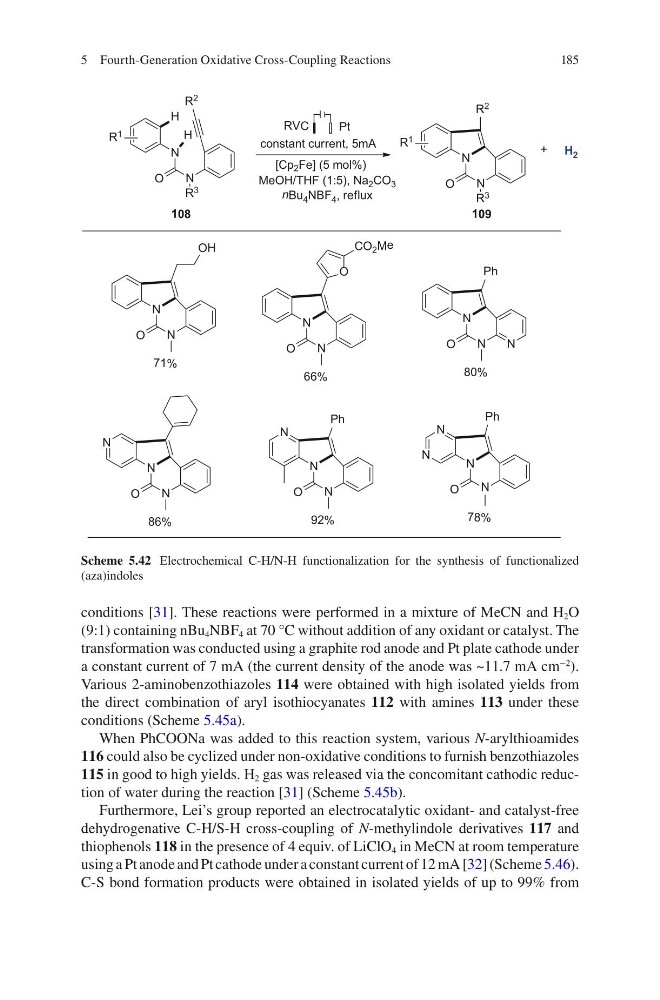
Scheme 5.42 Electrochemical C-H/N-H functionalization for the synthesis of functionalized
(aza)indoles
5 Fourth-Generation Oxidative Cross-Coupling Reactions
conditions [31]. These reactions were performed in a mixture of MeCN and H 2 O
(9:1) containing nBu 4 NBF 4 at 70 °C without addition of any oxidant or catalyst. The
transformation was conducted using a graphite rod anode and Pt plate cathode under
a constant current of 7 mA (the current density of the anode was ~11.7 mA cm
−2
).
Various 2-aminobenzothiazoles 114 were obtained with high isolated yields from
the direct combination of aryl isothiocyanates 112 with amines 113 under these
conditions (Scheme 5.45a).
When PhCOONa was added to this reaction system, various N-arylthioamides
116 could also be cyclized under non-oxidative conditions to furnish benzothiazoles
115 in good to high yields. H 2 gas was released via the concomitant cathodic reduction of water during the reaction [31] (Scheme 5.45b).
Furthermore, Lei’s group reported an electrocatalytic oxidant- and catalyst-free
dehydrogenative C-H/S-H cross-coupling of N-methylindole derivatives 117 and
thiophenols 118 in the presence of 4 equiv. of LiClO 4 in MeCN at room temperature
using a Pt anode and Pt cathode under a constant current of 12 mA [32] (Scheme 5.46).
C-S bond formation products were obtained in isolated yields of up to 99% from
+ H 2
[Cp 2 Fe] (5 mol%)
MeOH/THF (1:5), Na 2 CO 3
nBu 4 NBF 4 , reflux
RVC
Pt
constant current, 5mA
N
N
O
R 3
H
H
R 2
R 1
N
N
O
R 3
R 2
R 1
N
N
N
O
86%
N
N
N
O
Ph
92%
N
N
N
N
O
Ph
78%
N
N
O
71%
OH
N
N
O
66%
O
CO 2 Me
N
N
N
O
Ph
80%
108
109
Scheme 5.42 Electrochemical C-H/N-H functionalization for the synthesis of functionalized
(aza)indoles
5 Fourth-Generation Oxidative Cross-Coupling Reactions