

183
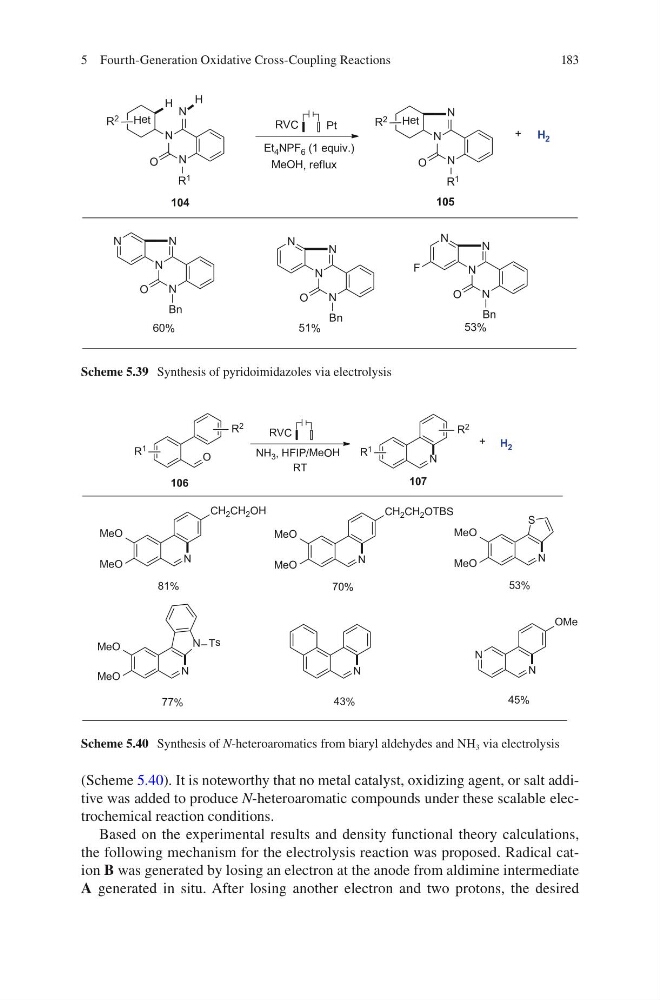
(Scheme 5.40). It is noteworthy that no metal catalyst, oxidizing agent, or salt additive was added to produce N-heteroaromatic compounds under these scalable electrochemical reaction conditions.
Based on the experimental results and density functional theory calculations,
the following mechanism for the electrolysis reaction was proposed. Radical cation B was generated by losing an electron at the anode from aldimine intermediate
A generated in situ. After losing another electron and two protons, the desired
H
N
N
O
N
H
R 1
Het
R 2
+ H 2
Et 4 NPF 6 (1 equiv.)
MeOH, reflux
RVC
Pt
60%
N
N
N
O
Bn
N
51%
53%
N
N
O
N
R 1
Het
R 2
N
N
N
O
N
Bn
N
N
N
O
Bn
N
F
104
105
Scheme 5.39 Synthesis of pyridoimidazoles via electrolysis
+ H 2
NH 3 , HFIP/MeOH
RVC
RT
O
R 2
R 1
N
R 2
R 1
N
CH 2 CH 2 OH
MeO
MeO
81%
N
CH 2 CH 2 OTBS
MeO
MeO
70%
N
MeO
MeO
53%
S
N
MeO
MeO
77%
N Ts
N
43%
N
N
OMe
45%
106
107
Scheme 5.40 Synthesis of N-heteroaromatics from biaryl aldehydes and NH 3 via electrolysis
5 Fourth-Generation Oxidative Cross-Coupling Reactions
(Scheme 5.40). It is noteworthy that no metal catalyst, oxidizing agent, or salt additive was added to produce N-heteroaromatic compounds under these scalable electrochemical reaction conditions.
Based on the experimental results and density functional theory calculations,
the following mechanism for the electrolysis reaction was proposed. Radical cation B was generated by losing an electron at the anode from aldimine intermediate
A generated in situ. After losing another electron and two protons, the desired
H
N
N
O
N
H
R 1
Het
R 2
+ H 2
Et 4 NPF 6 (1 equiv.)
MeOH, reflux
RVC
Pt
60%
N
N
N
O
Bn
N
51%
53%
N
N
O
N
R 1
Het
R 2
N
N
N
O
N
Bn
N
N
N
O
Bn
N
F
104
105
Scheme 5.39 Synthesis of pyridoimidazoles via electrolysis
+ H 2
NH 3 , HFIP/MeOH
RVC
RT
O
R 2
R 1
N
R 2
R 1
N
CH 2 CH 2 OH
MeO
MeO
81%
N
CH 2 CH 2 OTBS
MeO
MeO
70%
N
MeO
MeO
53%
S
N
MeO
MeO
77%
N Ts
N
43%
N
N
OMe
45%
106
107
Scheme 5.40 Synthesis of N-heteroaromatics from biaryl aldehydes and NH 3 via electrolysis
5 Fourth-Generation Oxidative Cross-Coupling Reactions