

182
5.3.1 Electrochemical N-H/C-H Cross-Coupling Reactions
N-Heterocycles are an important class of organic compounds because of their wideranging applications in both medicinal chemistry and chemical biology. An electrochemical approach to synthesize N-heterocycles without an oxidant has been
developed as an alternative strategy to classical synthetic methods.
Recently, Xu and co-workers developed an efficient intramolecular cyclization of
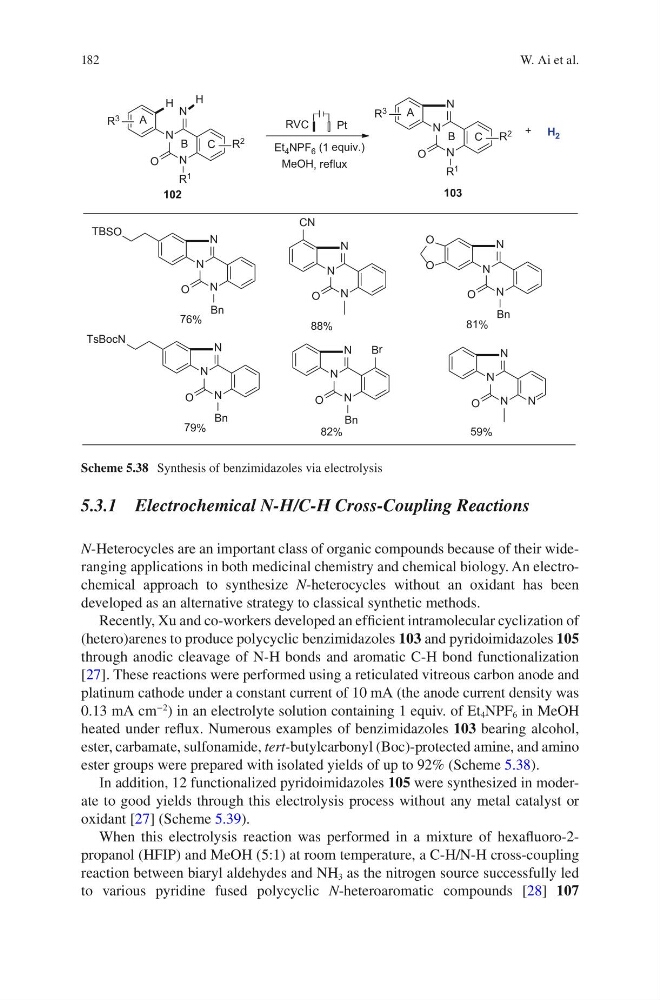
(hetero)arenes to produce polycyclic benzimidazoles 103 and pyridoimidazoles 105
through anodic cleavage of N-H bonds and aromatic C-H bond functionalization
[27]. These reactions were performed using a reticulated vitreous carbon anode and
platinum cathode under a constant current of 10 mA (the anode current density was
0.13 mA cm
−2
) in an electrolyte solution containing 1 equiv. of Et 4 NPF 6 in MeOH
heated under reflux. Numerous examples of benzimidazoles 103 bearing alcohol,
ester, carbamate, sulfonamide, tert-butylcarbonyl (Boc)-protected amine, and amino
ester groups were prepared with isolated yields of up to 92% (Scheme 5.38).
In addition, 12 functionalized pyridoimidazoles 105 were synthesized in moderate to good yields through this electrolysis process without any metal catalyst or
oxidant [27] (Scheme 5.39).
When this electrolysis reaction was performed in a mixture of hexafluoro-2propanol (HFIP) and MeOH (5:1) at room temperature, a C-H/N-H cross-coupling
reaction between biaryl aldehydes and NH 3 as the nitrogen source successfully led
to various pyridine fused polycyclic N-heteroaromatic compounds [28] 107
H
N
N
O
N
H
R 1
A
B
C
R 2
R 3
N
N
O
R 1
A
B
C
R 2
R 3
N
+ H 2
Et 4 NPF 6 (1 equiv.)
MeOH, reflux
RVC
Pt
N
N
O
Bn
N
TBSO
76%
N
N
O
N
88%
CN
N
N
O
Bn
N
81%
O
O
N
N
O
Bn
N
82%
Br
N
N
O
N
N
59%
N
N
O
Bn
N
TsBocN
79%
102
103
Scheme 5.38 Synthesis of benzimidazoles via electrolysis
W. Ai et al.
5.3.1 Electrochemical N-H/C-H Cross-Coupling Reactions
N-Heterocycles are an important class of organic compounds because of their wideranging applications in both medicinal chemistry and chemical biology. An electrochemical approach to synthesize N-heterocycles without an oxidant has been
developed as an alternative strategy to classical synthetic methods.
Recently, Xu and co-workers developed an efficient intramolecular cyclization of
(hetero)arenes to produce polycyclic benzimidazoles 103 and pyridoimidazoles 105
through anodic cleavage of N-H bonds and aromatic C-H bond functionalization
[27]. These reactions were performed using a reticulated vitreous carbon anode and
platinum cathode under a constant current of 10 mA (the anode current density was
0.13 mA cm
−2
) in an electrolyte solution containing 1 equiv. of Et 4 NPF 6 in MeOH
heated under reflux. Numerous examples of benzimidazoles 103 bearing alcohol,
ester, carbamate, sulfonamide, tert-butylcarbonyl (Boc)-protected amine, and amino
ester groups were prepared with isolated yields of up to 92% (Scheme 5.38).
In addition, 12 functionalized pyridoimidazoles 105 were synthesized in moderate to good yields through this electrolysis process without any metal catalyst or
oxidant [27] (Scheme 5.39).
When this electrolysis reaction was performed in a mixture of hexafluoro-2propanol (HFIP) and MeOH (5:1) at room temperature, a C-H/N-H cross-coupling
reaction between biaryl aldehydes and NH 3 as the nitrogen source successfully led
to various pyridine fused polycyclic N-heteroaromatic compounds [28] 107
H
N
N
O
N
H
R 1
A
B
C
R 2
R 3
N
N
O
R 1
A
B
C
R 2
R 3
N
+ H 2
Et 4 NPF 6 (1 equiv.)
MeOH, reflux
RVC
Pt
N
N
O
Bn
N
TBSO
76%
N
N
O
N
88%
CN
N
N
O
Bn
N
81%
O
O
N
N
O
Bn
N
82%
Br
N
N
O
N
N
59%
N
N
O
Bn
N
TsBocN
79%
102
103
Scheme 5.38 Synthesis of benzimidazoles via electrolysis
W. Ai et al.