

181
5.2.2.3 C-P Cross-Coupling Reactions
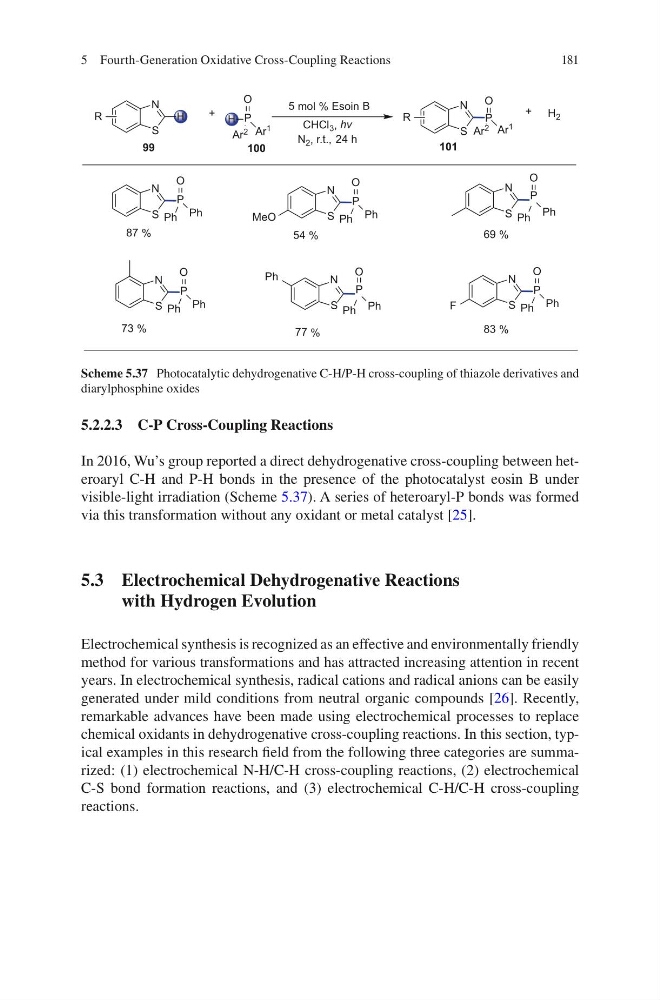
In 2016, Wu’s group reported a direct dehydrogenative cross-coupling between heteroaryl C-H and P-H bonds in the presence of the photocatalyst eosin B under
visible- light irradiation (Scheme 5.37). A series of heteroaryl-P bonds was formed
via this transformation without any oxidant or metal catalyst [25].
5.3 Electrochemical Dehydrogenative Reactions
with Hydrogen Evolution
Electrochemical synthesis is recognized as an effective and environmentally friendly
method for various transformations and has attracted increasing attention in recent
years. In electrochemical synthesis, radical cations and radical anions can be easily
generated under mild conditions from neutral organic compounds [26]. Recently,
remarkable advances have been made using electrochemical processes to replace
chemical oxidants in dehydrogenative cross-coupling reactions. In this section, typical examples in this research field from the following three categories are summarized: (1) electrochemical N-H/C-H cross-coupling reactions, (2) electrochemical
C-S bond formation reactions, and (3) electrochemical C-H/C-H cross-coupling
reactions.
S
N
H
R
+
P
H
O
5 mol % Esoin B
CHCl 3 , hv
N 2 , r.t., 24 h
Ar 1
Ar 2
S
N
R
P
O
Ar 1
Ar 2
+ H 2
99
100
101
S
N
P
O
Ph
Ph
S
N
P
O
Ph
Ph
S
N
P
O
Ph
Ph
S
N
P
O
Ph
Ph
S
N
P
O
Ph
Ph
S
N
P
O
Ph
Ph
MeO
Ph
F
87 %
54 %
69 %
73 %
77 %
83 %
Scheme 5.37 Photocatalytic dehydrogenative C-H/P-H cross-coupling of thiazole derivatives and
diarylphosphine oxides
5 Fourth-Generation Oxidative Cross-Coupling Reactions
5.2.2.3 C-P Cross-Coupling Reactions
In 2016, Wu’s group reported a direct dehydrogenative cross-coupling between heteroaryl C-H and P-H bonds in the presence of the photocatalyst eosin B under
visible- light irradiation (Scheme 5.37). A series of heteroaryl-P bonds was formed
via this transformation without any oxidant or metal catalyst [25].
5.3 Electrochemical Dehydrogenative Reactions
with Hydrogen Evolution
Electrochemical synthesis is recognized as an effective and environmentally friendly
method for various transformations and has attracted increasing attention in recent
years. In electrochemical synthesis, radical cations and radical anions can be easily
generated under mild conditions from neutral organic compounds [26]. Recently,
remarkable advances have been made using electrochemical processes to replace
chemical oxidants in dehydrogenative cross-coupling reactions. In this section, typical examples in this research field from the following three categories are summarized: (1) electrochemical N-H/C-H cross-coupling reactions, (2) electrochemical
C-S bond formation reactions, and (3) electrochemical C-H/C-H cross-coupling
reactions.
S
N
H
R
+
P
H
O
5 mol % Esoin B
CHCl 3 , hv
N 2 , r.t., 24 h
Ar 1
Ar 2
S
N
R
P
O
Ar 1
Ar 2
+ H 2
99
100
101
S
N
P
O
Ph
Ph
S
N
P
O
Ph
Ph
S
N
P
O
Ph
Ph
S
N
P
O
Ph
Ph
S
N
P
O
Ph
Ph
S
N
P
O
Ph
Ph
MeO
Ph
F
87 %
54 %
69 %
73 %
77 %
83 %
Scheme 5.37 Photocatalytic dehydrogenative C-H/P-H cross-coupling of thiazole derivatives and
diarylphosphine oxides
5 Fourth-Generation Oxidative Cross-Coupling Reactions