

166
5.2.1 Carbon-Carbon Cross-Coupling
The design of efficient, mild, and general methods for C-C bond construction is an
essential topic in organic chemistry. In an ideal C-C cross-coupling reaction via the
CCHE process, visible light could activate two different C-H bonds to form a C-C
bond directly and afford H 2 gas as the only by-product at ambient temperature without an oxidant.
5.2.1.1 C(sp
3
)-C(sp
2
) Cross-Coupling Reactions
In 2013, Wu’s group reported the first example of a visible-light-driven CCHE reaction [10]: the direct cross-coupling reaction of N-phenyl-1,2,3,4tetrahydroisoquinoline (1) and indole (2) promoted by visible light in the absence of
any oxidant. In this work, the organic dye eosin Y was used as a photosensitizer to
trigger this dehydrogenative cross-coupling reaction. A graphene-supported RuO 2
nanocomposite (G-RuO 2 ) was employed as a HEC to remove the extra electrons and
protons generated in the bond formation process. Optimization of the reaction conditions revealed that water was better than other solvents for this reaction. This is
because water provided more protons than other solvents for H 2 evolution from the
metal hydride intermediate (Scheme 5.16).
To identify the proton source of H 2 in this reaction, a deuterium labeling experiment was carried out. When D 2 O was used as the solvent, D 2 was generated as the
sole gas-phase product instead of H 2 , which suggested that the protons released
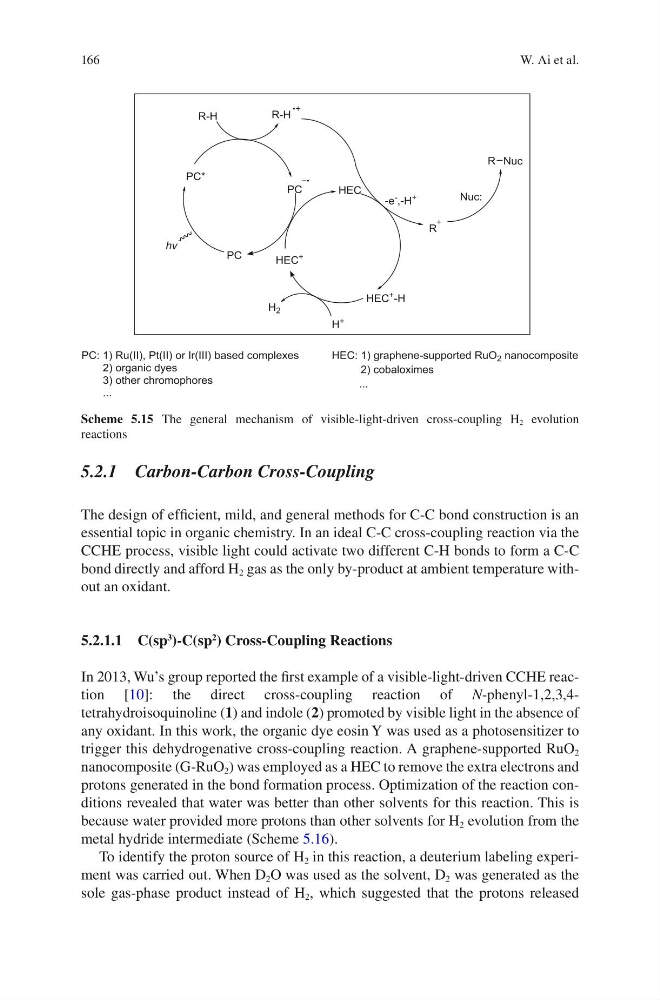
Scheme 5.15 The general mechanism of visible-light-driven cross-coupling H 2 evolution
reactions
W. Ai et al.
5.2.1 Carbon-Carbon Cross-Coupling
The design of efficient, mild, and general methods for C-C bond construction is an
essential topic in organic chemistry. In an ideal C-C cross-coupling reaction via the
CCHE process, visible light could activate two different C-H bonds to form a C-C
bond directly and afford H 2 gas as the only by-product at ambient temperature without an oxidant.
5.2.1.1 C(sp
3
)-C(sp
2
) Cross-Coupling Reactions
In 2013, Wu’s group reported the first example of a visible-light-driven CCHE reaction [10]: the direct cross-coupling reaction of N-phenyl-1,2,3,4tetrahydroisoquinoline (1) and indole (2) promoted by visible light in the absence of
any oxidant. In this work, the organic dye eosin Y was used as a photosensitizer to
trigger this dehydrogenative cross-coupling reaction. A graphene-supported RuO 2
nanocomposite (G-RuO 2 ) was employed as a HEC to remove the extra electrons and
protons generated in the bond formation process. Optimization of the reaction conditions revealed that water was better than other solvents for this reaction. This is
because water provided more protons than other solvents for H 2 evolution from the
metal hydride intermediate (Scheme 5.16).
To identify the proton source of H 2 in this reaction, a deuterium labeling experiment was carried out. When D 2 O was used as the solvent, D 2 was generated as the
sole gas-phase product instead of H 2 , which suggested that the protons released
Scheme 5.15 The general mechanism of visible-light-driven cross-coupling H 2 evolution
reactions
W. Ai et al.