

167
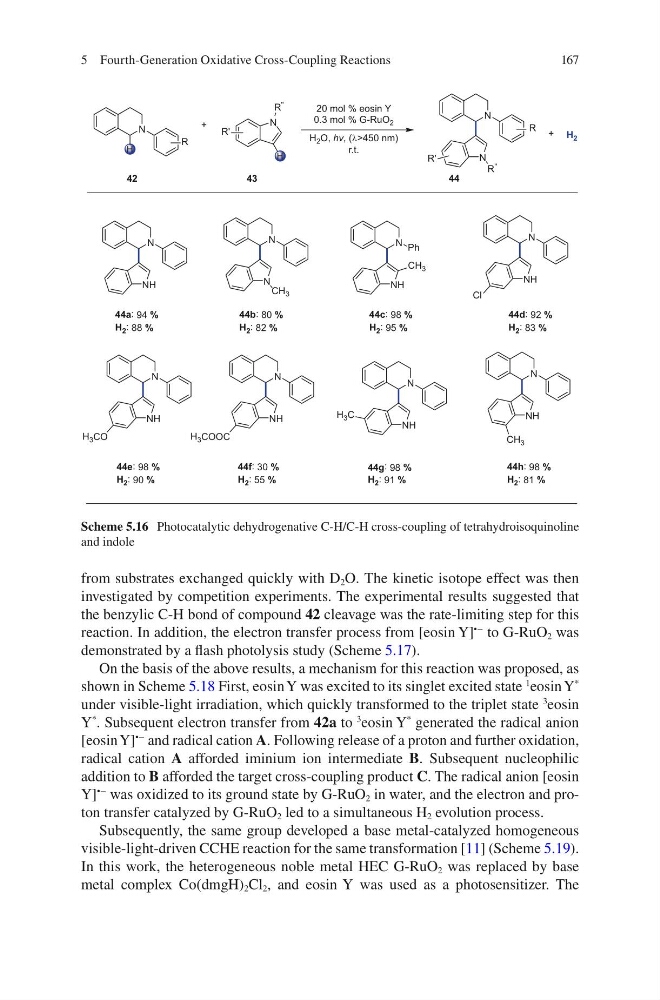
from substrates exchanged quickly with D 2 O. The kinetic isotope effect was then
investigated by competition experiments. The experimental results suggested that
the benzylic C-H bond of compound 42 cleavage was the rate-limiting step for this
reaction. In addition, the electron transfer process from [eosin Y]
•−
to G-RuO 2 was
demonstrated by a flash photolysis study (Scheme 5.17).
On the basis of the above results, a mechanism for this reaction was proposed, as
shown in Scheme 5.18 First, eosin Y was excited to its singlet excited state
1
eosin Y
*
under visible-light irradiation, which quickly transformed to the triplet state
3
eosin
Y
*
. Subsequent electron transfer from 42a to
3
eosin Y
*
generated the radical anion
[eosin Y]
•−
and radical cation A. Following release of a proton and further oxidation,
radical cation A afforded iminium ion intermediate B. Subsequent nucleophilic
addition to B afforded the target cross-coupling product C. The radical anion [eosin
Y]
•−
was oxidized to its ground state by G-RuO 2 in water, and the electron and proton transfer catalyzed by G-RuO 2 led to a simultaneous H 2 evolution process.
Subsequently, the same group developed a base metal-catalyzed homogeneous
visible-light-driven CCHE reaction for the same transformation [11] (Scheme 5.19).
In this work, the heterogeneous noble metal HEC G-RuO 2 was replaced by base
metal complex Co(dmgH) 2 Cl 2 , and eosin Y was used as a photosensitizer. The
N
R
+
N
R ''
R'
20 mol % eosin Y
0.3 mol % G-RuO 2
H 2 O, hv, (λ>450 nm)
r.t.
N
R
N
R ''
R'
+ H 2
42
43
44
H
H
N
NH
N
N CH 3
N Ph
NH
N
NH
CH 3
Cl
N
NH
H 3 CO
N
NH
N
NH
H 3 COOC
N
NH
H 3 C
CH 3
44a: 94 %
H 2 : 88 %
44b: 80 %
H 2 : 82 %
44c: 98 %
H 2 : 95 %
44d: 92 %
H 2 : 83 %
44e: 98 %
H 2 : 90 %
44f: 30 %
H 2 : 55 %
44g: 98 %
H 2 : 91 %
44h: 98 %
H 2 : 81 %
Scheme 5.16 Photocatalytic dehydrogenative C-H/C-H cross-coupling of tetrahydroisoquinoline
and indole
5 Fourth-Generation Oxidative Cross-Coupling Reactions
from substrates exchanged quickly with D 2 O. The kinetic isotope effect was then
investigated by competition experiments. The experimental results suggested that
the benzylic C-H bond of compound 42 cleavage was the rate-limiting step for this
reaction. In addition, the electron transfer process from [eosin Y]
•−
to G-RuO 2 was
demonstrated by a flash photolysis study (Scheme 5.17).
On the basis of the above results, a mechanism for this reaction was proposed, as
shown in Scheme 5.18 First, eosin Y was excited to its singlet excited state
1
eosin Y
*
under visible-light irradiation, which quickly transformed to the triplet state
3
eosin
Y
*
. Subsequent electron transfer from 42a to
3
eosin Y
*
generated the radical anion
[eosin Y]
•−
and radical cation A. Following release of a proton and further oxidation,
radical cation A afforded iminium ion intermediate B. Subsequent nucleophilic
addition to B afforded the target cross-coupling product C. The radical anion [eosin
Y]
•−
was oxidized to its ground state by G-RuO 2 in water, and the electron and proton transfer catalyzed by G-RuO 2 led to a simultaneous H 2 evolution process.
Subsequently, the same group developed a base metal-catalyzed homogeneous
visible-light-driven CCHE reaction for the same transformation [11] (Scheme 5.19).
In this work, the heterogeneous noble metal HEC G-RuO 2 was replaced by base
metal complex Co(dmgH) 2 Cl 2 , and eosin Y was used as a photosensitizer. The
N
R
+
N
R ''
R'
20 mol % eosin Y
0.3 mol % G-RuO 2
H 2 O, hv, (λ>450 nm)
r.t.
N
R
N
R ''
R'
+ H 2
42
43
44
H
H
N
NH
N
N CH 3
N Ph
NH
N
NH
CH 3
Cl
N
NH
H 3 CO
N
NH
N
NH
H 3 COOC
N
NH
H 3 C
CH 3
44a: 94 %
H 2 : 88 %
44b: 80 %
H 2 : 82 %
44c: 98 %
H 2 : 95 %
44d: 92 %
H 2 : 83 %
44e: 98 %
H 2 : 90 %
44f: 30 %
H 2 : 55 %
44g: 98 %
H 2 : 91 %
44h: 98 %
H 2 : 81 %
Scheme 5.16 Photocatalytic dehydrogenative C-H/C-H cross-coupling of tetrahydroisoquinoline
and indole
5 Fourth-Generation Oxidative Cross-Coupling Reactions