

165
As shown in Scheme 5.15, the initial step of this transformation is an intermolecular photo-induced electron transfer process from R-H to the excited state photosensitizer, resulting in the formation of electron transfer state [PC]
•−
and cation
radical [R-H]
•+
. The generated [R-H]
•+
further releases a proton and electron to produce a cation intermediate [R]
+
. Nucleophilic addition to [R]
+
gives the cross-coupling product. The radical anion [PC]
•−
is restored to its ground state by reacting
with HEC
+
and produces an HEC intermediate. Further reduction of HEC by [R-H]
•+
leads to the formation of HEC
•−
, which reacts with a proton to afford
HEC
+
-H. Protonation of HEC
+
-H finishes the H 2 evolution process and completes
this catalytic cycle. The photosensitizer can be a Ru(II), Pt(II), Ir(III)-based complex, organic dye, or other chromophore. HECs including graphene-supported RuO 2
nanocomposites and cobaloximes have been reported [1]. The CCHE reaction is a
very efficient and sustainable method to construct different C-C and C-X bonds.
The recent advances of CCHE reactions are summarized in the following two parts:
(1) C-C cross-coupling via CCHE reactions, including C(sp
3
)-C(sp
3
), C(sp
3
)-C(sp
2
),
and C(sp
2
)-C(sp
2
) bond formation reactions, and (2) C-X cross-coupling via CCHE
reactions, including C-S, C-N, C-O, and C-P bond formation reactions.
N
H
+
R
CuCl (5 mol %)
PPh 3 (6 mol %)
CH 3 CN
50 ~ 80 °C
N
H
R
+
H 2
H P
R 1
O
R 2
P R 2
O
R 1
39
40
41
N
H
P Ph
O
Ph
COOEt
R'
N
P Ph
O
Ph
COOEt
CH 3
N
P Ph
O
Ph
COOEt
Bn
N
P Ph
O
Ph
COOEt
N
P Ph
O
Ph
COOEt
CH 3
N
P Ph
O
Ph
CH 3
CH 3
H 3 C
H 3 C
Cl
N
41a, 93 %
41b, 97 %
41c, 80 %
41d, 90 %
41e, 89 %
41f, 73 %
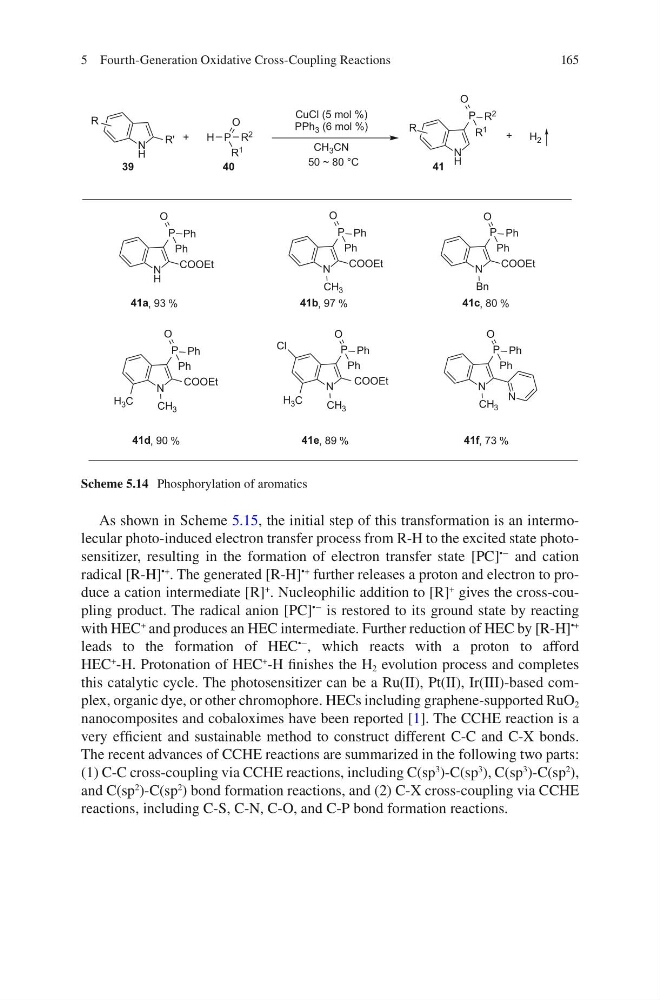
Scheme 5.14 Phosphorylation of aromatics
5 Fourth-Generation Oxidative Cross-Coupling Reactions
As shown in Scheme 5.15, the initial step of this transformation is an intermolecular photo-induced electron transfer process from R-H to the excited state photosensitizer, resulting in the formation of electron transfer state [PC]
•−
and cation
radical [R-H]
•+
. The generated [R-H]
•+
further releases a proton and electron to produce a cation intermediate [R]
+
. Nucleophilic addition to [R]
+
gives the cross-coupling product. The radical anion [PC]
•−
is restored to its ground state by reacting
with HEC
+
and produces an HEC intermediate. Further reduction of HEC by [R-H]
•+
leads to the formation of HEC
•−
, which reacts with a proton to afford
HEC
+
-H. Protonation of HEC
+
-H finishes the H 2 evolution process and completes
this catalytic cycle. The photosensitizer can be a Ru(II), Pt(II), Ir(III)-based complex, organic dye, or other chromophore. HECs including graphene-supported RuO 2
nanocomposites and cobaloximes have been reported [1]. The CCHE reaction is a
very efficient and sustainable method to construct different C-C and C-X bonds.
The recent advances of CCHE reactions are summarized in the following two parts:
(1) C-C cross-coupling via CCHE reactions, including C(sp
3
)-C(sp
3
), C(sp
3
)-C(sp
2
),
and C(sp
2
)-C(sp
2
) bond formation reactions, and (2) C-X cross-coupling via CCHE
reactions, including C-S, C-N, C-O, and C-P bond formation reactions.
N
H
+
R
CuCl (5 mol %)
PPh 3 (6 mol %)
CH 3 CN
50 ~ 80 °C
N
H
R
+
H 2
H P
R 1
O
R 2
P R 2
O
R 1
39
40
41
N
H
P Ph
O
Ph
COOEt
R'
N
P Ph
O
Ph
COOEt
CH 3
N
P Ph
O
Ph
COOEt
Bn
N
P Ph
O
Ph
COOEt
N
P Ph
O
Ph
COOEt
CH 3
N
P Ph
O
Ph
CH 3
CH 3
H 3 C
H 3 C
Cl
N
41a, 93 %
41b, 97 %
41c, 80 %
41d, 90 %
41e, 89 %
41f, 73 %
Scheme 5.14 Phosphorylation of aromatics
5 Fourth-Generation Oxidative Cross-Coupling Reactions