

164
5.1.2.3 Phosphorylation of Aromatic C-H Bonds
In 2014, Yang’s group reported a copper-catalyzed phosphorylation of indoles with
Ph 2 P(O)H to synthesize 3-phosphoindoles, which showed excellent bioactivity
against NNRTI-resistant HIV-1 in vitro (Scheme 5.14) [9]. The proposed reaction
path followed the general mechanism for the dehydrogenative coupling reaction, as
shown above (Scheme 5.2).
5.2 Visible-Light-Mediated Cross-Coupling Reactions
with H 2 Evolution
Another type of oxidant-free dehydrogenative cross-coupling reaction is those
driven by light energy. This strategy allows the construction of a C-C or C-X bond
directly from C-H and X-H bonds in the presence of photosensitizers and hydrogenevolution catalysts (HEC) and is named the cross-coupling hydrogen evolution
(CCHE) process. Compared with thermal energy-driven reactions, methodology
using visible-light activation is more general and environmentally benign.
N
H
+
R 1
N
X
Y
R 2
R 3
[Cp*IrCl 2 ] 2 (1 mol %)
NaOTf (10 mol %)
t-amyl alcohol
110 °C, N 2
N
H
R 1
N
X
Y
R 2
R 3
+
H 2
36
37
38
N
H
N
N
N
H
N
N
Br
N
H
N
OMe
O
38a, 63 %
38b, 74 %
38c, 63 %
N
H
N
N
H
N
N
N
H
N
N
38d, 26 %
38e, 79 %
38f, 56 %
O
Ph
Cl
Ph
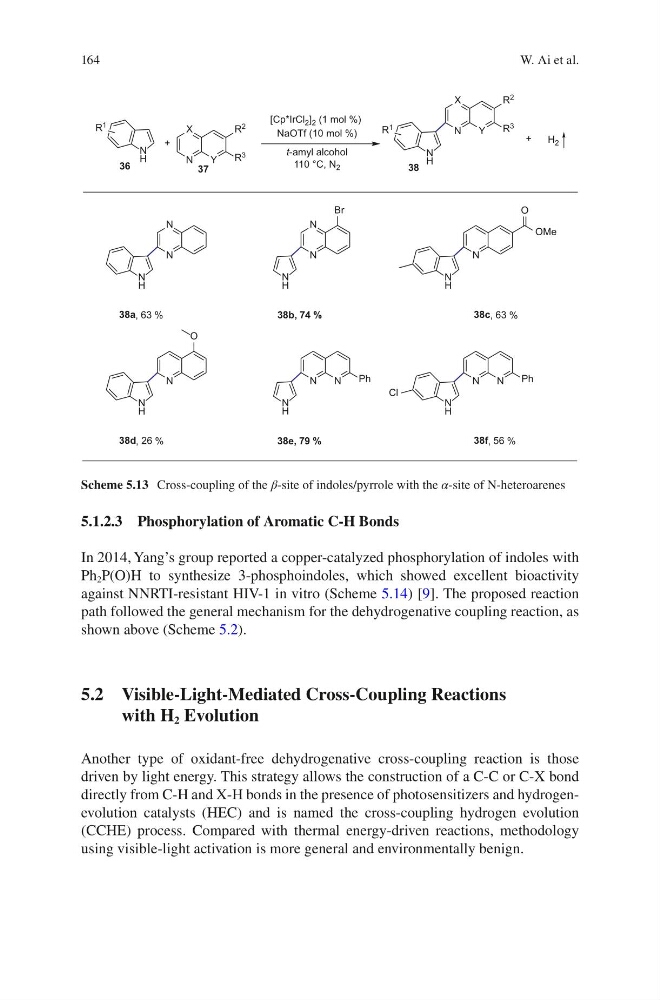
Scheme 5.13 Cross-coupling of the β-site of indoles/pyrrole with the α-site of N-heteroarenes
W. Ai et al.
5.1.2.3 Phosphorylation of Aromatic C-H Bonds
In 2014, Yang’s group reported a copper-catalyzed phosphorylation of indoles with
Ph 2 P(O)H to synthesize 3-phosphoindoles, which showed excellent bioactivity
against NNRTI-resistant HIV-1 in vitro (Scheme 5.14) [9]. The proposed reaction
path followed the general mechanism for the dehydrogenative coupling reaction, as
shown above (Scheme 5.2).
5.2 Visible-Light-Mediated Cross-Coupling Reactions
with H 2 Evolution
Another type of oxidant-free dehydrogenative cross-coupling reaction is those
driven by light energy. This strategy allows the construction of a C-C or C-X bond
directly from C-H and X-H bonds in the presence of photosensitizers and hydrogenevolution catalysts (HEC) and is named the cross-coupling hydrogen evolution
(CCHE) process. Compared with thermal energy-driven reactions, methodology
using visible-light activation is more general and environmentally benign.
N
H
+
R 1
N
X
Y
R 2
R 3
[Cp*IrCl 2 ] 2 (1 mol %)
NaOTf (10 mol %)
t-amyl alcohol
110 °C, N 2
N
H
R 1
N
X
Y
R 2
R 3
+
H 2
36
37
38
N
H
N
N
N
H
N
N
Br
N
H
N
OMe
O
38a, 63 %
38b, 74 %
38c, 63 %
N
H
N
N
H
N
N
N
H
N
N
38d, 26 %
38e, 79 %
38f, 56 %
O
Ph
Cl
Ph
Scheme 5.13 Cross-coupling of the β-site of indoles/pyrrole with the α-site of N-heteroarenes
W. Ai et al.