

126
aldehydes, and benzyl alcohols will undergo C-C bond cleavage to produce corresponding radical species under oxidation conditions.
A silver-catalyzed decarboxylative acylation of coumarins has been developed
by using oxocarboxylic acids as acyl sources (Scheme 4.47) [30]. This protocol
provides a straightforward access to double aroyl substituted coumarins. And control experiments suggest aroylation is step by step, and mono-acylation product is
the starting material of the double acylation.
Decarboxylative acylation of acrylamides would afford five- or six-member
rings when the substituted alkene is different (Scheme 4.48) [31, 32]. Under the
reaction conditions of AgNO 3 as the catalyst and K 2 S 2 O 8 as the oxidant, acrylamides
R = Me,
75%
CO 2 Et, 82%
CN,
80%
F,
78%
I,
76%
N
O
2 mol% Cu 2 O
2 equiv TBPB
120 °C
N
O
H 3 C Ar
Ar
+
N
O
Ph
R
N
O
Ph
R
R = Me, 92%
F, 88%
N
O
R
R = 4-Me, 90%
3-Me, 95%
2-Me, 85%
4-F, 80%
4-Cl,
4-CN,
H
N
R
1
R
2
O
N
R
1
O
R
2
TBPB
Ph
N
R 1
O
R
2
Ph
N
R 1
O
R
2
Ph
Ph CH 3
Ph C
H
H
Cu(II)
Cu(I)
77%
45%
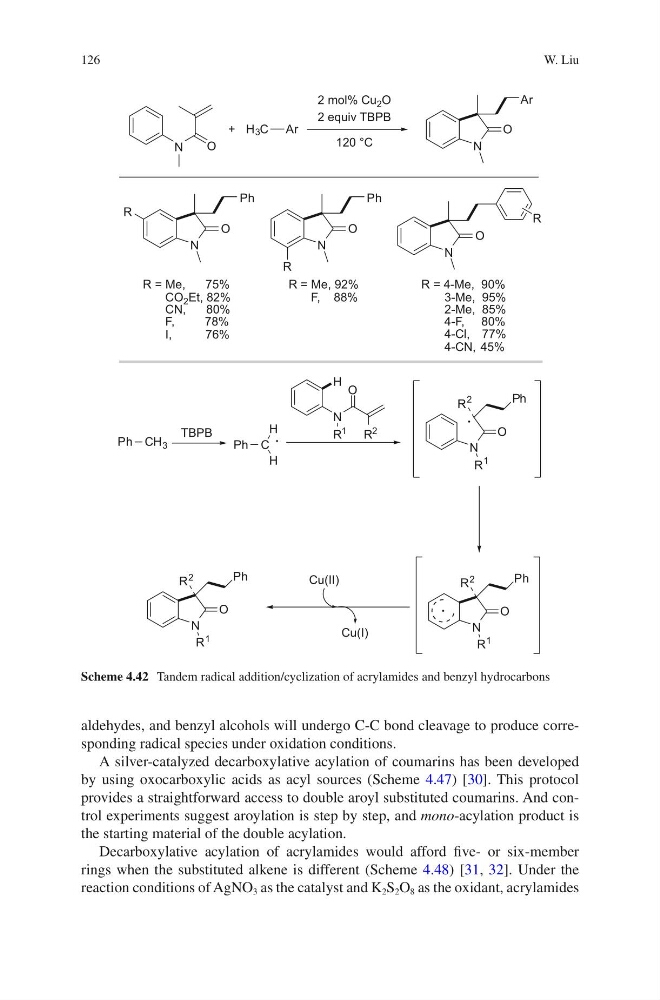
Scheme 4.42 Tandem radical addition/cyclization of acrylamides and benzyl hydrocarbons
W. Liu
aldehydes, and benzyl alcohols will undergo C-C bond cleavage to produce corresponding radical species under oxidation conditions.
A silver-catalyzed decarboxylative acylation of coumarins has been developed
by using oxocarboxylic acids as acyl sources (Scheme 4.47) [30]. This protocol
provides a straightforward access to double aroyl substituted coumarins. And control experiments suggest aroylation is step by step, and mono-acylation product is
the starting material of the double acylation.
Decarboxylative acylation of acrylamides would afford five- or six-member
rings when the substituted alkene is different (Scheme 4.48) [31, 32]. Under the
reaction conditions of AgNO 3 as the catalyst and K 2 S 2 O 8 as the oxidant, acrylamides
R = Me,
75%
CO 2 Et, 82%
CN,
80%
F,
78%
I,
76%
N
O
2 mol% Cu 2 O
2 equiv TBPB
120 °C
N
O
H 3 C Ar
Ar
+
N
O
Ph
R
N
O
Ph
R
R = Me, 92%
F, 88%
N
O
R
R = 4-Me, 90%
3-Me, 95%
2-Me, 85%
4-F, 80%
4-Cl,
4-CN,
H
N
R
1
R
2
O
N
R
1
O
R
2
TBPB
Ph
N
R 1
O
R
2
Ph
N
R 1
O
R
2
Ph
Ph CH 3
Ph C
H
H
Cu(II)
Cu(I)
77%
45%
Scheme 4.42 Tandem radical addition/cyclization of acrylamides and benzyl hydrocarbons
W. Liu