

84
F. Sagan and M. P. Mitoraj
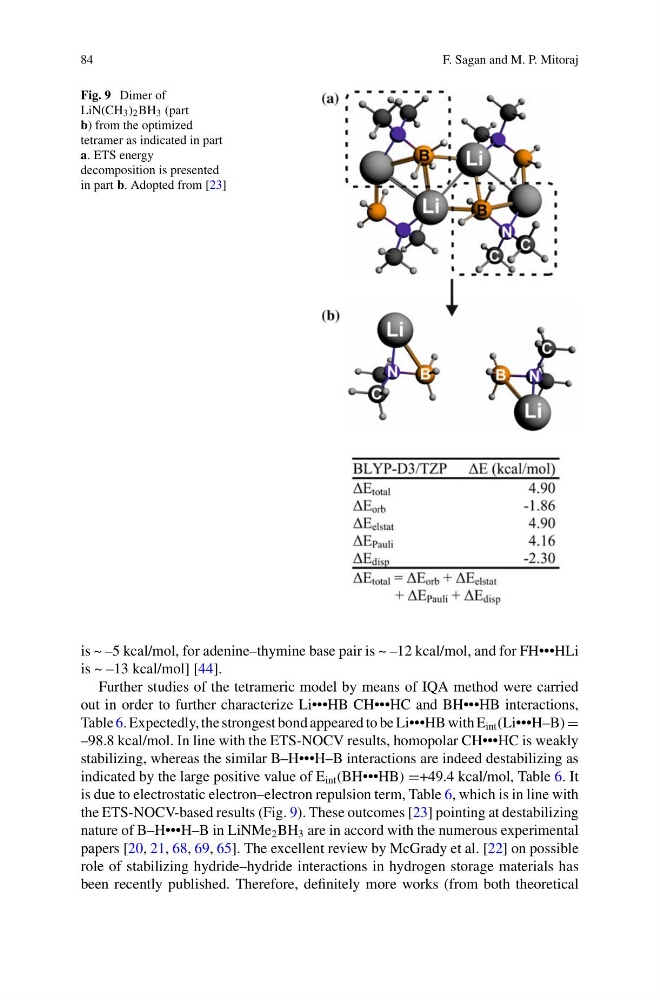
Fig. 9 Dimer of
LiN(CH 3 ) 2 BH 3 (part
b) from the optimized
tetramer as indicated in part
a. ETS energy
decomposition is presented
in part b. Adopted from [23]
is ~ –5 kcal/mol, for adenine–thymine base pair is ~ –12 kcal/mol, and for FH•••HLi
is ~ –13 kcal/mol] [44].
Further studies of the tetrameric model by means of IQA method were carried
out in order to further characterize Li•••HB CH•••HC and BH•••HB interactions,
Table 6. Expectedly, the strongest bond appeared to be Li•••HB with E int (Li•••H–B)
–98.8 kcal/mol. In line with the ETS-NOCV results, homopolar CH•••HC is weakly
stabilizing, whereas the similar B–H•••H–B interactions are indeed destabilizing as
indicated by the large positive value of E int (BH•••HB) +49.4 kcal/mol, Table 6. It
is due to electrostatic electron–electron repulsion term, Table 6, which is in line with
the ETS-NOCV-based results (Fig. 9). These outcomes [23] pointing at destabilizing
nature of B–H•••H–B in LiNMe 2 BH 3 are in accord with the numerous experimental
papers [20, 21, 68, 69, 65]. The excellent review by McGrady et al. [22] on possible
role of stabilizing hydride–hydride interactions in hydrogen storage materials has
been recently published. Therefore, definitely more works (from both theoretical
F. Sagan and M. P. Mitoraj
Fig. 9 Dimer of
LiN(CH 3 ) 2 BH 3 (part
b) from the optimized
tetramer as indicated in part
a. ETS energy
decomposition is presented
in part b. Adopted from [23]
is ~ –5 kcal/mol, for adenine–thymine base pair is ~ –12 kcal/mol, and for FH•••HLi
is ~ –13 kcal/mol] [44].
Further studies of the tetrameric model by means of IQA method were carried
out in order to further characterize Li•••HB CH•••HC and BH•••HB interactions,
Table 6. Expectedly, the strongest bond appeared to be Li•••HB with E int (Li•••H–B)
–98.8 kcal/mol. In line with the ETS-NOCV results, homopolar CH•••HC is weakly
stabilizing, whereas the similar B–H•••H–B interactions are indeed destabilizing as
indicated by the large positive value of E int (BH•••HB) +49.4 kcal/mol, Table 6. It
is due to electrostatic electron–electron repulsion term, Table 6, which is in line with
the ETS-NOCV-based results (Fig. 9). These outcomes [23] pointing at destabilizing
nature of B–H•••H–B in LiNMe 2 BH 3 are in accord with the numerous experimental
papers [20, 21, 68, 69, 65]. The excellent review by McGrady et al. [22] on possible
role of stabilizing hydride–hydride interactions in hydrogen storage materials has
been recently published. Therefore, definitely more works (from both theoretical