

Non-covalent Interactions in Selected Transition Metal Complexes
83
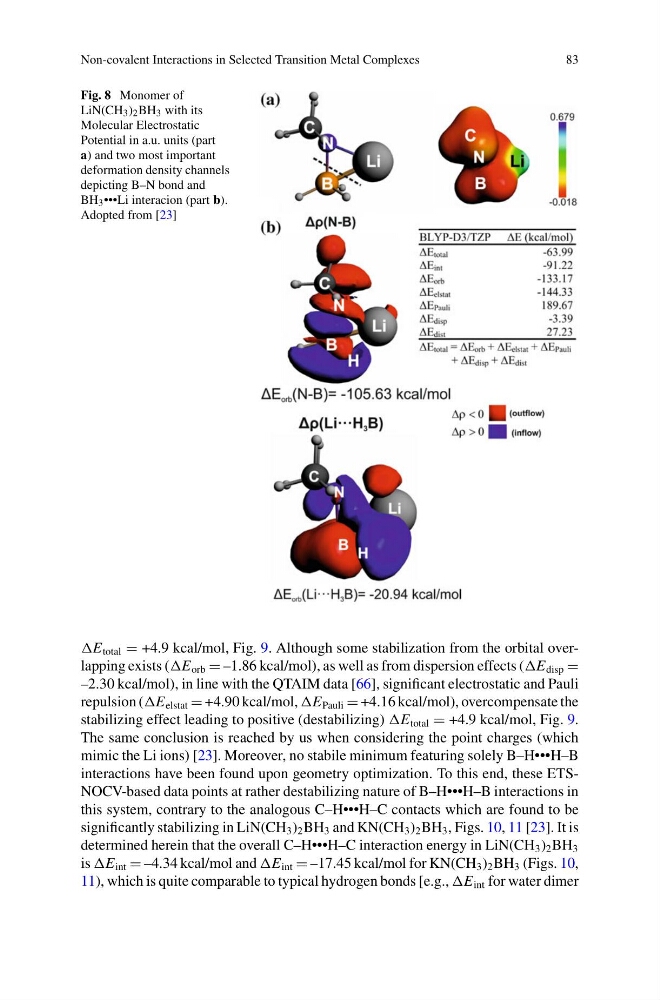
Fig. 8 Monomer of
LiN(CH 3 ) 2 BH 3 with its
Molecular Electrostatic
Potential in a.u. units (part
a) and two most important
deformation density channels
depicting B–N bond and
BH 3 •••Li interacion (part b).
Adopted from [23]
E total +4.9 kcal/mol, Fig. 9. Although some stabilization from the orbital overlapping exists (E orb –1.86 kcal/mol), as well as from dispersion effects (E disp
–2.30 kcal/mol), in line with the QTAIM data [66], significant electrostatic and Pauli
repulsion (E elstat +4.90 kcal/mol, E Pauli +4.16 kcal/mol), overcompensate the
stabilizing effect leading to positive (destabilizing) E total +4.9 kcal/mol, Fig. 9.
The same conclusion is reached by us when considering the point charges (which
mimic the Li ions) [23]. Moreover, no stabile minimum featuring solely B–H•••H–B
interactions have been found upon geometry optimization. To this end, these ETSNOCV-based data points at rather destabilizing nature of B–H•••H–B interactions in
this system, contrary to the analogous C–H•••H–C contacts which are found to be
significantly stabilizing in LiN(CH 3 ) 2 BH 3 and KN(CH 3 ) 2 BH 3 , Figs. 10, 11 [23]. It is
determined herein that the overall C–H•••H–C interaction energy in LiN(CH 3 ) 2 BH 3
is E int –4.34 kcal/mol and E int –17.45 kcal/mol for KN(CH 3 ) 2 BH 3 (Figs. 10,
11), which is quite comparable to typical hydrogen bonds [e.g., E int for water dimer
83
Fig. 8 Monomer of
LiN(CH 3 ) 2 BH 3 with its
Molecular Electrostatic
Potential in a.u. units (part
a) and two most important
deformation density channels
depicting B–N bond and
BH 3 •••Li interacion (part b).
Adopted from [23]
E total +4.9 kcal/mol, Fig. 9. Although some stabilization from the orbital overlapping exists (E orb –1.86 kcal/mol), as well as from dispersion effects (E disp
–2.30 kcal/mol), in line with the QTAIM data [66], significant electrostatic and Pauli
repulsion (E elstat +4.90 kcal/mol, E Pauli +4.16 kcal/mol), overcompensate the
stabilizing effect leading to positive (destabilizing) E total +4.9 kcal/mol, Fig. 9.
The same conclusion is reached by us when considering the point charges (which
mimic the Li ions) [23]. Moreover, no stabile minimum featuring solely B–H•••H–B
interactions have been found upon geometry optimization. To this end, these ETSNOCV-based data points at rather destabilizing nature of B–H•••H–B interactions in
this system, contrary to the analogous C–H•••H–C contacts which are found to be
significantly stabilizing in LiN(CH 3 ) 2 BH 3 and KN(CH 3 ) 2 BH 3 , Figs. 10, 11 [23]. It is
determined herein that the overall C–H•••H–C interaction energy in LiN(CH 3 ) 2 BH 3
is E int –4.34 kcal/mol and E int –17.45 kcal/mol for KN(CH 3 ) 2 BH 3 (Figs. 10,
11), which is quite comparable to typical hydrogen bonds [e.g., E int for water dimer