

82
F. Sagan and M. P. Mitoraj
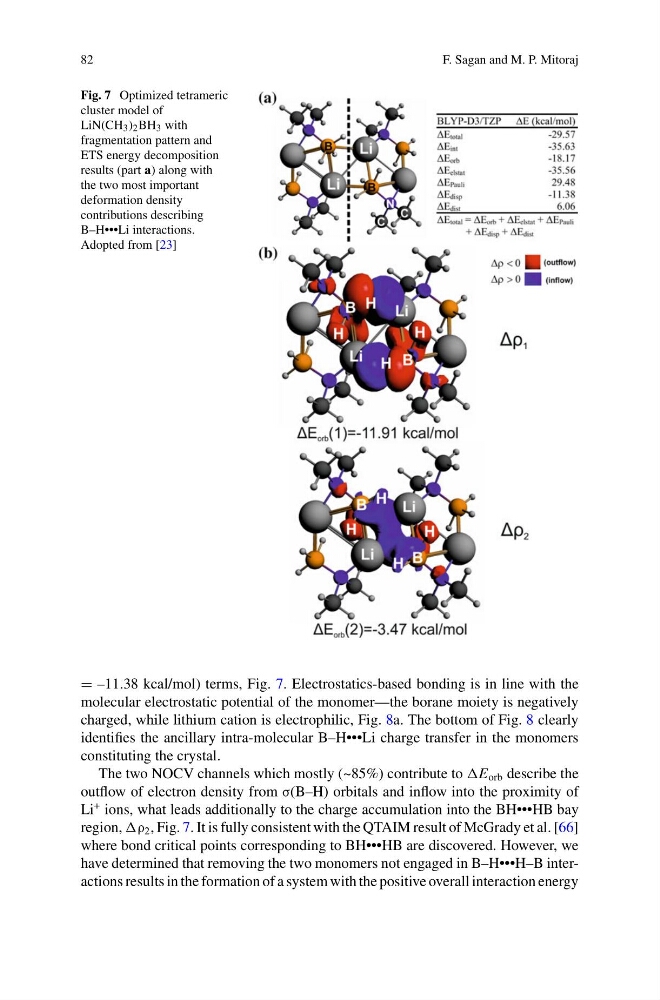
Fig. 7 Optimized tetrameric
cluster model of
LiN(CH 3 ) 2 BH 3 with
fragmentation pattern and
ETS energy decomposition
results (part a) along with
the two most important
deformation density
contributions describing
B–H•••Li interactions.
Adopted from [23]
–11.38 kcal/mol) terms, Fig. 7. Electrostatics-based bonding is in line with the
molecular electrostatic potential of the monomer—the borane moiety is negatively
charged, while lithium cation is electrophilic, Fig. 8a. The bottom of Fig. 8 clearly
identifies the ancillary intra-molecular B–H•••Li charge transfer in the monomers
constituting the crystal.
The two NOCV channels which mostly (~85%) contribute to E orb describe the
outflow of electron density from σ(B–H) orbitals and inflow into the proximity of
Li
+ ions, what leads additionally to the charge accumulation into the BH•••HB bay
region, ρ 2 , Fig. 7. It is fully consistent with the QTAIM result of McGrady et al. [66]
where bond critical points corresponding to BH•••HB are discovered. However, we
have determined that removing the two monomers not engaged in B–H•••H–B interactions results in the formation of a system with the positive overall interaction energy
F. Sagan and M. P. Mitoraj
Fig. 7 Optimized tetrameric
cluster model of
LiN(CH 3 ) 2 BH 3 with
fragmentation pattern and
ETS energy decomposition
results (part a) along with
the two most important
deformation density
contributions describing
B–H•••Li interactions.
Adopted from [23]
–11.38 kcal/mol) terms, Fig. 7. Electrostatics-based bonding is in line with the
molecular electrostatic potential of the monomer—the borane moiety is negatively
charged, while lithium cation is electrophilic, Fig. 8a. The bottom of Fig. 8 clearly
identifies the ancillary intra-molecular B–H•••Li charge transfer in the monomers
constituting the crystal.
The two NOCV channels which mostly (~85%) contribute to E orb describe the
outflow of electron density from σ(B–H) orbitals and inflow into the proximity of
Li
+ ions, what leads additionally to the charge accumulation into the BH•••HB bay
region, ρ 2 , Fig. 7. It is fully consistent with the QTAIM result of McGrady et al. [66]
where bond critical points corresponding to BH•••HB are discovered. However, we
have determined that removing the two monomers not engaged in B–H•••H–B interactions results in the formation of a system with the positive overall interaction energy