

Non-covalent Interactions in Selected Transition Metal Complexes
77
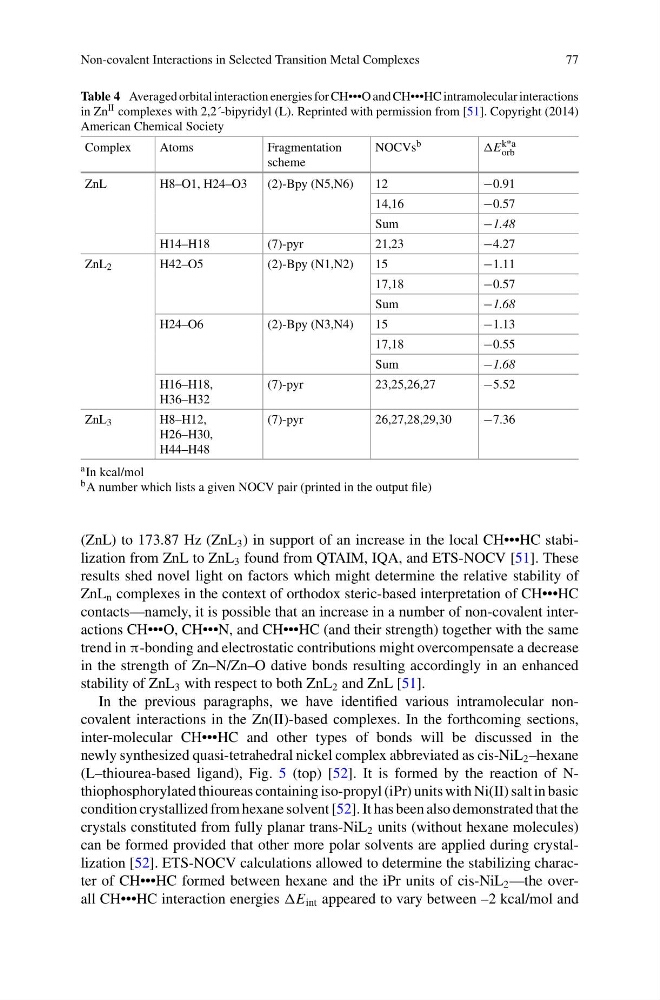
Table 4 Averaged orbital interaction energies for CH•••O and CH•••HC intramolecular interactions
in Zn II complexes with 2,2´-bipyridyl (L). Reprinted with permission from [51]. Copyright (2014)
American Chemical Society
Complex
Atoms
Fragmentation
scheme
NOCVs b
E k*a
orb
ZnL
H8–O1, H24–O3
(2)-Bpy (N5,N6)
12
−0.91
14,16
−0.57
Sum
−1.48
H14–H18
(7)-pyr
21,23
−4.27
ZnL 2
H42–O5
(2)-Bpy (N1,N2)
15
−1.11
17,18
−0.57
Sum
−1.68
H24–O6
(2)-Bpy (N3,N4)
15
−1.13
17,18
−0.55
Sum
−1.68
H16–H18,
H36–H32
(7)-pyr
23,25,26,27
−5.52
ZnL 3
H8–H12,
H26–H30,
H44–H48
(7)-pyr
26,27,28,29,30
−7.36
a In kcal/mol
b A number which lists a given NOCV pair (printed in the output file)
(ZnL) to 173.87 Hz (ZnL 3 ) in support of an increase in the local CH•••HC stabilization from ZnL to ZnL 3 found from QTAIM, IQA, and ETS-NOCV [51]. These
results shed novel light on factors which might determine the relative stability of
ZnL n complexes in the context of orthodox steric-based interpretation of CH•••HC
contacts—namely, it is possible that an increase in a number of non-covalent interactions CH•••O, CH•••N, and CH•••HC (and their strength) together with the same
trend in π-bonding and electrostatic contributions might overcompensate a decrease
in the strength of Zn–N/Zn–O dative bonds resulting accordingly in an enhanced
stability of ZnL 3 with respect to both ZnL 2 and ZnL [51].
In the previous paragraphs, we have identified various intramolecular noncovalent interactions in the Zn(II)-based complexes. In the forthcoming sections,
inter-molecular CH•••HC and other types of bonds will be discussed in the
newly synthesized quasi-tetrahedral nickel complex abbreviated as cis-NiL 2 –hexane
(L–thiourea-based ligand), Fig. 5 (top) [52]. It is formed by the reaction of Nthiophosphorylated thioureas containing iso-propyl (iPr) units with Ni(II) salt in basic
condition crystallized from hexane solvent [52]. It has been also demonstrated that the
crystals constituted from fully planar trans-NiL 2 units (without hexane molecules)
can be formed provided that other more polar solvents are applied during crystallization [52]. ETS-NOCV calculations allowed to determine the stabilizing character of CH•••HC formed between hexane and the iPr units of cis-NiL 2 —the overall CH•••HC interaction energies E int appeared to vary between –2 kcal/mol and
77
Table 4 Averaged orbital interaction energies for CH•••O and CH•••HC intramolecular interactions
in Zn II complexes with 2,2´-bipyridyl (L). Reprinted with permission from [51]. Copyright (2014)
American Chemical Society
Complex
Atoms
Fragmentation
scheme
NOCVs b
E k*a
orb
ZnL
H8–O1, H24–O3
(2)-Bpy (N5,N6)
12
−0.91
14,16
−0.57
Sum
−1.48
H14–H18
(7)-pyr
21,23
−4.27
ZnL 2
H42–O5
(2)-Bpy (N1,N2)
15
−1.11
17,18
−0.57
Sum
−1.68
H24–O6
(2)-Bpy (N3,N4)
15
−1.13
17,18
−0.55
Sum
−1.68
H16–H18,
H36–H32
(7)-pyr
23,25,26,27
−5.52
ZnL 3
H8–H12,
H26–H30,
H44–H48
(7)-pyr
26,27,28,29,30
−7.36
a In kcal/mol
b A number which lists a given NOCV pair (printed in the output file)
(ZnL) to 173.87 Hz (ZnL 3 ) in support of an increase in the local CH•••HC stabilization from ZnL to ZnL 3 found from QTAIM, IQA, and ETS-NOCV [51]. These
results shed novel light on factors which might determine the relative stability of
ZnL n complexes in the context of orthodox steric-based interpretation of CH•••HC
contacts—namely, it is possible that an increase in a number of non-covalent interactions CH•••O, CH•••N, and CH•••HC (and their strength) together with the same
trend in π-bonding and electrostatic contributions might overcompensate a decrease
in the strength of Zn–N/Zn–O dative bonds resulting accordingly in an enhanced
stability of ZnL 3 with respect to both ZnL 2 and ZnL [51].
In the previous paragraphs, we have identified various intramolecular noncovalent interactions in the Zn(II)-based complexes. In the forthcoming sections,
inter-molecular CH•••HC and other types of bonds will be discussed in the
newly synthesized quasi-tetrahedral nickel complex abbreviated as cis-NiL 2 –hexane
(L–thiourea-based ligand), Fig. 5 (top) [52]. It is formed by the reaction of Nthiophosphorylated thioureas containing iso-propyl (iPr) units with Ni(II) salt in basic
condition crystallized from hexane solvent [52]. It has been also demonstrated that the
crystals constituted from fully planar trans-NiL 2 units (without hexane molecules)
can be formed provided that other more polar solvents are applied during crystallization [52]. ETS-NOCV calculations allowed to determine the stabilizing character of CH•••HC formed between hexane and the iPr units of cis-NiL 2 —the overall CH•••HC interaction energies E int appeared to vary between –2 kcal/mol and