

76
F. Sagan and M. P. Mitoraj
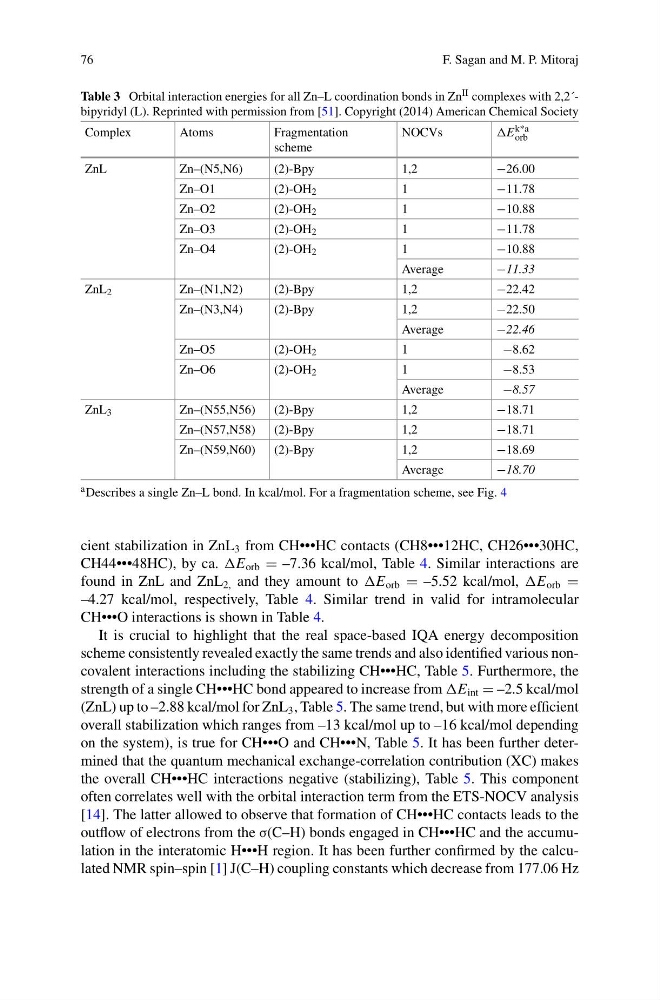
Table 3 Orbital interaction energies for all Zn–L coordination bonds in Zn II complexes with 2,2´bipyridyl (L). Reprinted with permission from [51]. Copyright (2014) American Chemical Society
Complex
Atoms
Fragmentation
scheme
NOCVs
E k*a
orb
ZnL
Zn–(N5,N6)
(2)-Bpy
1,2
−26.00
Zn–O1
(2)-OH 2
1
−11.78
Zn–O2
(2)-OH 2
1
−10.88
Zn–O3
(2)-OH 2
1
−11.78
Zn–O4
(2)-OH 2
1
−10.88
Average
−11.33
ZnL 2
Zn–(N1,N2)
(2)-Bpy
1,2
−22.42
Zn–(N3,N4)
(2)-Bpy
1,2
−22.50
Average
−22.46
Zn–O5
(2)-OH 2
1
−8.62
Zn–O6
(2)-OH 2
1
−8.53
Average
−8.57
ZnL 3
Zn–(N55,N56) (2)-Bpy
1,2
−18.71
Zn–(N57,N58) (2)-Bpy
1,2
−18.71
Zn–(N59,N60) (2)-Bpy
1,2
−18.69
Average
−18.70
a Describes a single Zn–L bond. In kcal/mol. For a fragmentation scheme, see Fig. 4
cient stabilization in ZnL 3 from CH•••HC contacts (CH8•••12HC, CH26•••30HC,
CH44•••48HC), by ca. E orb –7.36 kcal/mol, Table 4. Similar interactions are
found in ZnL and ZnL 2, and they amount to E orb –5.52 kcal/mol, E orb
–4.27 kcal/mol, respectively, Table 4. Similar trend in valid for intramolecular
CH•••O interactions is shown in Table 4.
It is crucial to highlight that the real space-based IQA energy decomposition
scheme consistently revealed exactly the same trends and also identified various noncovalent interactions including the stabilizing CH•••HC, Table 5. Furthermore, the
strength of a single CH•••HC bond appeared to increase from E int –2.5 kcal/mol
(ZnL) up to –2.88 kcal/mol for ZnL 3 , Table 5. The same trend, but with more efficient
overall stabilization which ranges from –13 kcal/mol up to –16 kcal/mol depending
on the system), is true for CH•••O and CH•••N, Table 5. It has been further determined that the quantum mechanical exchange-correlation contribution (XC) makes
the overall CH•••HC interactions negative (stabilizing), Table 5. This component
often correlates well with the orbital interaction term from the ETS-NOCV analysis
[14]. The latter allowed to observe that formation of CH•••HC contacts leads to the
outflow of electrons from the σ(C–H) bonds engaged in CH•••HC and the accumulation in the interatomic H•••H region. It has been further confirmed by the calculated NMR spin–spin [1] J(C–H) coupling constants which decrease from 177.06 Hz
F. Sagan and M. P. Mitoraj
Table 3 Orbital interaction energies for all Zn–L coordination bonds in Zn II complexes with 2,2´bipyridyl (L). Reprinted with permission from [51]. Copyright (2014) American Chemical Society
Complex
Atoms
Fragmentation
scheme
NOCVs
E k*a
orb
ZnL
Zn–(N5,N6)
(2)-Bpy
1,2
−26.00
Zn–O1
(2)-OH 2
1
−11.78
Zn–O2
(2)-OH 2
1
−10.88
Zn–O3
(2)-OH 2
1
−11.78
Zn–O4
(2)-OH 2
1
−10.88
Average
−11.33
ZnL 2
Zn–(N1,N2)
(2)-Bpy
1,2
−22.42
Zn–(N3,N4)
(2)-Bpy
1,2
−22.50
Average
−22.46
Zn–O5
(2)-OH 2
1
−8.62
Zn–O6
(2)-OH 2
1
−8.53
Average
−8.57
ZnL 3
Zn–(N55,N56) (2)-Bpy
1,2
−18.71
Zn–(N57,N58) (2)-Bpy
1,2
−18.71
Zn–(N59,N60) (2)-Bpy
1,2
−18.69
Average
−18.70
a Describes a single Zn–L bond. In kcal/mol. For a fragmentation scheme, see Fig. 4
cient stabilization in ZnL 3 from CH•••HC contacts (CH8•••12HC, CH26•••30HC,
CH44•••48HC), by ca. E orb –7.36 kcal/mol, Table 4. Similar interactions are
found in ZnL and ZnL 2, and they amount to E orb –5.52 kcal/mol, E orb
–4.27 kcal/mol, respectively, Table 4. Similar trend in valid for intramolecular
CH•••O interactions is shown in Table 4.
It is crucial to highlight that the real space-based IQA energy decomposition
scheme consistently revealed exactly the same trends and also identified various noncovalent interactions including the stabilizing CH•••HC, Table 5. Furthermore, the
strength of a single CH•••HC bond appeared to increase from E int –2.5 kcal/mol
(ZnL) up to –2.88 kcal/mol for ZnL 3 , Table 5. The same trend, but with more efficient
overall stabilization which ranges from –13 kcal/mol up to –16 kcal/mol depending
on the system), is true for CH•••O and CH•••N, Table 5. It has been further determined that the quantum mechanical exchange-correlation contribution (XC) makes
the overall CH•••HC interactions negative (stabilizing), Table 5. This component
often correlates well with the orbital interaction term from the ETS-NOCV analysis
[14]. The latter allowed to observe that formation of CH•••HC contacts leads to the
outflow of electrons from the σ(C–H) bonds engaged in CH•••HC and the accumulation in the interatomic H•••H region. It has been further confirmed by the calculated NMR spin–spin [1] J(C–H) coupling constants which decrease from 177.06 Hz