

Non-covalent Interactions in Selected Transition Metal Complexes
75
(a)
(b)
(c)
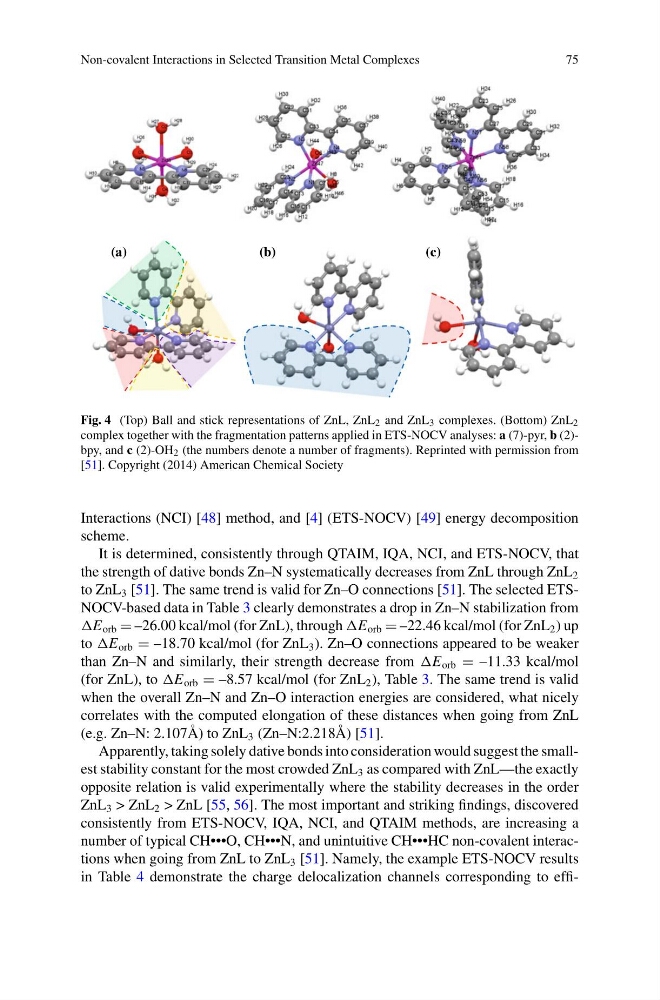
Fig. 4 (Top) Ball and stick representations of ZnL, ZnL 2 and ZnL 3 complexes. (Bottom) ZnL 2
complex together with the fragmentation patterns applied in ETS-NOCV analyses: a (7)-pyr, b (2)bpy, and c (2)-OH 2 (the numbers denote a number of fragments). Reprinted with permission from
[51]. Copyright (2014) American Chemical Society
Interactions (NCI) [48] method, and [4] (ETS-NOCV) [49] energy decomposition
scheme.
It is determined, consistently through QTAIM, IQA, NCI, and ETS-NOCV, that
the strength of dative bonds Zn–N systematically decreases from ZnL through ZnL 2
to ZnL 3 [51]. The same trend is valid for Zn–O connections [51]. The selected ETSNOCV-based data in Table 3 clearly demonstrates a drop in Zn–N stabilization from
E orb –26.00 kcal/mol (for ZnL), through orb –22.46 kcal/mol (for ZnL 2 ) up
to orb –18.70 kcal/mol (for ZnL 3 ). Zn–O connections appeared to be weaker
than Zn–N and similarly, their strength decrease from orb –11.33 kcal/mol
(for ZnL), to orb –8.57 kcal/mol (for ZnL 2 ), Table 3. The same trend is valid
when the overall Zn–N and Zn–O interaction energies are considered, what nicely
correlates with the computed elongation of these distances when going from ZnL
(e.g. Zn–N: 2.107Å) to ZnL 3 (Zn–N:2.218Å) [51].
Apparently, taking solely dative bonds into consideration would suggest the smallest stability constant for the most crowded ZnL 3 as compared with ZnL—the exactly
opposite relation is valid experimentally where the stability decreases in the order
ZnL 3 > ZnL 2 > ZnL [55, 56]. The most important and striking findings, discovered
consistently from ETS-NOCV, IQA, NCI, and QTAIM methods, are increasing a
number of typical CH•••O, CH•••N, and unintuitive CH•••HC non-covalent interactions when going from ZnL to ZnL 3 [51]. Namely, the example ETS-NOCV results
in Table 4 demonstrate the charge delocalization channels corresponding to effi-
75
(a)
(b)
(c)
Fig. 4 (Top) Ball and stick representations of ZnL, ZnL 2 and ZnL 3 complexes. (Bottom) ZnL 2
complex together with the fragmentation patterns applied in ETS-NOCV analyses: a (7)-pyr, b (2)bpy, and c (2)-OH 2 (the numbers denote a number of fragments). Reprinted with permission from
[51]. Copyright (2014) American Chemical Society
Interactions (NCI) [48] method, and [4] (ETS-NOCV) [49] energy decomposition
scheme.
It is determined, consistently through QTAIM, IQA, NCI, and ETS-NOCV, that
the strength of dative bonds Zn–N systematically decreases from ZnL through ZnL 2
to ZnL 3 [51]. The same trend is valid for Zn–O connections [51]. The selected ETSNOCV-based data in Table 3 clearly demonstrates a drop in Zn–N stabilization from
E orb –26.00 kcal/mol (for ZnL), through orb –22.46 kcal/mol (for ZnL 2 ) up
to orb –18.70 kcal/mol (for ZnL 3 ). Zn–O connections appeared to be weaker
than Zn–N and similarly, their strength decrease from orb –11.33 kcal/mol
(for ZnL), to orb –8.57 kcal/mol (for ZnL 2 ), Table 3. The same trend is valid
when the overall Zn–N and Zn–O interaction energies are considered, what nicely
correlates with the computed elongation of these distances when going from ZnL
(e.g. Zn–N: 2.107Å) to ZnL 3 (Zn–N:2.218Å) [51].
Apparently, taking solely dative bonds into consideration would suggest the smallest stability constant for the most crowded ZnL 3 as compared with ZnL—the exactly
opposite relation is valid experimentally where the stability decreases in the order
ZnL 3 > ZnL 2 > ZnL [55, 56]. The most important and striking findings, discovered
consistently from ETS-NOCV, IQA, NCI, and QTAIM methods, are increasing a
number of typical CH•••O, CH•••N, and unintuitive CH•••HC non-covalent interactions when going from ZnL to ZnL 3 [51]. Namely, the example ETS-NOCV results
in Table 4 demonstrate the charge delocalization channels corresponding to effi-