

74
F. Sagan and M. P. Mitoraj
Table 2 ETS energy
decomposition results (in
kcal/mol) describing the
interaction between
NTA/NTPA ligands and the
Zn(H 2 O) 2 fragment in
ZnNTA/ZnNTPA complexes.
Interaction in the gas phase
and the solvent is presented.
Reprinted with permission
from [50]. Copyright (2011)
American Chemical Society
ETS results a, b
ZnNTA
ZnNTPA
E orb
−183.5
−210.4
E Pauli
140.9
166.8
E elstat
−690.2
−699.5
E int
−732.8
−743.1
E dist-Zn(H2O)2
23.4
38.7
E dist-NTA/NTPA
38.8
81.7
E dist
62.2
120.4
E total
−670.6
−622.7
E int (solvent)
−148.7
−172.1
E dist-Zn(H2O)2 (solvent)
21.1
37.3
E dist-NTA/NTPA (solvent)
20.5
31.8
E dist (solvent)
41.6
69.1
E total (solvent) c
−107.1
−103.0
a kcal/mol
b E total E dist + E int E dist-Zn(H2O)2 + E dist-NTA/NTPA +
E elstat + E Pauli + E orb
c E total (solvent) E int (solvent) + E dist (solvent)
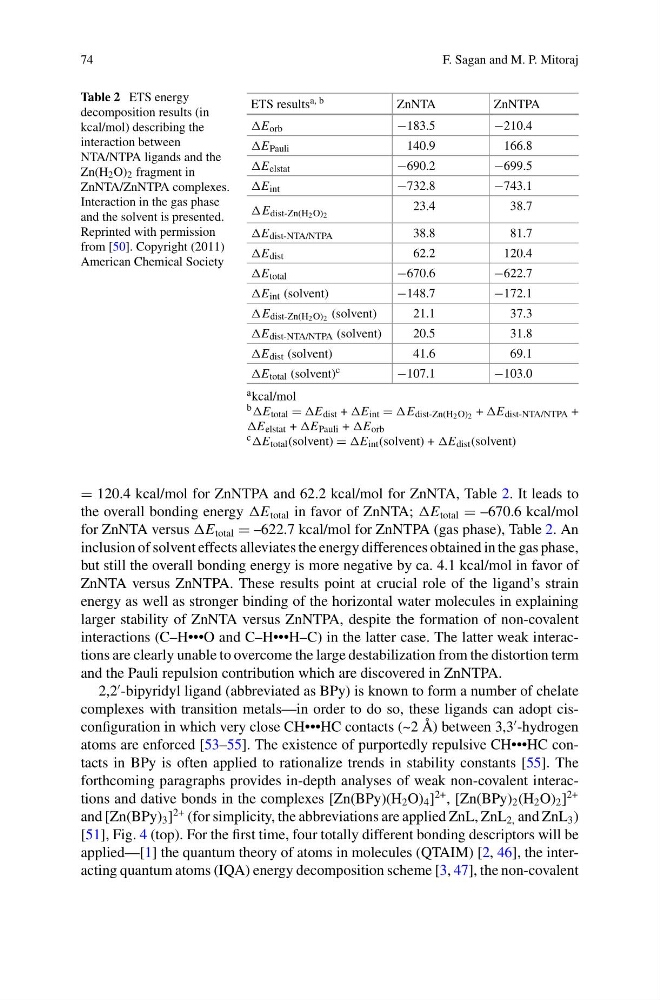
120.4 kcal/mol for ZnNTPA and 62.2 kcal/mol for ZnNTA, Table 2. It leads to
the overall bonding energy E total in favor of ZnNTA; E total –670.6 kcal/mol
for ZnNTA versus E total –622.7 kcal/mol for ZnNTPA (gas phase), Table 2. An
inclusion of solvent effects alleviates the energy differences obtained in the gas phase,
but still the overall bonding energy is more negative by ca. 4.1 kcal/mol in favor of
ZnNTA versus ZnNTPA. These results point at crucial role of the ligand’s strain
energy as well as stronger binding of the horizontal water molecules in explaining
larger stability of ZnNTA versus ZnNTPA, despite the formation of non-covalent
interactions (C–H•••O and C–H•••H–C) in the latter case. The latter weak interactions are clearly unable to overcome the large destabilization from the distortion term
and the Pauli repulsion contribution which are discovered in ZnNTPA.
2,2
-bipyridyl ligand (abbreviated as BPy) is known to form a number of chelate
complexes with transition metals—in order to do so, these ligands can adopt cisconfiguration in which very close CH•••HC contacts (~2 Å) between 3,3
-hydrogen
atoms are enforced [53–55]. The existence of purportedly repulsive CH•••HC contacts in BPy is often applied to rationalize trends in stability constants [55]. The
forthcoming paragraphs provides in-depth analyses of weak non-covalent interactions and dative bonds in the complexes [Zn(BPy)(H 2 O) 4 ]
2+ , [Zn(BPy) 2 (H 2 O) 2 ]
2+
and [Zn(BPy) 3 ]
2+ (for simplicity, the abbreviations are applied ZnL, ZnL 2, and ZnL 3 )
[51], Fig. 4 (top). For the first time, four totally different bonding descriptors will be
applied—[1] the quantum theory of atoms in molecules (QTAIM) [2, 46], the interacting quantum atoms (IQA) energy decomposition scheme [3, 47], the non-covalent
F. Sagan and M. P. Mitoraj
Table 2 ETS energy
decomposition results (in
kcal/mol) describing the
interaction between
NTA/NTPA ligands and the
Zn(H 2 O) 2 fragment in
ZnNTA/ZnNTPA complexes.
Interaction in the gas phase
and the solvent is presented.
Reprinted with permission
from [50]. Copyright (2011)
American Chemical Society
ETS results a, b
ZnNTA
ZnNTPA
E orb
−183.5
−210.4
E Pauli
140.9
166.8
E elstat
−690.2
−699.5
E int
−732.8
−743.1
E dist-Zn(H2O)2
23.4
38.7
E dist-NTA/NTPA
38.8
81.7
E dist
62.2
120.4
E total
−670.6
−622.7
E int (solvent)
−148.7
−172.1
E dist-Zn(H2O)2 (solvent)
21.1
37.3
E dist-NTA/NTPA (solvent)
20.5
31.8
E dist (solvent)
41.6
69.1
E total (solvent) c
−107.1
−103.0
a kcal/mol
b E total E dist + E int E dist-Zn(H2O)2 + E dist-NTA/NTPA +
E elstat + E Pauli + E orb
c E total (solvent) E int (solvent) + E dist (solvent)
120.4 kcal/mol for ZnNTPA and 62.2 kcal/mol for ZnNTA, Table 2. It leads to
the overall bonding energy E total in favor of ZnNTA; E total –670.6 kcal/mol
for ZnNTA versus E total –622.7 kcal/mol for ZnNTPA (gas phase), Table 2. An
inclusion of solvent effects alleviates the energy differences obtained in the gas phase,
but still the overall bonding energy is more negative by ca. 4.1 kcal/mol in favor of
ZnNTA versus ZnNTPA. These results point at crucial role of the ligand’s strain
energy as well as stronger binding of the horizontal water molecules in explaining
larger stability of ZnNTA versus ZnNTPA, despite the formation of non-covalent
interactions (C–H•••O and C–H•••H–C) in the latter case. The latter weak interactions are clearly unable to overcome the large destabilization from the distortion term
and the Pauli repulsion contribution which are discovered in ZnNTPA.
2,2
-bipyridyl ligand (abbreviated as BPy) is known to form a number of chelate
complexes with transition metals—in order to do so, these ligands can adopt cisconfiguration in which very close CH•••HC contacts (~2 Å) between 3,3
-hydrogen
atoms are enforced [53–55]. The existence of purportedly repulsive CH•••HC contacts in BPy is often applied to rationalize trends in stability constants [55]. The
forthcoming paragraphs provides in-depth analyses of weak non-covalent interactions and dative bonds in the complexes [Zn(BPy)(H 2 O) 4 ]
2+ , [Zn(BPy) 2 (H 2 O) 2 ]
2+
and [Zn(BPy) 3 ]
2+ (for simplicity, the abbreviations are applied ZnL, ZnL 2, and ZnL 3 )
[51], Fig. 4 (top). For the first time, four totally different bonding descriptors will be
applied—[1] the quantum theory of atoms in molecules (QTAIM) [2, 46], the interacting quantum atoms (IQA) energy decomposition scheme [3, 47], the non-covalent