

Non-covalent Interactions in Selected Transition Metal Complexes
71
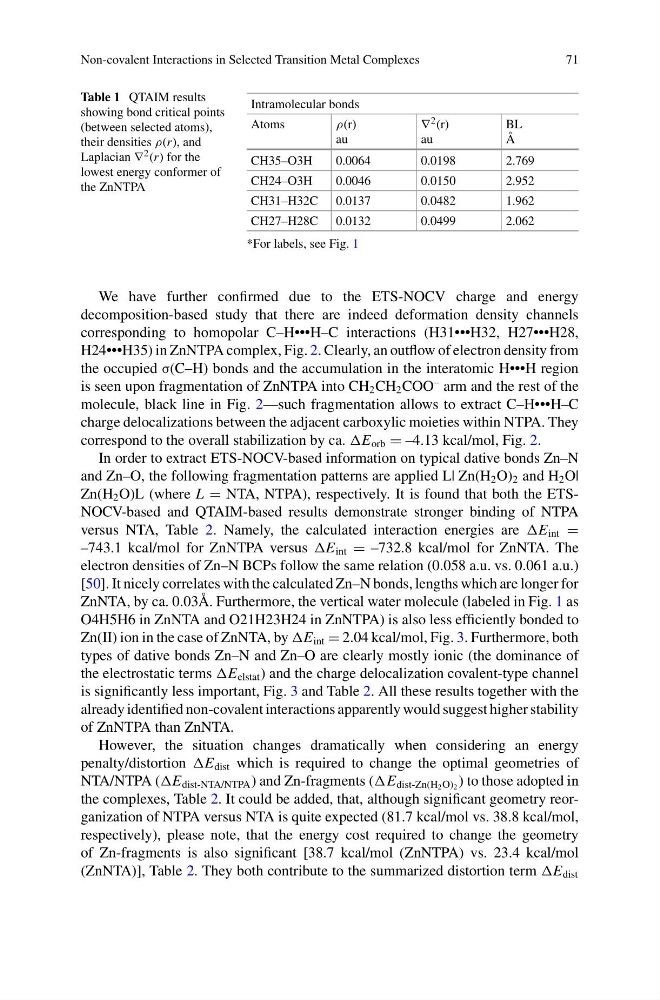
Table 1 QTAIM results
showing bond critical points
(between selected atoms),
their densities ρ(r), and
Laplacian ∇ 2 (r) for the
lowest energy conformer of
the ZnNTPA
Intramolecular bonds
Atoms
ρ(r)
au
∇ 2 (r)
au
BL
Å
CH35–O3H
0.0064
0.0198
2.769
CH24–O3H
0.0046
0.0150
2.952
CH31–H32C 0.0137
0.0482
1.962
CH27–H28C 0.0132
0.0499
2.062
*For labels, see Fig. 1
We have further confirmed due to the ETS-NOCV charge and energy
decomposition-based study that there are indeed deformation density channels
corresponding to homopolar C–H•••H–C interactions (H31•••H32, H27•••H28,
H24•••H35) in ZnNTPA complex, Fig. 2. Clearly, an outflow of electron density from
the occupied σ(C–H) bonds and the accumulation in the interatomic H•••H region
is seen upon fragmentation of ZnNTPA into CH 2 CH 2 COO
– arm and the rest of the
molecule, black line in Fig. 2—such fragmentation allows to extract C–H•••H–C
charge delocalizations between the adjacent carboxylic moieties within NTPA. They
correspond to the overall stabilization by ca. E orb –4.13 kcal/mol, Fig. 2.
In order to extract ETS-NOCV-based information on typical dative bonds Zn–N
and Zn–O, the following fragmentation patterns are applied L| Zn(H 2 O) 2 and H 2 O|
Zn(H 2 O)L (where L NTA, NTPA), respectively. It is found that both the ETSNOCV-based and QTAIM-based results demonstrate stronger binding of NTPA
versus NTA, Table 2. Namely, the calculated interaction energies are E int
–743.1 kcal/mol for ZnNTPA versus E int –732.8 kcal/mol for ZnNTA. The
electron densities of Zn–N BCPs follow the same relation (0.058 a.u. vs. 0.061 a.u.)
[50]. It nicely correlates with the calculated Zn–N bonds, lengths which are longer for
ZnNTA, by ca. 0.03Å. Furthermore, the vertical water molecule (labeled in Fig. 1 as
O4H5H6 in ZnNTA and O21H23H24 in ZnNTPA) is also less efficiently bonded to
Zn(II) ion in the case of ZnNTA, by E int 2.04 kcal/mol, Fig. 3. Furthermore, both
types of dative bonds Zn–N and Zn–O are clearly mostly ionic (the dominance of
the electrostatic terms E elstat ) and the charge delocalization covalent-type channel
is significantly less important, Fig. 3 and Table 2. All these results together with the
already identified non-covalent interactions apparently would suggest higher stability
of ZnNTPA than ZnNTA.
However, the situation changes dramatically when considering an energy
penalty/distortion E dist which is required to change the optimal geometries of
NTA/NTPA (E dist-NTA/NTPA ) and Zn-fragments (E dist-Zn(H 2 O) 2 ) to those adopted in
the complexes, Table 2. It could be added, that, although significant geometry reorganization of NTPA versus NTA is quite expected (81.7 kcal/mol vs. 38.8 kcal/mol,
respectively), please note, that the energy cost required to change the geometry
of Zn-fragments is also significant [38.7 kcal/mol (ZnNTPA) vs. 23.4 kcal/mol
(ZnNTA)], Table 2. They both contribute to the summarized distortion term E dist
71
Table 1 QTAIM results
showing bond critical points
(between selected atoms),
their densities ρ(r), and
Laplacian ∇ 2 (r) for the
lowest energy conformer of
the ZnNTPA
Intramolecular bonds
Atoms
ρ(r)
au
∇ 2 (r)
au
BL
Å
CH35–O3H
0.0064
0.0198
2.769
CH24–O3H
0.0046
0.0150
2.952
CH31–H32C 0.0137
0.0482
1.962
CH27–H28C 0.0132
0.0499
2.062
*For labels, see Fig. 1
We have further confirmed due to the ETS-NOCV charge and energy
decomposition-based study that there are indeed deformation density channels
corresponding to homopolar C–H•••H–C interactions (H31•••H32, H27•••H28,
H24•••H35) in ZnNTPA complex, Fig. 2. Clearly, an outflow of electron density from
the occupied σ(C–H) bonds and the accumulation in the interatomic H•••H region
is seen upon fragmentation of ZnNTPA into CH 2 CH 2 COO
– arm and the rest of the
molecule, black line in Fig. 2—such fragmentation allows to extract C–H•••H–C
charge delocalizations between the adjacent carboxylic moieties within NTPA. They
correspond to the overall stabilization by ca. E orb –4.13 kcal/mol, Fig. 2.
In order to extract ETS-NOCV-based information on typical dative bonds Zn–N
and Zn–O, the following fragmentation patterns are applied L| Zn(H 2 O) 2 and H 2 O|
Zn(H 2 O)L (where L NTA, NTPA), respectively. It is found that both the ETSNOCV-based and QTAIM-based results demonstrate stronger binding of NTPA
versus NTA, Table 2. Namely, the calculated interaction energies are E int
–743.1 kcal/mol for ZnNTPA versus E int –732.8 kcal/mol for ZnNTA. The
electron densities of Zn–N BCPs follow the same relation (0.058 a.u. vs. 0.061 a.u.)
[50]. It nicely correlates with the calculated Zn–N bonds, lengths which are longer for
ZnNTA, by ca. 0.03Å. Furthermore, the vertical water molecule (labeled in Fig. 1 as
O4H5H6 in ZnNTA and O21H23H24 in ZnNTPA) is also less efficiently bonded to
Zn(II) ion in the case of ZnNTA, by E int 2.04 kcal/mol, Fig. 3. Furthermore, both
types of dative bonds Zn–N and Zn–O are clearly mostly ionic (the dominance of
the electrostatic terms E elstat ) and the charge delocalization covalent-type channel
is significantly less important, Fig. 3 and Table 2. All these results together with the
already identified non-covalent interactions apparently would suggest higher stability
of ZnNTPA than ZnNTA.
However, the situation changes dramatically when considering an energy
penalty/distortion E dist which is required to change the optimal geometries of
NTA/NTPA (E dist-NTA/NTPA ) and Zn-fragments (E dist-Zn(H 2 O) 2 ) to those adopted in
the complexes, Table 2. It could be added, that, although significant geometry reorganization of NTPA versus NTA is quite expected (81.7 kcal/mol vs. 38.8 kcal/mol,
respectively), please note, that the energy cost required to change the geometry
of Zn-fragments is also significant [38.7 kcal/mol (ZnNTPA) vs. 23.4 kcal/mol
(ZnNTA)], Table 2. They both contribute to the summarized distortion term E dist