

70
F. Sagan and M. P. Mitoraj
3 Results and Discussion
It is known experimentally that Zn(II) ion prefers binding with five-member chelate
rings (e.g., nitrotriacetic acid, NTA) rather than with six-member units (e.g., nitrotri3-propanoic acid, NTPA)—the experimentally determined formation constants in
water are logK 5.3 for ZnNTPA complex and logK 10.45 for ZnNTA, Fig. 1 [53,
54, 50]. Such difference in the stability is intuitively explained by the increased steric
crowding (due to C–H•••H–C contacts between the adjacent C–H bonds) in the case
of ZnNTPA [53, 54]. In order to shed some light on the origin of different stability
between ZnNTPA and ZnNTA, we have performed an in-depth study of bonding
situations in both complexes by the charge and energy decomposition method ETSNOCV as well as by the QTAIM approach [50].
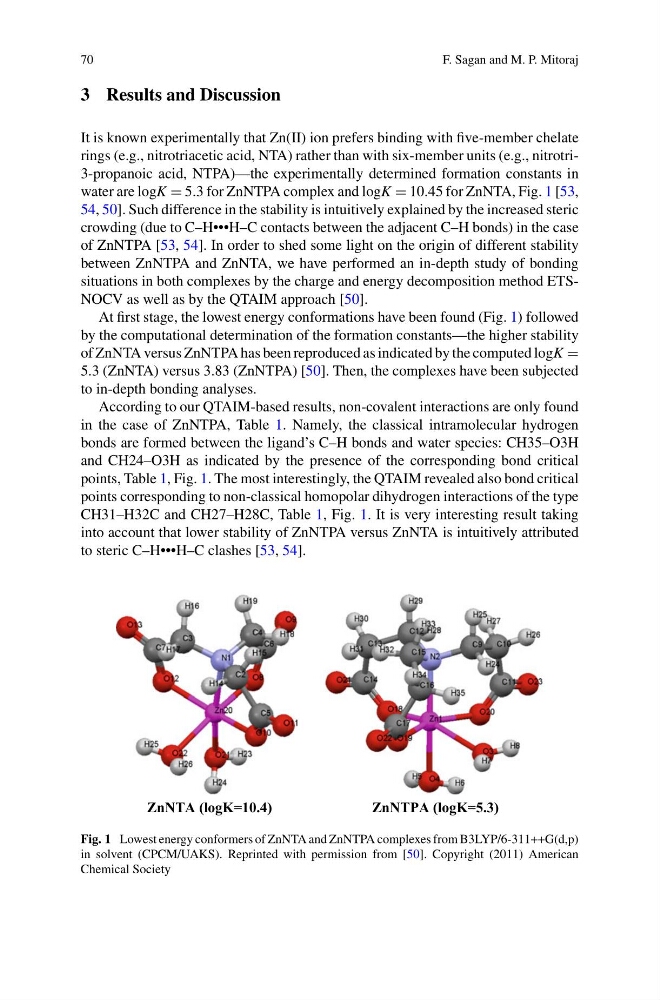
At first stage, the lowest energy conformations have been found (Fig. 1) followed
by the computational determination of the formation constants—the higher stability
of ZnNTA versus ZnNTPA has been reproduced as indicated by the computed logK
5.3 (ZnNTA) versus 3.83 (ZnNTPA) [50]. Then, the complexes have been subjected
to in-depth bonding analyses.
According to our QTAIM-based results, non-covalent interactions are only found
in the case of ZnNTPA, Table 1. Namely, the classical intramolecular hydrogen
bonds are formed between the ligand’s C–H bonds and water species: CH35–O3H
and CH24–O3H as indicated by the presence of the corresponding bond critical
points, Table 1, Fig. 1. The most interestingly, the QTAIM revealed also bond critical
points corresponding to non-classical homopolar dihydrogen interactions of the type
CH31–H32C and CH27–H28C, Table 1, Fig. 1. It is very interesting result taking
into account that lower stability of ZnNTPA versus ZnNTA is intuitively attributed
to steric C–H•••H–C clashes [53, 54].
ZnNTA (logK=10.4)
ZnNTPA (logK=5.3)
Fig. 1 Lowest energy conformers of ZnNTA and ZnNTPA complexes from B3LYP/6-311++G(d,p)
in solvent (CPCM/UAKS). Reprinted with permission from [50]. Copyright (2011) American
Chemical Society
F. Sagan and M. P. Mitoraj
3 Results and Discussion
It is known experimentally that Zn(II) ion prefers binding with five-member chelate
rings (e.g., nitrotriacetic acid, NTA) rather than with six-member units (e.g., nitrotri3-propanoic acid, NTPA)—the experimentally determined formation constants in
water are logK 5.3 for ZnNTPA complex and logK 10.45 for ZnNTA, Fig. 1 [53,
54, 50]. Such difference in the stability is intuitively explained by the increased steric
crowding (due to C–H•••H–C contacts between the adjacent C–H bonds) in the case
of ZnNTPA [53, 54]. In order to shed some light on the origin of different stability
between ZnNTPA and ZnNTA, we have performed an in-depth study of bonding
situations in both complexes by the charge and energy decomposition method ETSNOCV as well as by the QTAIM approach [50].
At first stage, the lowest energy conformations have been found (Fig. 1) followed
by the computational determination of the formation constants—the higher stability
of ZnNTA versus ZnNTPA has been reproduced as indicated by the computed logK
5.3 (ZnNTA) versus 3.83 (ZnNTPA) [50]. Then, the complexes have been subjected
to in-depth bonding analyses.
According to our QTAIM-based results, non-covalent interactions are only found
in the case of ZnNTPA, Table 1. Namely, the classical intramolecular hydrogen
bonds are formed between the ligand’s C–H bonds and water species: CH35–O3H
and CH24–O3H as indicated by the presence of the corresponding bond critical
points, Table 1, Fig. 1. The most interestingly, the QTAIM revealed also bond critical
points corresponding to non-classical homopolar dihydrogen interactions of the type
CH31–H32C and CH27–H28C, Table 1, Fig. 1. It is very interesting result taking
into account that lower stability of ZnNTPA versus ZnNTA is intuitively attributed
to steric C–H•••H–C clashes [53, 54].
ZnNTA (logK=10.4)
ZnNTPA (logK=5.3)
Fig. 1 Lowest energy conformers of ZnNTA and ZnNTPA complexes from B3LYP/6-311++G(d,p)
in solvent (CPCM/UAKS). Reprinted with permission from [50]. Copyright (2011) American
Chemical Society