

42
M. Stein
a iso
2
3
g e μ B g N μ N |ψ(O)|
2
(5)
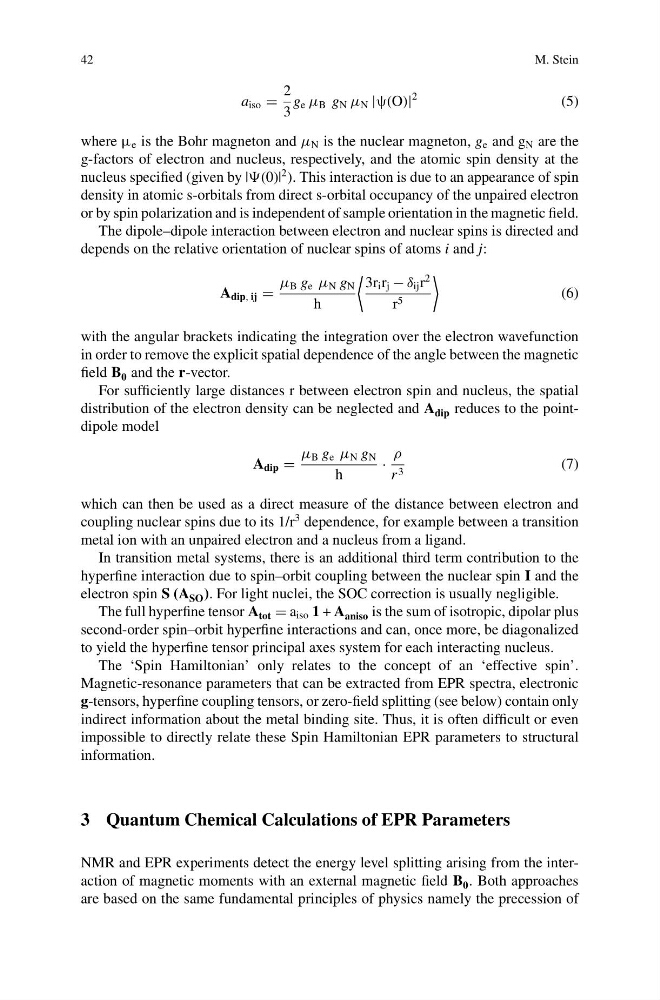
where μ e is the Bohr magneton and μ N is the nuclear magneton, g e and g N are the
g-factors of electron and nucleus, respectively, and the atomic spin density at the
nucleus specified (given by |(0)|
2 ). This interaction is due to an appearance of spin
density in atomic s-orbitals from direct s-orbital occupancy of the unpaired electron
or by spin polarization and is independent of sample orientation in the magnetic field.
The dipole–dipole interaction between electron and nuclear spins is directed and
depends on the relative orientation of nuclear spins of atoms i and j:
A dip, ij
μ B g e μ N g N
h
3r i r j − δ ij r
2
r 5
(6)
with the angular brackets indicating the integration over the electron wavefunction
in order to remove the explicit spatial dependence of the angle between the magnetic
field B 0 and the r-vector.
For sufficiently large distances r between electron spin and nucleus, the spatial
distribution of the electron density can be neglected and A dip reduces to the pointdipole model
A dip
μ B g e μ N g N
h
·
ρ
r 3
(7)
which can then be used as a direct measure of the distance between electron and
coupling nuclear spins due to its 1/r
3 dependence, for example between a transition
metal ion with an unpaired electron and a nucleus from a ligand.
In transition metal systems, there is an additional third term contribution to the
hyperfine interaction due to spin–orbit coupling between the nuclear spin I and the
electron spin S (A SO ). For light nuclei, the SOC correction is usually negligible.
The full hyperfine tensor A tot a iso 1 + A aniso is the sum of isotropic, dipolar plus
second-order spin–orbit hyperfine interactions and can, once more, be diagonalized
to yield the hyperfine tensor principal axes system for each interacting nucleus.
The ‘Spin Hamiltonian’ only relates to the concept of an ‘effective spin’.
Magnetic-resonance parameters that can be extracted from EPR spectra, electronic
g-tensors, hyperfine coupling tensors, or zero-field splitting (see below) contain only
indirect information about the metal binding site. Thus, it is often difficult or even
impossible to directly relate these Spin Hamiltonian EPR parameters to structural
information.
3 Quantum Chemical Calculations of EPR Parameters
NMR and EPR experiments detect the energy level splitting arising from the interaction of magnetic moments with an external magnetic field B 0 . Both approaches
are based on the same fundamental principles of physics namely the precession of
M. Stein
a iso
2
3
g e μ B g N μ N |ψ(O)|
2
(5)
where μ e is the Bohr magneton and μ N is the nuclear magneton, g e and g N are the
g-factors of electron and nucleus, respectively, and the atomic spin density at the
nucleus specified (given by |(0)|
2 ). This interaction is due to an appearance of spin
density in atomic s-orbitals from direct s-orbital occupancy of the unpaired electron
or by spin polarization and is independent of sample orientation in the magnetic field.
The dipole–dipole interaction between electron and nuclear spins is directed and
depends on the relative orientation of nuclear spins of atoms i and j:
A dip, ij
μ B g e μ N g N
h
3r i r j − δ ij r
2
r 5
(6)
with the angular brackets indicating the integration over the electron wavefunction
in order to remove the explicit spatial dependence of the angle between the magnetic
field B 0 and the r-vector.
For sufficiently large distances r between electron spin and nucleus, the spatial
distribution of the electron density can be neglected and A dip reduces to the pointdipole model
A dip
μ B g e μ N g N
h
·
ρ
r 3
(7)
which can then be used as a direct measure of the distance between electron and
coupling nuclear spins due to its 1/r
3 dependence, for example between a transition
metal ion with an unpaired electron and a nucleus from a ligand.
In transition metal systems, there is an additional third term contribution to the
hyperfine interaction due to spin–orbit coupling between the nuclear spin I and the
electron spin S (A SO ). For light nuclei, the SOC correction is usually negligible.
The full hyperfine tensor A tot a iso 1 + A aniso is the sum of isotropic, dipolar plus
second-order spin–orbit hyperfine interactions and can, once more, be diagonalized
to yield the hyperfine tensor principal axes system for each interacting nucleus.
The ‘Spin Hamiltonian’ only relates to the concept of an ‘effective spin’.
Magnetic-resonance parameters that can be extracted from EPR spectra, electronic
g-tensors, hyperfine coupling tensors, or zero-field splitting (see below) contain only
indirect information about the metal binding site. Thus, it is often difficult or even
impossible to directly relate these Spin Hamiltonian EPR parameters to structural
information.
3 Quantum Chemical Calculations of EPR Parameters
NMR and EPR experiments detect the energy level splitting arising from the interaction of magnetic moments with an external magnetic field B 0 . Both approaches
are based on the same fundamental principles of physics namely the precession of