

Anisotropic Magnetic Spin Interactions of Transition Metal …
41
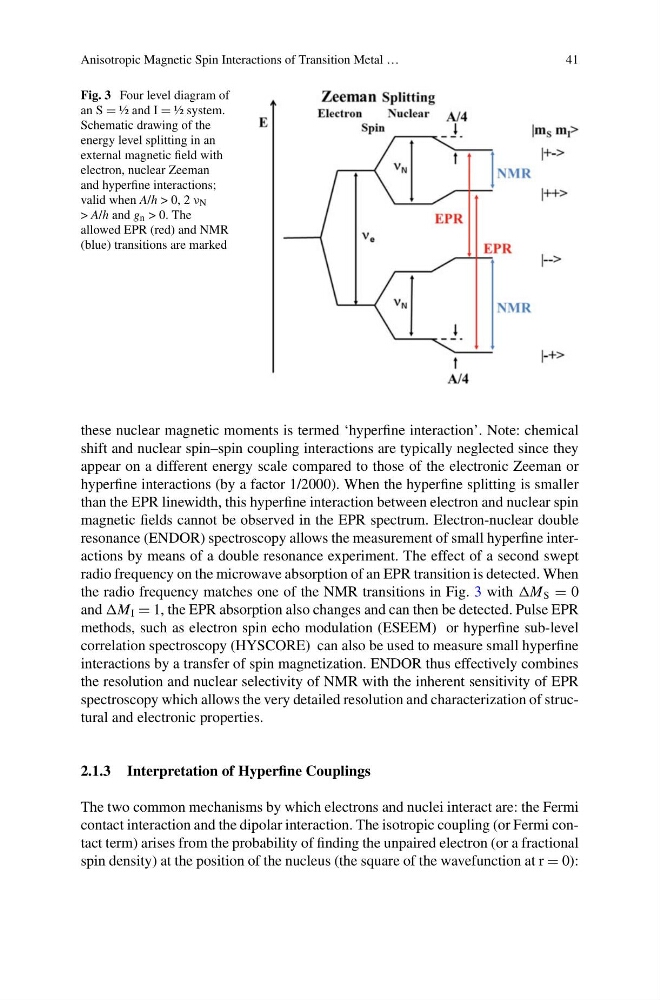
Fig. 3 Four level diagram of
an S ½ and I ½ system.
Schematic drawing of the
energy level splitting in an
external magnetic field with
electron, nuclear Zeeman
and hyperfine interactions;
valid when A/h > 0, 2 ν N
> A/h and g n > 0. The
allowed EPR (red) and NMR
(blue) transitions are marked
these nuclear magnetic moments is termed ‘hyperfine interaction’. Note: chemical
shift and nuclear spin–spin coupling interactions are typically neglected since they
appear on a different energy scale compared to those of the electronic Zeeman or
hyperfine interactions (by a factor 1/2000). When the hyperfine splitting is smaller
than the EPR linewidth, this hyperfine interaction between electron and nuclear spin
magnetic fields cannot be observed in the EPR spectrum. Electron-nuclear double
resonance (ENDOR) spectroscopy allows the measurement of small hyperfine interactions by means of a double resonance experiment. The effect of a second swept
radio frequency on the microwave absorption of an EPR transition is detected. When
the radio frequency matches one of the NMR transitions in Fig. 3 with M S 0
and M I 1, the EPR absorption also changes and can then be detected. Pulse EPR
methods, such as electron spin echo modulation (ESEEM) or hyperfine sub-level
correlation spectroscopy (HYSCORE) can also be used to measure small hyperfine
interactions by a transfer of spin magnetization. ENDOR thus effectively combines
the resolution and nuclear selectivity of NMR with the inherent sensitivity of EPR
spectroscopy which allows the very detailed resolution and characterization of structural and electronic properties.
2.1.3 Interpretation of Hyperfine Couplings
The two common mechanisms by which electrons and nuclei interact are: the Fermi
contact interaction and the dipolar interaction. The isotropic coupling (or Fermi contact term) arises from the probability of finding the unpaired electron (or a fractional
spin density) at the position of the nucleus (the square of the wavefunction at r 0):
41
Fig. 3 Four level diagram of
an S ½ and I ½ system.
Schematic drawing of the
energy level splitting in an
external magnetic field with
electron, nuclear Zeeman
and hyperfine interactions;
valid when A/h > 0, 2 ν N
> A/h and g n > 0. The
allowed EPR (red) and NMR
(blue) transitions are marked
these nuclear magnetic moments is termed ‘hyperfine interaction’. Note: chemical
shift and nuclear spin–spin coupling interactions are typically neglected since they
appear on a different energy scale compared to those of the electronic Zeeman or
hyperfine interactions (by a factor 1/2000). When the hyperfine splitting is smaller
than the EPR linewidth, this hyperfine interaction between electron and nuclear spin
magnetic fields cannot be observed in the EPR spectrum. Electron-nuclear double
resonance (ENDOR) spectroscopy allows the measurement of small hyperfine interactions by means of a double resonance experiment. The effect of a second swept
radio frequency on the microwave absorption of an EPR transition is detected. When
the radio frequency matches one of the NMR transitions in Fig. 3 with M S 0
and M I 1, the EPR absorption also changes and can then be detected. Pulse EPR
methods, such as electron spin echo modulation (ESEEM) or hyperfine sub-level
correlation spectroscopy (HYSCORE) can also be used to measure small hyperfine
interactions by a transfer of spin magnetization. ENDOR thus effectively combines
the resolution and nuclear selectivity of NMR with the inherent sensitivity of EPR
spectroscopy which allows the very detailed resolution and characterization of structural and electronic properties.
2.1.3 Interpretation of Hyperfine Couplings
The two common mechanisms by which electrons and nuclei interact are: the Fermi
contact interaction and the dipolar interaction. The isotropic coupling (or Fermi contact term) arises from the probability of finding the unpaired electron (or a fractional
spin density) at the position of the nucleus (the square of the wavefunction at r 0):