

40
M. Stein
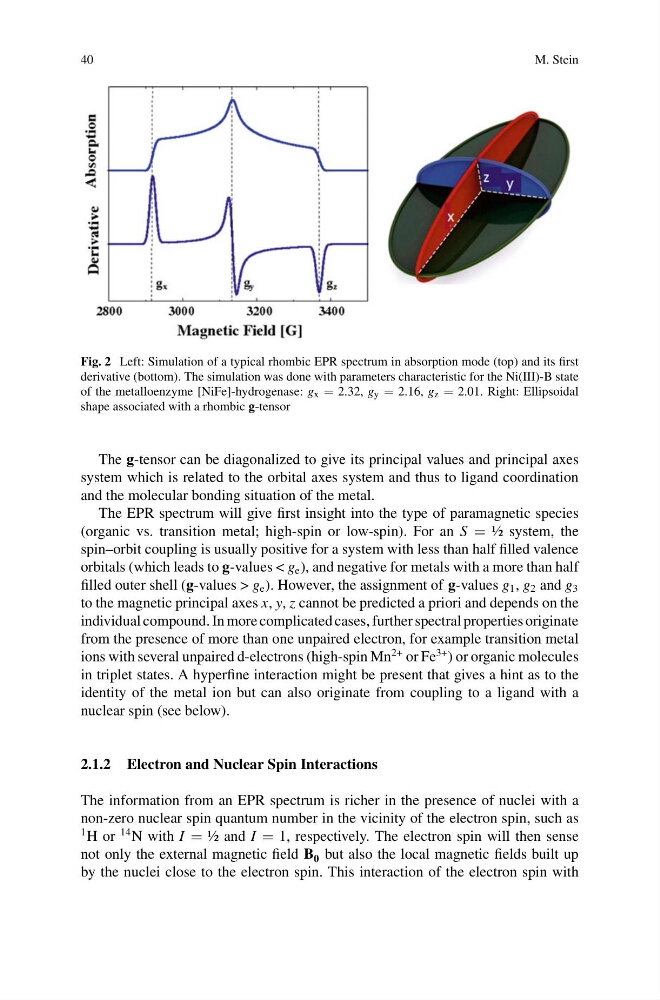
Fig. 2 Left: Simulation of a typical rhombic EPR spectrum in absorption mode (top) and its first
derivative (bottom). The simulation was done with parameters characteristic for the Ni(III)-B state
of the metalloenzyme [NiFe]-hydrogenase: g x 2.32, g y 2.16, g z 2.01. Right: Ellipsoidal
shape associated with a rhombic g-tensor
The g-tensor can be diagonalized to give its principal values and principal axes
system which is related to the orbital axes system and thus to ligand coordination
and the molecular bonding situation of the metal.
The EPR spectrum will give first insight into the type of paramagnetic species
(organic vs. transition metal; high-spin or low-spin). For an S ½ system, the
spin–orbit coupling is usually positive for a system with less than half filled valence
orbitals (which leads to g-values < g e ), and negative for metals with a more than half
filled outer shell (g-values > g e ). However, the assignment of g-values g 1 , g 2 and g 3
to the magnetic principal axes x, y, z cannot be predicted a priori and depends on the
individual compound. In more complicated cases, further spectral properties originate
from the presence of more than one unpaired electron, for example transition metal
ions with several unpaired d-electrons (high-spin Mn
2+ or Fe
3+ ) or organic molecules
in triplet states. A hyperfine interaction might be present that gives a hint as to the
identity of the metal ion but can also originate from coupling to a ligand with a
nuclear spin (see below).
2.1.2 Electron and Nuclear Spin Interactions
The information from an EPR spectrum is richer in the presence of nuclei with a
non-zero nuclear spin quantum number in the vicinity of the electron spin, such as
1 H or
14 N with I ½ and I 1, respectively. The electron spin will then sense
not only the external magnetic field B 0 but also the local magnetic fields built up
by the nuclei close to the electron spin. This interaction of the electron spin with
M. Stein
Fig. 2 Left: Simulation of a typical rhombic EPR spectrum in absorption mode (top) and its first
derivative (bottom). The simulation was done with parameters characteristic for the Ni(III)-B state
of the metalloenzyme [NiFe]-hydrogenase: g x 2.32, g y 2.16, g z 2.01. Right: Ellipsoidal
shape associated with a rhombic g-tensor
The g-tensor can be diagonalized to give its principal values and principal axes
system which is related to the orbital axes system and thus to ligand coordination
and the molecular bonding situation of the metal.
The EPR spectrum will give first insight into the type of paramagnetic species
(organic vs. transition metal; high-spin or low-spin). For an S ½ system, the
spin–orbit coupling is usually positive for a system with less than half filled valence
orbitals (which leads to g-values < g e ), and negative for metals with a more than half
filled outer shell (g-values > g e ). However, the assignment of g-values g 1 , g 2 and g 3
to the magnetic principal axes x, y, z cannot be predicted a priori and depends on the
individual compound. In more complicated cases, further spectral properties originate
from the presence of more than one unpaired electron, for example transition metal
ions with several unpaired d-electrons (high-spin Mn
2+ or Fe
3+ ) or organic molecules
in triplet states. A hyperfine interaction might be present that gives a hint as to the
identity of the metal ion but can also originate from coupling to a ligand with a
nuclear spin (see below).
2.1.2 Electron and Nuclear Spin Interactions
The information from an EPR spectrum is richer in the presence of nuclei with a
non-zero nuclear spin quantum number in the vicinity of the electron spin, such as
1 H or
14 N with I ½ and I 1, respectively. The electron spin will then sense
not only the external magnetic field B 0 but also the local magnetic fields built up
by the nuclei close to the electron spin. This interaction of the electron spin with