

Anisotropic Magnetic Spin Interactions of Transition Metal …
39
tation of measured EPR spectra is complicated and not straightforward (see below).
It allows the identification of the type of radical and an assignment of an oxidation
state but the electron-nuclear hyperfine interactions are richer in nature.
2.1.1 Isotropic and Anisotropic Electron Zeeman Interactions
In liquid solution, the rotational and translational motions of a paramagnetic molecule
average out and only the isotropic average of each tensor is relevant if there is
no hyperfine interaction with a nucleus of non-zero spin. Thus, the EPR spectrum
appears ‘isotropic’. In frozen solution, glassy environments or polycrystalline samples, the spectra are superpositions of many single-crystal-like spectra and their
analysis requires the introduction of anisotropic parameters. In single crystal EPR,
the various tensor components can be obtained separately.
The deviation of the g-values from that of the free electron g e is dependent on the
orbital angular momentum L, electron spin S, and the spin–orbit coupling (SOC).
This interaction is direction-dependent and thus the spectrum becomes anisotropic.
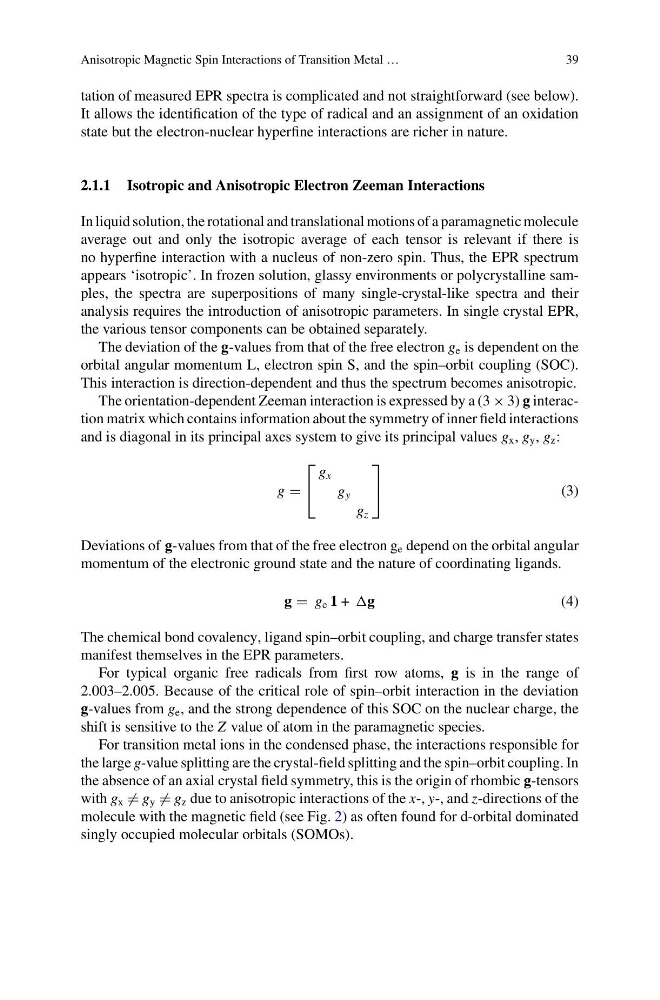
The orientation-dependent Zeeman interaction is expressed by a (3 × 3) g interaction matrix which contains information about the symmetry of inner field interactions
and is diagonal in its principal axes system to give its principal values g x , g y , g z :
g
⎡
⎣
g x
g y
g z
⎤
⎦
(3)
Deviations of g-values from that of the free electron g e depend on the orbital angular
momentum of the electronic ground state and the nature of coordinating ligands.
g g e 1 + g
(4)
The chemical bond covalency, ligand spin–orbit coupling, and charge transfer states
manifest themselves in the EPR parameters.
For typical organic free radicals from first row atoms, g is in the range of
2.003–2.005. Because of the critical role of spin–orbit interaction in the deviation
g-values from g e , and the strong dependence of this SOC on the nuclear charge, the
shift is sensitive to the Z value of atom in the paramagnetic species.
For transition metal ions in the condensed phase, the interactions responsible for
the large g-value splitting are the crystal-field splitting and the spin–orbit coupling. In
the absence of an axial crystal field symmetry, this is the origin of rhombic g-tensors
with g x g y g z due to anisotropic interactions of the x-, y-, and z-directions of the
molecule with the magnetic field (see Fig. 2) as often found for d-orbital dominated
singly occupied molecular orbitals (SOMOs).
39
tation of measured EPR spectra is complicated and not straightforward (see below).
It allows the identification of the type of radical and an assignment of an oxidation
state but the electron-nuclear hyperfine interactions are richer in nature.
2.1.1 Isotropic and Anisotropic Electron Zeeman Interactions
In liquid solution, the rotational and translational motions of a paramagnetic molecule
average out and only the isotropic average of each tensor is relevant if there is
no hyperfine interaction with a nucleus of non-zero spin. Thus, the EPR spectrum
appears ‘isotropic’. In frozen solution, glassy environments or polycrystalline samples, the spectra are superpositions of many single-crystal-like spectra and their
analysis requires the introduction of anisotropic parameters. In single crystal EPR,
the various tensor components can be obtained separately.
The deviation of the g-values from that of the free electron g e is dependent on the
orbital angular momentum L, electron spin S, and the spin–orbit coupling (SOC).
This interaction is direction-dependent and thus the spectrum becomes anisotropic.
The orientation-dependent Zeeman interaction is expressed by a (3 × 3) g interaction matrix which contains information about the symmetry of inner field interactions
and is diagonal in its principal axes system to give its principal values g x , g y , g z :
g
⎡
⎣
g x
g y
g z
⎤
⎦
(3)
Deviations of g-values from that of the free electron g e depend on the orbital angular
momentum of the electronic ground state and the nature of coordinating ligands.
g g e 1 + g
(4)
The chemical bond covalency, ligand spin–orbit coupling, and charge transfer states
manifest themselves in the EPR parameters.
For typical organic free radicals from first row atoms, g is in the range of
2.003–2.005. Because of the critical role of spin–orbit interaction in the deviation
g-values from g e , and the strong dependence of this SOC on the nuclear charge, the
shift is sensitive to the Z value of atom in the paramagnetic species.
For transition metal ions in the condensed phase, the interactions responsible for
the large g-value splitting are the crystal-field splitting and the spin–orbit coupling. In
the absence of an axial crystal field symmetry, this is the origin of rhombic g-tensors
with g x g y g z due to anisotropic interactions of the x-, y-, and z-directions of the
molecule with the magnetic field (see Fig. 2) as often found for d-orbital dominated
singly occupied molecular orbitals (SOMOs).