

38
M. Stein
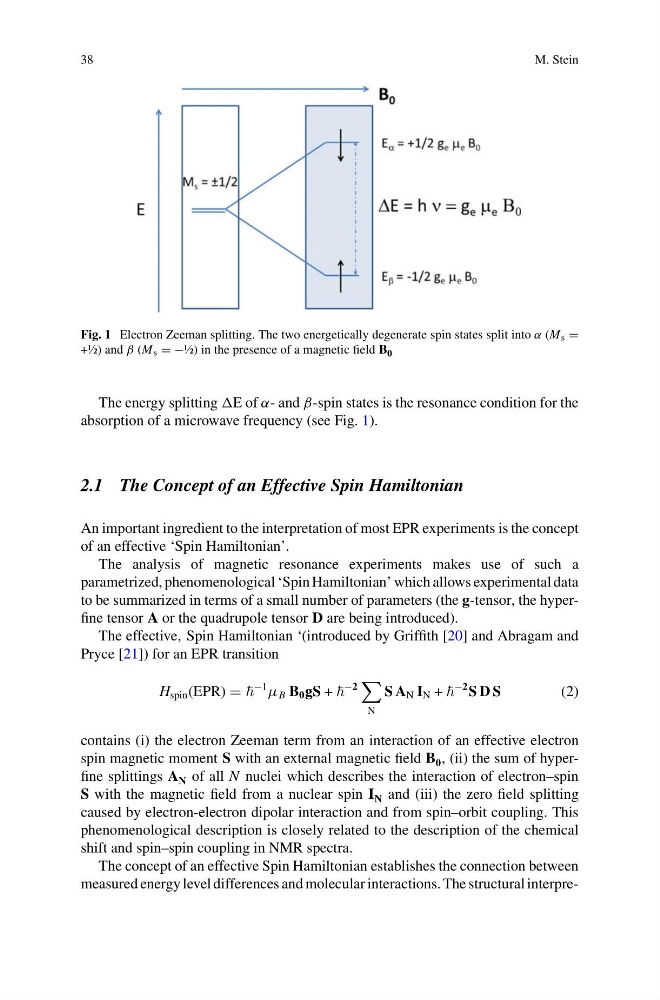
Fig. 1 Electron Zeeman splitting. The two energetically degenerate spin states split into α (M s
+½) and β (M s −½) in the presence of a magnetic field B 0
The energy splitting E of α- and β-spin states is the resonance condition for the
absorption of a microwave frequency (see Fig. 1).
2.1 The Concept of an Effective Spin Hamiltonian
An important ingredient to the interpretation of most EPR experiments is the concept
of an effective ‘Spin Hamiltonian’.
The analysis of magnetic resonance experiments makes use of such a
parametrized, phenomenological ‘Spin Hamiltonian’ which allows experimental data
to be summarized in terms of a small number of parameters (the g-tensor, the hyperfine tensor A or the quadrupole tensor D are being introduced).
The effective‚ Spin Hamiltonian ‘(introduced by Griffith [20] and Abragam and
Pryce [21]) for an EPR transition
H spin (EPR)
−1
μ B B 0 gS +
−2
N
S A N I N +
−2 S D S
(2)
contains (i) the electron Zeeman term from an interaction of an effective electron
spin magnetic moment S with an external magnetic field B 0 , (ii) the sum of hyperfine splittings A N of all N nuclei which describes the interaction of electron–spin
S with the magnetic field from a nuclear spin I N and (iii) the zero field splitting
caused by electron-electron dipolar interaction and from spin–orbit coupling. This
phenomenological description is closely related to the description of the chemical
shift and spin–spin coupling in NMR spectra.
The concept of an effective Spin Hamiltonian establishes the connection between
measured energy level differences and molecular interactions. The structural interpre-
M. Stein
Fig. 1 Electron Zeeman splitting. The two energetically degenerate spin states split into α (M s
+½) and β (M s −½) in the presence of a magnetic field B 0
The energy splitting E of α- and β-spin states is the resonance condition for the
absorption of a microwave frequency (see Fig. 1).
2.1 The Concept of an Effective Spin Hamiltonian
An important ingredient to the interpretation of most EPR experiments is the concept
of an effective ‘Spin Hamiltonian’.
The analysis of magnetic resonance experiments makes use of such a
parametrized, phenomenological ‘Spin Hamiltonian’ which allows experimental data
to be summarized in terms of a small number of parameters (the g-tensor, the hyperfine tensor A or the quadrupole tensor D are being introduced).
The effective‚ Spin Hamiltonian ‘(introduced by Griffith [20] and Abragam and
Pryce [21]) for an EPR transition
H spin (EPR)
−1
μ B B 0 gS +
−2
N
S A N I N +
−2 S D S
(2)
contains (i) the electron Zeeman term from an interaction of an effective electron
spin magnetic moment S with an external magnetic field B 0 , (ii) the sum of hyperfine splittings A N of all N nuclei which describes the interaction of electron–spin
S with the magnetic field from a nuclear spin I N and (iii) the zero field splitting
caused by electron-electron dipolar interaction and from spin–orbit coupling. This
phenomenological description is closely related to the description of the chemical
shift and spin–spin coupling in NMR spectra.
The concept of an effective Spin Hamiltonian establishes the connection between
measured energy level differences and molecular interactions. The structural interpre-