

Anisotropic Magnetic Spin Interactions of Transition Metal …
43
electron and nuclear spin dipole moments in a magnetic field and can thus be formulated in very similar ways.
The full quantum mechanical formulation of electron spin resonance is given
in the textbook by Harriman [22] and its reproduction is beyond the scope of this
chapter.
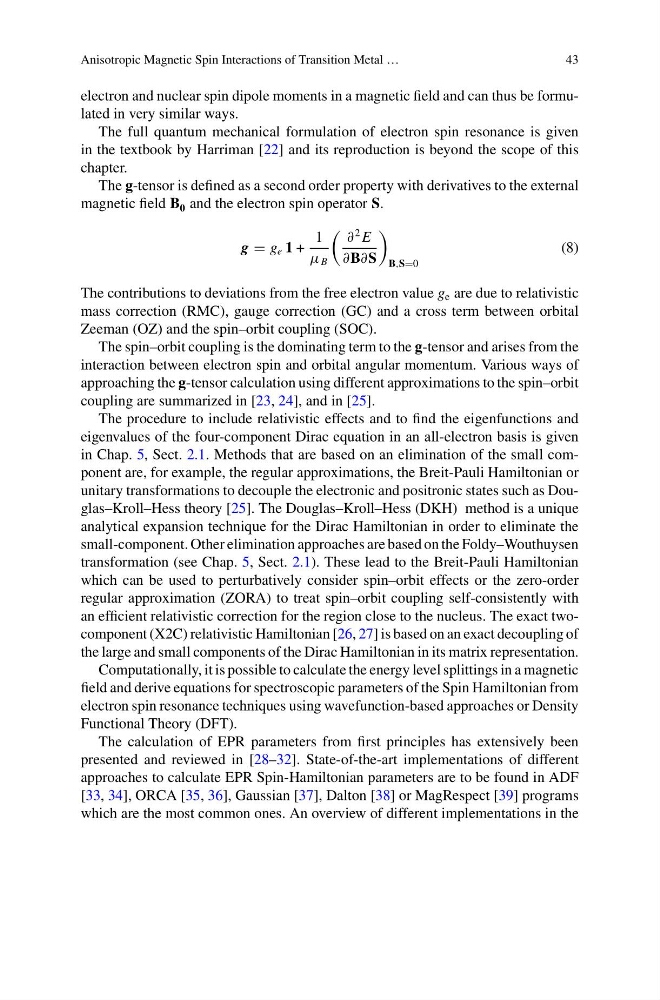
The g-tensor is defined as a second order property with derivatives to the external
magnetic field B 0 and the electron spin operator S.
g g e 1 +
1
μ B
∂
2 E
∂B∂S
B,S0
(8)
The contributions to deviations from the free electron value g e are due to relativistic
mass correction (RMC), gauge correction (GC) and a cross term between orbital
Zeeman (OZ) and the spin–orbit coupling (SOC).
The spin–orbit coupling is the dominating term to the g-tensor and arises from the
interaction between electron spin and orbital angular momentum. Various ways of
approaching the g-tensor calculation using different approximations to the spin–orbit
coupling are summarized in [23, 24], and in [25].
The procedure to include relativistic effects and to find the eigenfunctions and
eigenvalues of the four-component Dirac equation in an all-electron basis is given
in Chap. 5, Sect. 2.1. Methods that are based on an elimination of the small component are, for example, the regular approximations, the Breit-Pauli Hamiltonian or
unitary transformations to decouple the electronic and positronic states such as Douglas–Kroll–Hess theory [25]. The Douglas–Kroll–Hess (DKH) method is a unique
analytical expansion technique for the Dirac Hamiltonian in order to eliminate the
small-component. Other elimination approaches are based on the Foldy–Wouthuysen
transformation (see Chap. 5, Sect. 2.1). These lead to the Breit-Pauli Hamiltonian
which can be used to perturbatively consider spin–orbit effects or the zero-order
regular approximation (ZORA) to treat spin–orbit coupling self-consistently with
an efficient relativistic correction for the region close to the nucleus. The exact twocomponent (X2C) relativistic Hamiltonian [26, 27] is based on an exact decoupling of
the large and small components of the Dirac Hamiltonian in its matrix representation.
Computationally, it is possible to calculate the energy level splittings in a magnetic
field and derive equations for spectroscopic parameters of the Spin Hamiltonian from
electron spin resonance techniques using wavefunction-based approaches or Density
Functional Theory (DFT).
The calculation of EPR parameters from first principles has extensively been
presented and reviewed in [28–32]. State-of-the-art implementations of different
approaches to calculate EPR Spin-Hamiltonian parameters are to be found in ADF
[33, 34], ORCA [35, 36], Gaussian [37], Dalton [38] or MagRespect [39] programs
which are the most common ones. An overview of different implementations in the
43
electron and nuclear spin dipole moments in a magnetic field and can thus be formulated in very similar ways.
The full quantum mechanical formulation of electron spin resonance is given
in the textbook by Harriman [22] and its reproduction is beyond the scope of this
chapter.
The g-tensor is defined as a second order property with derivatives to the external
magnetic field B 0 and the electron spin operator S.
g g e 1 +
1
μ B
∂
2 E
∂B∂S
B,S0
(8)
The contributions to deviations from the free electron value g e are due to relativistic
mass correction (RMC), gauge correction (GC) and a cross term between orbital
Zeeman (OZ) and the spin–orbit coupling (SOC).
The spin–orbit coupling is the dominating term to the g-tensor and arises from the
interaction between electron spin and orbital angular momentum. Various ways of
approaching the g-tensor calculation using different approximations to the spin–orbit
coupling are summarized in [23, 24], and in [25].
The procedure to include relativistic effects and to find the eigenfunctions and
eigenvalues of the four-component Dirac equation in an all-electron basis is given
in Chap. 5, Sect. 2.1. Methods that are based on an elimination of the small component are, for example, the regular approximations, the Breit-Pauli Hamiltonian or
unitary transformations to decouple the electronic and positronic states such as Douglas–Kroll–Hess theory [25]. The Douglas–Kroll–Hess (DKH) method is a unique
analytical expansion technique for the Dirac Hamiltonian in order to eliminate the
small-component. Other elimination approaches are based on the Foldy–Wouthuysen
transformation (see Chap. 5, Sect. 2.1). These lead to the Breit-Pauli Hamiltonian
which can be used to perturbatively consider spin–orbit effects or the zero-order
regular approximation (ZORA) to treat spin–orbit coupling self-consistently with
an efficient relativistic correction for the region close to the nucleus. The exact twocomponent (X2C) relativistic Hamiltonian [26, 27] is based on an exact decoupling of
the large and small components of the Dirac Hamiltonian in its matrix representation.
Computationally, it is possible to calculate the energy level splittings in a magnetic
field and derive equations for spectroscopic parameters of the Spin Hamiltonian from
electron spin resonance techniques using wavefunction-based approaches or Density
Functional Theory (DFT).
The calculation of EPR parameters from first principles has extensively been
presented and reviewed in [28–32]. State-of-the-art implementations of different
approaches to calculate EPR Spin-Hamiltonian parameters are to be found in ADF
[33, 34], ORCA [35, 36], Gaussian [37], Dalton [38] or MagRespect [39] programs
which are the most common ones. An overview of different implementations in the