

494
T. Marinoet al.
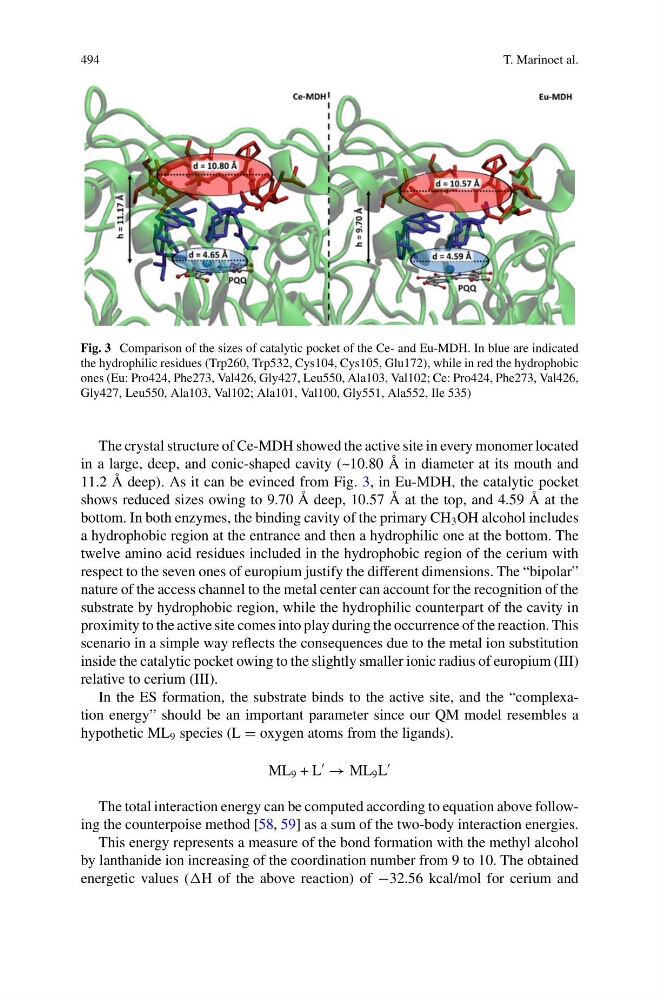
Fig. 3 Comparison of the sizes of catalytic pocket of the Ce- and Eu-MDH. In blue are indicated
the hydrophilic residues (Trp260, Trp532, Cys104, Cys105, Glu172), while in red the hydrophobic
ones (Eu: Pro424, Phe273, Val426, Gly427, Leu550, Ala103, Val102; Ce: Pro424, Phe273, Val426,
Gly427, Leu550, Ala103, Val102; Ala101, Val100, Gly551, Ala552, Ile 535)
The crystal structure of Ce-MDH showed the active site in every monomer located
in a large, deep, and conic-shaped cavity (~10.80 Å in diameter at its mouth and
11.2 Å deep). As it can be evinced from Fig. 3, in Eu-MDH, the catalytic pocket
shows reduced sizes owing to 9.70 Å deep, 10.57 Å at the top, and 4.59 Å at the
bottom. In both enzymes, the binding cavity of the primary CH 3 OH alcohol includes
a hydrophobic region at the entrance and then a hydrophilic one at the bottom. The
twelve amino acid residues included in the hydrophobic region of the cerium with
respect to the seven ones of europium justify the different dimensions. The “bipolar”
nature of the access channel to the metal center can account for the recognition of the
substrate by hydrophobic region, while the hydrophilic counterpart of the cavity in
proximity to the active site comes into play during the occurrence of the reaction. This
scenario in a simple way reflects the consequences due to the metal ion substitution
inside the catalytic pocket owing to the slightly smaller ionic radius of europium (III)
relative to cerium (III).
In the ES formation, the substrate binds to the active site, and the “complexation energy” should be an important parameter since our QM model resembles a
hypothetic ML 9 species (L oxygen atoms from the ligands).
ML 9 + L
→ ML 9 L
The total interaction energy can be computed according to equation above following the counterpoise method [58, 59] as a sum of the two-body interaction energies.
This energy represents a measure of the bond formation with the methyl alcohol
by lanthanide ion increasing of the coordination number from 9 to 10. The obtained
energetic values (H of the above reaction) of −32.56 kcal/mol for cerium and
T. Marinoet al.
Fig. 3 Comparison of the sizes of catalytic pocket of the Ce- and Eu-MDH. In blue are indicated
the hydrophilic residues (Trp260, Trp532, Cys104, Cys105, Glu172), while in red the hydrophobic
ones (Eu: Pro424, Phe273, Val426, Gly427, Leu550, Ala103, Val102; Ce: Pro424, Phe273, Val426,
Gly427, Leu550, Ala103, Val102; Ala101, Val100, Gly551, Ala552, Ile 535)
The crystal structure of Ce-MDH showed the active site in every monomer located
in a large, deep, and conic-shaped cavity (~10.80 Å in diameter at its mouth and
11.2 Å deep). As it can be evinced from Fig. 3, in Eu-MDH, the catalytic pocket
shows reduced sizes owing to 9.70 Å deep, 10.57 Å at the top, and 4.59 Å at the
bottom. In both enzymes, the binding cavity of the primary CH 3 OH alcohol includes
a hydrophobic region at the entrance and then a hydrophilic one at the bottom. The
twelve amino acid residues included in the hydrophobic region of the cerium with
respect to the seven ones of europium justify the different dimensions. The “bipolar”
nature of the access channel to the metal center can account for the recognition of the
substrate by hydrophobic region, while the hydrophilic counterpart of the cavity in
proximity to the active site comes into play during the occurrence of the reaction. This
scenario in a simple way reflects the consequences due to the metal ion substitution
inside the catalytic pocket owing to the slightly smaller ionic radius of europium (III)
relative to cerium (III).
In the ES formation, the substrate binds to the active site, and the “complexation energy” should be an important parameter since our QM model resembles a
hypothetic ML 9 species (L oxygen atoms from the ligands).
ML 9 + L
→ ML 9 L
The total interaction energy can be computed according to equation above following the counterpoise method [58, 59] as a sum of the two-body interaction energies.
This energy represents a measure of the bond formation with the methyl alcohol
by lanthanide ion increasing of the coordination number from 9 to 10. The obtained
energetic values (H of the above reaction) of −32.56 kcal/mol for cerium and