

How Metal Coordination in the Ca-, Ce- and Eu-Containing …
493
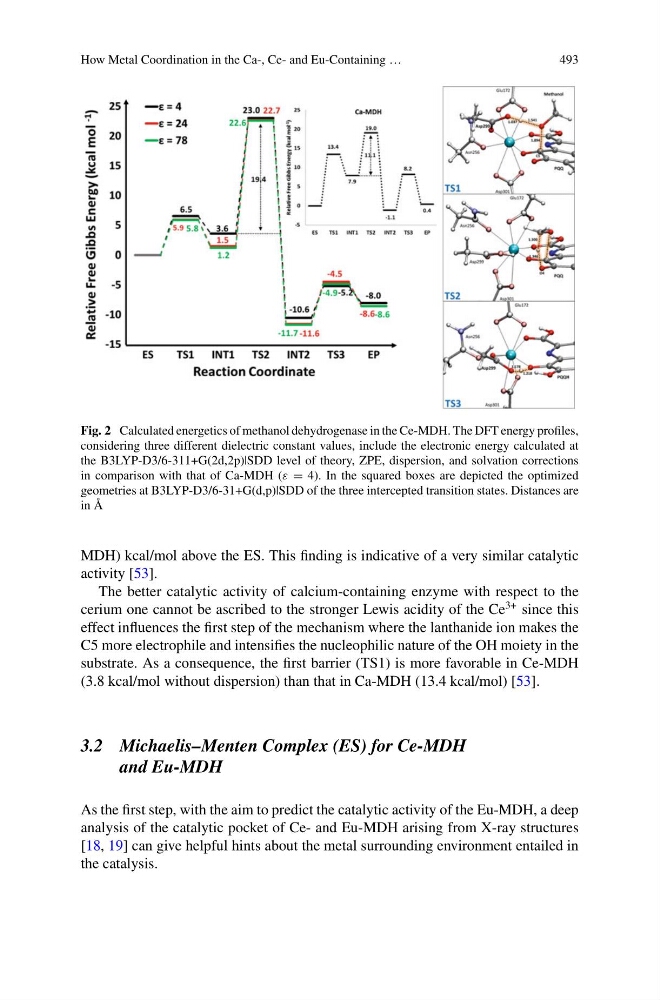
Fig. 2 Calculated energetics of methanol dehydrogenase in the Ce-MDH. The DFT energy profiles,
considering three different dielectric constant values, include the electronic energy calculated at
the B3LYP-D3/6-311+G(2d,2p)|SDD level of theory, ZPE, dispersion, and solvation corrections
in comparison with that of Ca-MDH (ε 4). In the squared boxes are depicted the optimized
geometries at B3LYP-D3/6-31+G(d,p)|SDD of the three intercepted transition states. Distances are
in Å
MDH) kcal/mol above the ES. This finding is indicative of a very similar catalytic
activity [53].
The better catalytic activity of calcium-containing enzyme with respect to the
cerium one cannot be ascribed to the stronger Lewis acidity of the Ce
3+ since this
effect influences the first step of the mechanism where the lanthanide ion makes the
C5 more electrophile and intensifies the nucleophilic nature of the OH moiety in the
substrate. As a consequence, the first barrier (TS1) is more favorable in Ce-MDH
(3.8 kcal/mol without dispersion) than that in Ca-MDH (13.4 kcal/mol) [53].
3.2 Michaelis–Menten Complex (ES) for Ce-MDH
and Eu-MDH
As the first step, with the aim to predict the catalytic activity of the Eu-MDH, a deep
analysis of the catalytic pocket of Ce- and Eu-MDH arising from X-ray structures
[18, 19] can give helpful hints about the metal surrounding environment entailed in
the catalysis.
493
Fig. 2 Calculated energetics of methanol dehydrogenase in the Ce-MDH. The DFT energy profiles,
considering three different dielectric constant values, include the electronic energy calculated at
the B3LYP-D3/6-311+G(2d,2p)|SDD level of theory, ZPE, dispersion, and solvation corrections
in comparison with that of Ca-MDH (ε 4). In the squared boxes are depicted the optimized
geometries at B3LYP-D3/6-31+G(d,p)|SDD of the three intercepted transition states. Distances are
in Å
MDH) kcal/mol above the ES. This finding is indicative of a very similar catalytic
activity [53].
The better catalytic activity of calcium-containing enzyme with respect to the
cerium one cannot be ascribed to the stronger Lewis acidity of the Ce
3+ since this
effect influences the first step of the mechanism where the lanthanide ion makes the
C5 more electrophile and intensifies the nucleophilic nature of the OH moiety in the
substrate. As a consequence, the first barrier (TS1) is more favorable in Ce-MDH
(3.8 kcal/mol without dispersion) than that in Ca-MDH (13.4 kcal/mol) [53].
3.2 Michaelis–Menten Complex (ES) for Ce-MDH
and Eu-MDH
As the first step, with the aim to predict the catalytic activity of the Eu-MDH, a deep
analysis of the catalytic pocket of Ce- and Eu-MDH arising from X-ray structures
[18, 19] can give helpful hints about the metal surrounding environment entailed in
the catalysis.