

492
T. Marinoet al.
The results shown in Fig. 2 clearly show the absence of relevant effects in both
minima and transition states as a function of the dielectric constants. Only in the case
of the INT1 species, a major stabilization, by few kcal/mol, can be observed. This
behavior can be ascribed to the fact that the INT1 species is the result of a series of
rearrangements accomplished by different charge distributions. The absence of large
solvent effects is usually related to the “completeness” of the QM selected model
that already explicitly includes most of the polarization effects. The rate determining
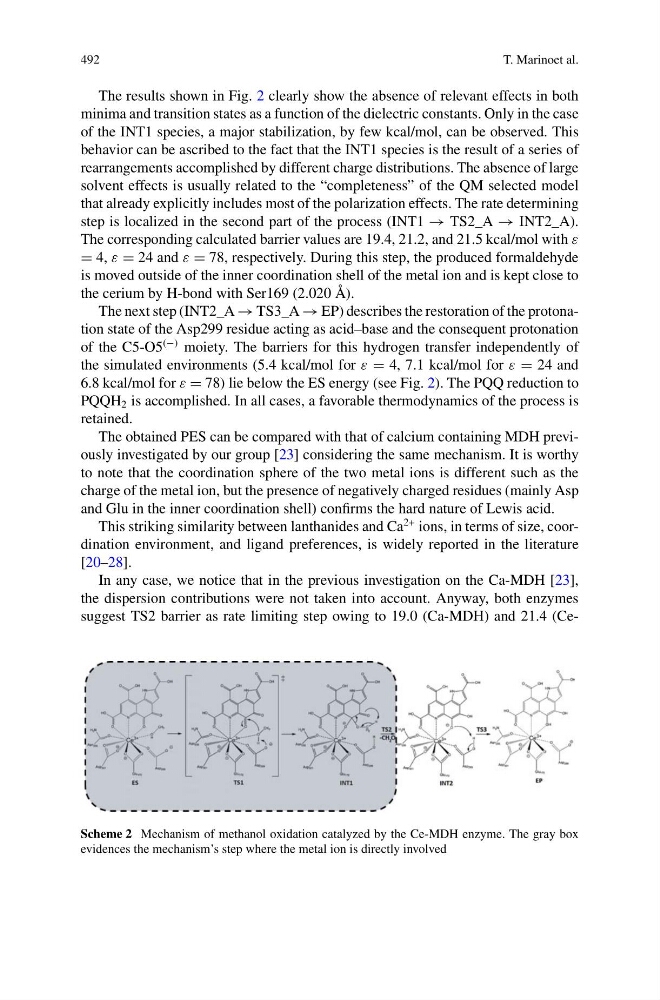
step is localized in the second part of the process (INT1 → TS2_A → INT2_A).
The corresponding calculated barrier values are 19.4, 21.2, and 21.5 kcal/mol with ε
4, ε 24 and ε 78, respectively. During this step, the produced formaldehyde
is moved outside of the inner coordination shell of the metal ion and is kept close to
the cerium by H-bond with Ser169 (2.020 Å).
The next step (INT2_A → TS3_A → EP) describes the restoration of the protonation state of the Asp299 residue acting as acid–base and the consequent protonation
of the C5-O5
(−) moiety. The barriers for this hydrogen transfer independently of
the simulated environments (5.4 kcal/mol for ε 4, 7.1 kcal/mol for ε 24 and
6.8 kcal/mol for ε 78) lie below the ES energy (see Fig. 2). The PQQ reduction to
PQQH 2 is accomplished. In all cases, a favorable thermodynamics of the process is
retained.
The obtained PES can be compared with that of calcium containing MDH previously investigated by our group [23] considering the same mechanism. It is worthy
to note that the coordination sphere of the two metal ions is different such as the
charge of the metal ion, but the presence of negatively charged residues (mainly Asp
and Glu in the inner coordination shell) confirms the hard nature of Lewis acid.
This striking similarity between lanthanides and Ca
2+ ions, in terms of size, coordination environment, and ligand preferences, is widely reported in the literature
[20–28].
In any case, we notice that in the previous investigation on the Ca-MDH [23],
the dispersion contributions were not taken into account. Anyway, both enzymes
suggest TS2 barrier as rate limiting step owing to 19.0 (Ca-MDH) and 21.4 (CeScheme 2 Mechanism of methanol oxidation catalyzed by the Ce-MDH enzyme. The gray box
evidences the mechanism’s step where the metal ion is directly involved
T. Marinoet al.
The results shown in Fig. 2 clearly show the absence of relevant effects in both
minima and transition states as a function of the dielectric constants. Only in the case
of the INT1 species, a major stabilization, by few kcal/mol, can be observed. This
behavior can be ascribed to the fact that the INT1 species is the result of a series of
rearrangements accomplished by different charge distributions. The absence of large
solvent effects is usually related to the “completeness” of the QM selected model
that already explicitly includes most of the polarization effects. The rate determining
step is localized in the second part of the process (INT1 → TS2_A → INT2_A).
The corresponding calculated barrier values are 19.4, 21.2, and 21.5 kcal/mol with ε
4, ε 24 and ε 78, respectively. During this step, the produced formaldehyde
is moved outside of the inner coordination shell of the metal ion and is kept close to
the cerium by H-bond with Ser169 (2.020 Å).
The next step (INT2_A → TS3_A → EP) describes the restoration of the protonation state of the Asp299 residue acting as acid–base and the consequent protonation
of the C5-O5
(−) moiety. The barriers for this hydrogen transfer independently of
the simulated environments (5.4 kcal/mol for ε 4, 7.1 kcal/mol for ε 24 and
6.8 kcal/mol for ε 78) lie below the ES energy (see Fig. 2). The PQQ reduction to
PQQH 2 is accomplished. In all cases, a favorable thermodynamics of the process is
retained.
The obtained PES can be compared with that of calcium containing MDH previously investigated by our group [23] considering the same mechanism. It is worthy
to note that the coordination sphere of the two metal ions is different such as the
charge of the metal ion, but the presence of negatively charged residues (mainly Asp
and Glu in the inner coordination shell) confirms the hard nature of Lewis acid.
This striking similarity between lanthanides and Ca
2+ ions, in terms of size, coordination environment, and ligand preferences, is widely reported in the literature
[20–28].
In any case, we notice that in the previous investigation on the Ca-MDH [23],
the dispersion contributions were not taken into account. Anyway, both enzymes
suggest TS2 barrier as rate limiting step owing to 19.0 (Ca-MDH) and 21.4 (CeScheme 2 Mechanism of methanol oxidation catalyzed by the Ce-MDH enzyme. The gray box
evidences the mechanism’s step where the metal ion is directly involved