

476
H. Hirao
Mo
O
S
S
O
S
C N
Cu
S
n-Bu
(b)
(c)
Mo
O
S
S
O
S
C O
Cu
S
Mo
O
S
S
O
S Cu S
(a)
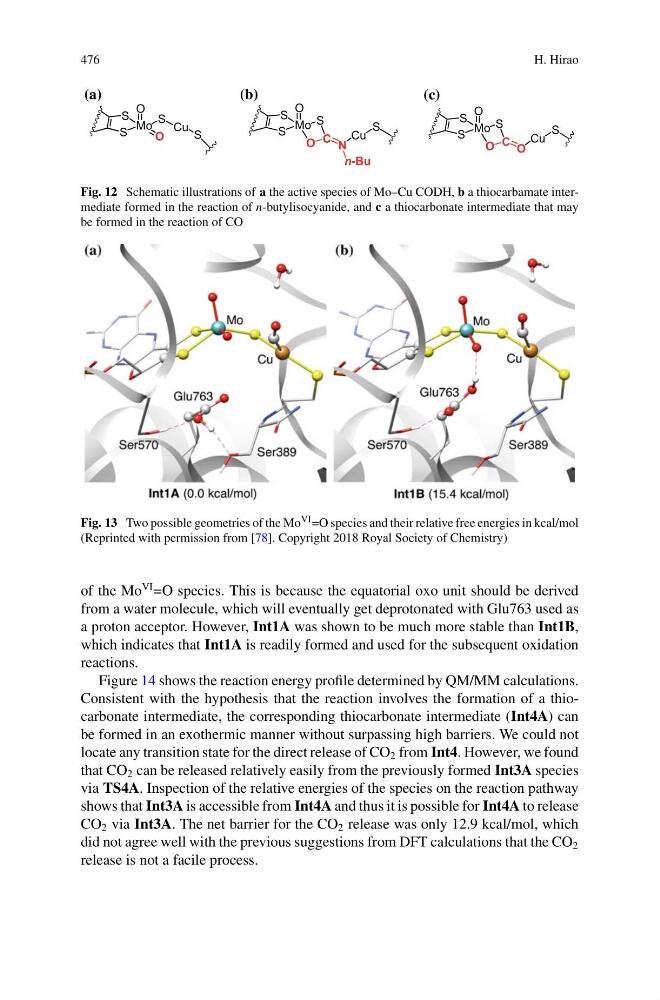
Fig. 12 Schematic illustrations of a the active species of Mo–Cu CODH, b a thiocarbamate intermediate formed in the reaction of n-butylisocyanide, and c a thiocarbonate intermediate that may
be formed in the reaction of CO
Fig. 13 Two possible geometries of the Mo VI =O species and their relative free energies in kcal/mol
(Reprinted with permission from [78]. Copyright 2018 Royal Society of Chemistry)
of the Mo
VI =O species. This is because the equatorial oxo unit should be derived
from a water molecule, which will eventually get deprotonated with Glu763 used as
a proton acceptor. However, Int1A was shown to be much more stable than Int1B,
which indicates that Int1A is readily formed and used for the subsequent oxidation
reactions.
Figure 14 shows the reaction energy profile determined by QM/MM calculations.
Consistent with the hypothesis that the reaction involves the formation of a thiocarbonate intermediate, the corresponding thiocarbonate intermediate (Int4A) can
be formed in an exothermic manner without surpassing high barriers. We could not
locate any transition state for the direct release of CO 2 from Int4. However, we found
that CO 2 can be released relatively easily from the previously formed Int3A species
via TS4A. Inspection of the relative energies of the species on the reaction pathway
shows that Int3A is accessible from Int4A and thus it is possible for Int4A to release
CO 2 via Int3A. The net barrier for the CO 2 release was only 12.9 kcal/mol, which
did not agree well with the previous suggestions from DFT calculations that the CO 2
release is not a facile process.
H. Hirao
Mo
O
S
S
O
S
C N
Cu
S
n-Bu
(b)
(c)
Mo
O
S
S
O
S
C O
Cu
S
Mo
O
S
S
O
S Cu S
(a)
Fig. 12 Schematic illustrations of a the active species of Mo–Cu CODH, b a thiocarbamate intermediate formed in the reaction of n-butylisocyanide, and c a thiocarbonate intermediate that may
be formed in the reaction of CO
Fig. 13 Two possible geometries of the Mo VI =O species and their relative free energies in kcal/mol
(Reprinted with permission from [78]. Copyright 2018 Royal Society of Chemistry)
of the Mo
VI =O species. This is because the equatorial oxo unit should be derived
from a water molecule, which will eventually get deprotonated with Glu763 used as
a proton acceptor. However, Int1A was shown to be much more stable than Int1B,
which indicates that Int1A is readily formed and used for the subsequent oxidation
reactions.
Figure 14 shows the reaction energy profile determined by QM/MM calculations.
Consistent with the hypothesis that the reaction involves the formation of a thiocarbonate intermediate, the corresponding thiocarbonate intermediate (Int4A) can
be formed in an exothermic manner without surpassing high barriers. We could not
locate any transition state for the direct release of CO 2 from Int4. However, we found
that CO 2 can be released relatively easily from the previously formed Int3A species
via TS4A. Inspection of the relative energies of the species on the reaction pathway
shows that Int3A is accessible from Int4A and thus it is possible for Int4A to release
CO 2 via Int3A. The net barrier for the CO 2 release was only 12.9 kcal/mol, which
did not agree well with the previous suggestions from DFT calculations that the CO 2
release is not a facile process.