

Applications of Computational Chemistry to Selected Problems …
477
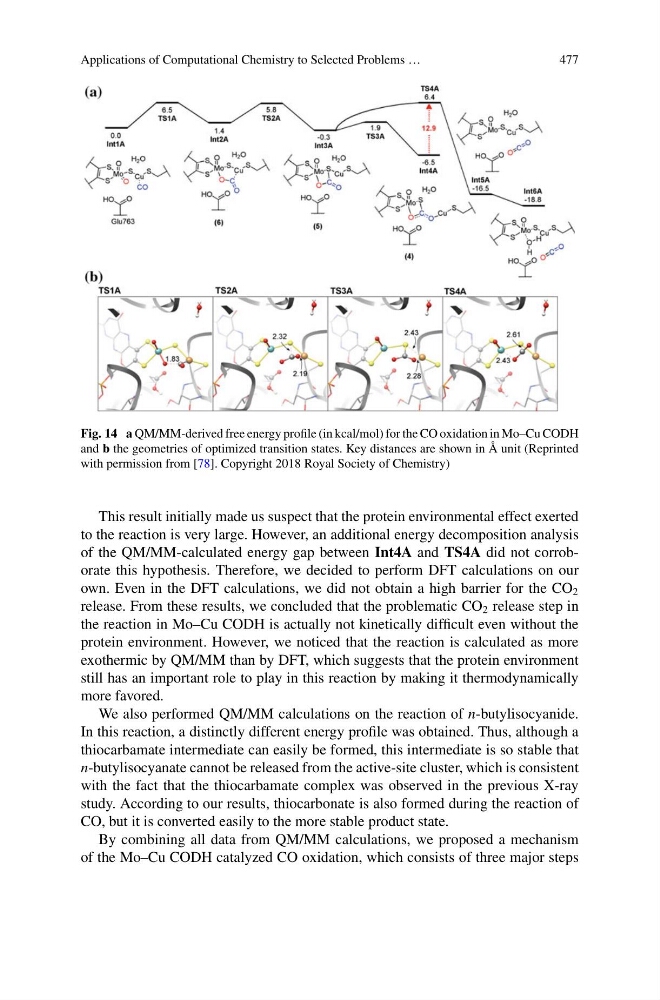
Fig. 14 a QM/MM-derived free energy profile (in kcal/mol) for the CO oxidation in Mo–Cu CODH
and b the geometries of optimized transition states. Key distances are shown in Å unit (Reprinted
with permission from [78]. Copyright 2018 Royal Society of Chemistry)
This result initially made us suspect that the protein environmental effect exerted
to the reaction is very large. However, an additional energy decomposition analysis
of the QM/MM-calculated energy gap between Int4A and TS4A did not corroborate this hypothesis. Therefore, we decided to perform DFT calculations on our
own. Even in the DFT calculations, we did not obtain a high barrier for the CO 2
release. From these results, we concluded that the problematic CO 2 release step in
the reaction in Mo–Cu CODH is actually not kinetically difficult even without the
protein environment. However, we noticed that the reaction is calculated as more
exothermic by QM/MM than by DFT, which suggests that the protein environment
still has an important role to play in this reaction by making it thermodynamically
more favored.
We also performed QM/MM calculations on the reaction of n-butylisocyanide.
In this reaction, a distinctly different energy profile was obtained. Thus, although a
thiocarbamate intermediate can easily be formed, this intermediate is so stable that
n-butylisocyanate cannot be released from the active-site cluster, which is consistent
with the fact that the thiocarbamate complex was observed in the previous X-ray
study. According to our results, thiocarbonate is also formed during the reaction of
CO, but it is converted easily to the more stable product state.
By combining all data from QM/MM calculations, we proposed a mechanism
of the Mo–Cu CODH catalyzed CO oxidation, which consists of three major steps
477
Fig. 14 a QM/MM-derived free energy profile (in kcal/mol) for the CO oxidation in Mo–Cu CODH
and b the geometries of optimized transition states. Key distances are shown in Å unit (Reprinted
with permission from [78]. Copyright 2018 Royal Society of Chemistry)
This result initially made us suspect that the protein environmental effect exerted
to the reaction is very large. However, an additional energy decomposition analysis
of the QM/MM-calculated energy gap between Int4A and TS4A did not corroborate this hypothesis. Therefore, we decided to perform DFT calculations on our
own. Even in the DFT calculations, we did not obtain a high barrier for the CO 2
release. From these results, we concluded that the problematic CO 2 release step in
the reaction in Mo–Cu CODH is actually not kinetically difficult even without the
protein environment. However, we noticed that the reaction is calculated as more
exothermic by QM/MM than by DFT, which suggests that the protein environment
still has an important role to play in this reaction by making it thermodynamically
more favored.
We also performed QM/MM calculations on the reaction of n-butylisocyanide.
In this reaction, a distinctly different energy profile was obtained. Thus, although a
thiocarbamate intermediate can easily be formed, this intermediate is so stable that
n-butylisocyanate cannot be released from the active-site cluster, which is consistent
with the fact that the thiocarbamate complex was observed in the previous X-ray
study. According to our results, thiocarbonate is also formed during the reaction of
CO, but it is converted easily to the more stable product state.
By combining all data from QM/MM calculations, we proposed a mechanism
of the Mo–Cu CODH catalyzed CO oxidation, which consists of three major steps