

Applications of Computational Chemistry to Selected Problems …
467
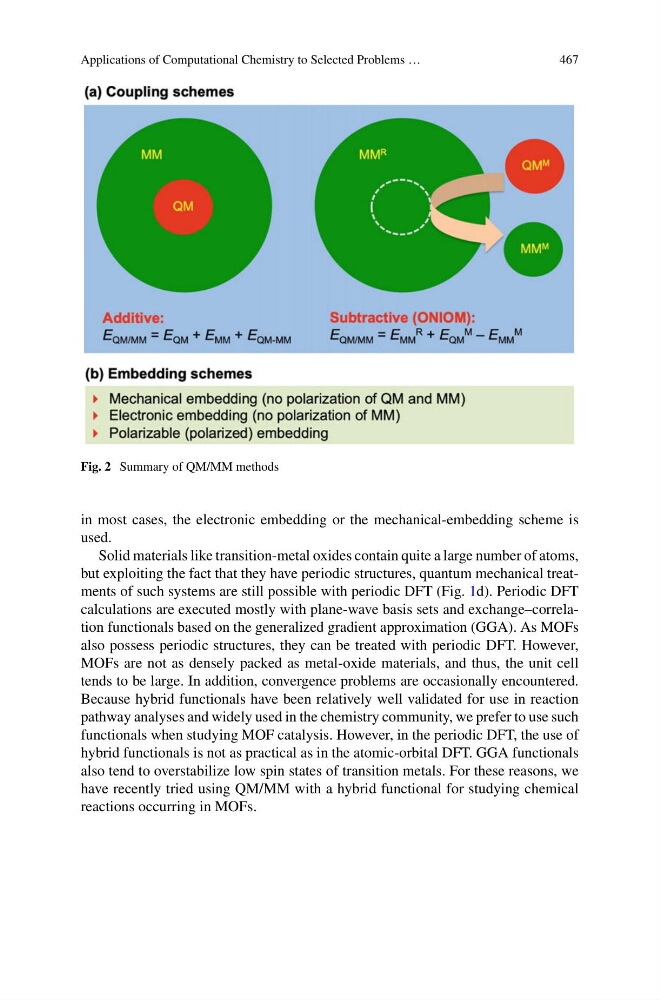
Fig. 2 Summary of QM/MM methods
in most cases, the electronic embedding or the mechanical-embedding scheme is
used.
Solid materials like transition-metal oxides contain quite a large number of atoms,
but exploiting the fact that they have periodic structures, quantum mechanical treatments of such systems are still possible with periodic DFT (Fig. 1d). Periodic DFT
calculations are executed mostly with plane-wave basis sets and exchange–correlation functionals based on the generalized gradient approximation (GGA). As MOFs
also possess periodic structures, they can be treated with periodic DFT. However,
MOFs are not as densely packed as metal-oxide materials, and thus, the unit cell
tends to be large. In addition, convergence problems are occasionally encountered.
Because hybrid functionals have been relatively well validated for use in reaction
pathway analyses and widely used in the chemistry community, we prefer to use such
functionals when studying MOF catalysis. However, in the periodic DFT, the use of
hybrid functionals is not as practical as in the atomic-orbital DFT. GGA functionals
also tend to overstabilize low spin states of transition metals. For these reasons, we
have recently tried using QM/MM with a hybrid functional for studying chemical
reactions occurring in MOFs.
467
Fig. 2 Summary of QM/MM methods
in most cases, the electronic embedding or the mechanical-embedding scheme is
used.
Solid materials like transition-metal oxides contain quite a large number of atoms,
but exploiting the fact that they have periodic structures, quantum mechanical treatments of such systems are still possible with periodic DFT (Fig. 1d). Periodic DFT
calculations are executed mostly with plane-wave basis sets and exchange–correlation functionals based on the generalized gradient approximation (GGA). As MOFs
also possess periodic structures, they can be treated with periodic DFT. However,
MOFs are not as densely packed as metal-oxide materials, and thus, the unit cell
tends to be large. In addition, convergence problems are occasionally encountered.
Because hybrid functionals have been relatively well validated for use in reaction
pathway analyses and widely used in the chemistry community, we prefer to use such
functionals when studying MOF catalysis. However, in the periodic DFT, the use of
hybrid functionals is not as practical as in the atomic-orbital DFT. GGA functionals
also tend to overstabilize low spin states of transition metals. For these reasons, we
have recently tried using QM/MM with a hybrid functional for studying chemical
reactions occurring in MOFs.