

468
H. Hirao
3 Studies of Transition-Metal Complexes for Homogeneous
Catalysis
3.1 DFT Studies of Reaction Pathways in the Ground State
Fortunately, homogeneous transition-metal catalysts usually do not contain too many
atoms, and then full DFT descriptions are possible in many cases. So far, we have
applied DFT to a wide range of transition-metal-catalyzed reactions. Although many
impressive homogeneous catalytic systems have already been developed, precious
metals are often used to induce satisfactory catalytic activities. From a sustainable
chemistry perspective, replacement of precious metals in catalysts with base metals
is highly desired in the future, and we believe that DFT calculations play integral
roles in such efforts.
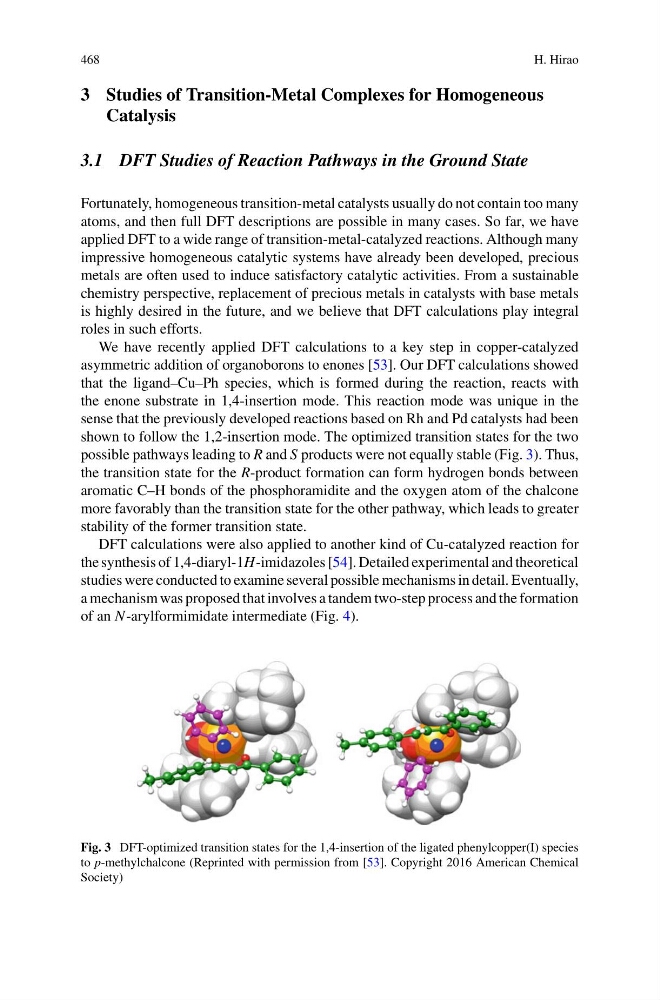
We have recently applied DFT calculations to a key step in copper-catalyzed
asymmetric addition of organoborons to enones [53]. Our DFT calculations showed
that the ligand–Cu–Ph species, which is formed during the reaction, reacts with
the enone substrate in 1,4-insertion mode. This reaction mode was unique in the
sense that the previously developed reactions based on Rh and Pd catalysts had been
shown to follow the 1,2-insertion mode. The optimized transition states for the two
possible pathways leading to R and S products were not equally stable (Fig. 3). Thus,
the transition state for the R-product formation can form hydrogen bonds between
aromatic C–H bonds of the phosphoramidite and the oxygen atom of the chalcone
more favorably than the transition state for the other pathway, which leads to greater
stability of the former transition state.
DFT calculations were also applied to another kind of Cu-catalyzed reaction for
the synthesis of 1,4-diaryl-1H-imidazoles [54]. Detailed experimental and theoretical
studies were conducted to examine several possible mechanisms in detail. Eventually,
a mechanism was proposed that involves a tandem two-step process and the formation
of an N-arylformimidate intermediate (Fig. 4).
Fig. 3 DFT-optimized transition states for the 1,4-insertion of the ligated phenylcopper(I) species
to p-methylchalcone (Reprinted with permission from [53]. Copyright 2016 American Chemical
Society)
H. Hirao
3 Studies of Transition-Metal Complexes for Homogeneous
Catalysis
3.1 DFT Studies of Reaction Pathways in the Ground State
Fortunately, homogeneous transition-metal catalysts usually do not contain too many
atoms, and then full DFT descriptions are possible in many cases. So far, we have
applied DFT to a wide range of transition-metal-catalyzed reactions. Although many
impressive homogeneous catalytic systems have already been developed, precious
metals are often used to induce satisfactory catalytic activities. From a sustainable
chemistry perspective, replacement of precious metals in catalysts with base metals
is highly desired in the future, and we believe that DFT calculations play integral
roles in such efforts.
We have recently applied DFT calculations to a key step in copper-catalyzed
asymmetric addition of organoborons to enones [53]. Our DFT calculations showed
that the ligand–Cu–Ph species, which is formed during the reaction, reacts with
the enone substrate in 1,4-insertion mode. This reaction mode was unique in the
sense that the previously developed reactions based on Rh and Pd catalysts had been
shown to follow the 1,2-insertion mode. The optimized transition states for the two
possible pathways leading to R and S products were not equally stable (Fig. 3). Thus,
the transition state for the R-product formation can form hydrogen bonds between
aromatic C–H bonds of the phosphoramidite and the oxygen atom of the chalcone
more favorably than the transition state for the other pathway, which leads to greater
stability of the former transition state.
DFT calculations were also applied to another kind of Cu-catalyzed reaction for
the synthesis of 1,4-diaryl-1H-imidazoles [54]. Detailed experimental and theoretical
studies were conducted to examine several possible mechanisms in detail. Eventually,
a mechanism was proposed that involves a tandem two-step process and the formation
of an N-arylformimidate intermediate (Fig. 4).
Fig. 3 DFT-optimized transition states for the 1,4-insertion of the ligated phenylcopper(I) species
to p-methylchalcone (Reprinted with permission from [53]. Copyright 2016 American Chemical
Society)