

454
M. G. Quesne and S. P. de Visser
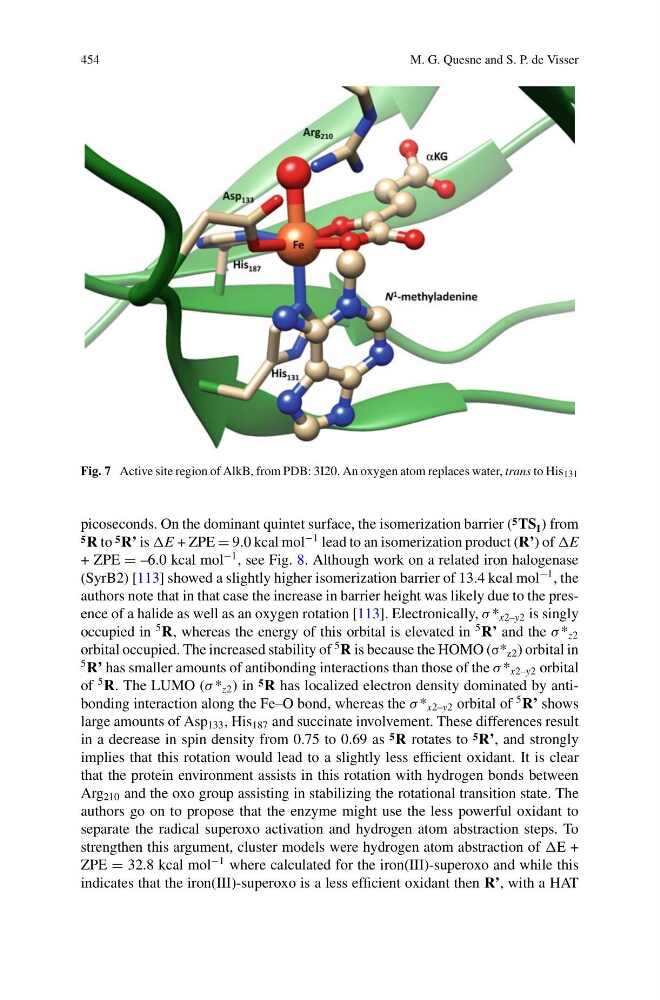
Fig. 7 Active site region of AlkB, from PDB: 3I20. An oxygen atom replaces water, trans to His 131
picoseconds. On the dominant quintet surface, the isomerization barrier ( 5 TS I ) from
5 R to 5 R’ is E + ZPE 9.0 kcal mol
−1 lead to an isomerization product (R’) of E
+ ZPE –6.0 kcal mol
−1 , see Fig. 8. Although work on a related iron halogenase
(SyrB2) [113] showed a slightly higher isomerization barrier of 13.4 kcal mol
−1 , the
authors note that in that case the increase in barrier height was likely due to the presence of a halide as well as an oxygen rotation [113]. Electronically, σ * x2–y2 is singly
occupied in
5 R, whereas the energy of this orbital is elevated in
5 R’ and the σ * z2
orbital occupied. The increased stability of
5 R is because the HOMO (σ* z2 ) orbital in
5 R’ has smaller amounts of antibonding interactions than those of the σ * x2–y2 orbital
of
5 R. The LUMO (σ * z2 ) in 5 R has localized electron density dominated by antibonding interaction along the Fe–O bond, whereas the σ * x2–y2 orbital of
5 R’ shows
large amounts of Asp 133 , His 187 and succinate involvement. These differences result
in a decrease in spin density from 0.75 to 0.69 as 5 R rotates to 5 R’, and strongly
implies that this rotation would lead to a slightly less efficient oxidant. It is clear
that the protein environment assists in this rotation with hydrogen bonds between
Arg 210 and the oxo group assisting in stabilizing the rotational transition state. The
authors go on to propose that the enzyme might use the less powerful oxidant to
separate the radical superoxo activation and hydrogen atom abstraction steps. To
strengthen this argument, cluster models were hydrogen atom abstraction of E +
ZPE 32.8 kcal mol
−1 where calculated for the iron(III)-superoxo and while this
indicates that the iron(III)-superoxo is a less efficient oxidant then R’, with a HAT
M. G. Quesne and S. P. de Visser
Fig. 7 Active site region of AlkB, from PDB: 3I20. An oxygen atom replaces water, trans to His 131
picoseconds. On the dominant quintet surface, the isomerization barrier ( 5 TS I ) from
5 R to 5 R’ is E + ZPE 9.0 kcal mol
−1 lead to an isomerization product (R’) of E
+ ZPE –6.0 kcal mol
−1 , see Fig. 8. Although work on a related iron halogenase
(SyrB2) [113] showed a slightly higher isomerization barrier of 13.4 kcal mol
−1 , the
authors note that in that case the increase in barrier height was likely due to the presence of a halide as well as an oxygen rotation [113]. Electronically, σ * x2–y2 is singly
occupied in
5 R, whereas the energy of this orbital is elevated in
5 R’ and the σ * z2
orbital occupied. The increased stability of
5 R is because the HOMO (σ* z2 ) orbital in
5 R’ has smaller amounts of antibonding interactions than those of the σ * x2–y2 orbital
of
5 R. The LUMO (σ * z2 ) in 5 R has localized electron density dominated by antibonding interaction along the Fe–O bond, whereas the σ * x2–y2 orbital of
5 R’ shows
large amounts of Asp 133 , His 187 and succinate involvement. These differences result
in a decrease in spin density from 0.75 to 0.69 as 5 R rotates to 5 R’, and strongly
implies that this rotation would lead to a slightly less efficient oxidant. It is clear
that the protein environment assists in this rotation with hydrogen bonds between
Arg 210 and the oxo group assisting in stabilizing the rotational transition state. The
authors go on to propose that the enzyme might use the less powerful oxidant to
separate the radical superoxo activation and hydrogen atom abstraction steps. To
strengthen this argument, cluster models were hydrogen atom abstraction of E +
ZPE 32.8 kcal mol
−1 where calculated for the iron(III)-superoxo and while this
indicates that the iron(III)-superoxo is a less efficient oxidant then R’, with a HAT