

The Quest for Accurate Theoretical Models of Metalloenzymes …
455
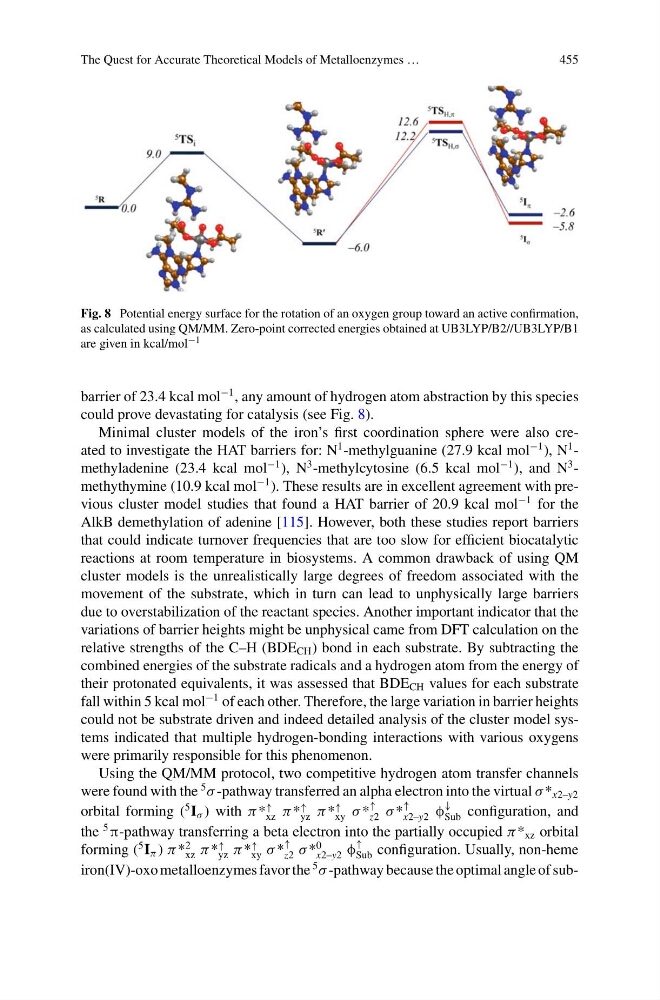
Fig. 8 Potential energy surface for the rotation of an oxygen group toward an active confirmation,
as calculated using QM/MM. Zero-point corrected energies obtained at UB3LYP/B2//UB3LYP/B1
are given in kcal/mol −1
barrier of 23.4 kcal mol
−1 , any amount of hydrogen atom abstraction by this species
could prove devastating for catalysis (see Fig. 8).
Minimal cluster models of the iron’s first coordination sphere were also created to investigate the HAT barriers for: N
1 -methylguanine (27.9 kcal mol
−1 ), N
1 -
methyladenine (23.4 kcal mol
−1 ), N
3 -methylcytosine (6.5 kcal mol
−1 ), and N
3 -
methythymine (10.9 kcal mol
−1 ). These results are in excellent agreement with previous cluster model studies that found a HAT barrier of 20.9 kcal mol
−1 for the
AlkB demethylation of adenine [115]. However, both these studies report barriers
that could indicate turnover frequencies that are too slow for efficient biocatalytic
reactions at room temperature in biosystems. A common drawback of using QM
cluster models is the unrealistically large degrees of freedom associated with the
movement of the substrate, which in turn can lead to unphysically large barriers
due to overstabilization of the reactant species. Another important indicator that the
variations of barrier heights might be unphysical came from DFT calculation on the
relative strengths of the C–H (BDE CH ) bond in each substrate. By subtracting the
combined energies of the substrate radicals and a hydrogen atom from the energy of
their protonated equivalents, it was assessed that BDE CH values for each substrate
fall within 5 kcal mol
−1 of each other. Therefore, the large variation in barrier heights
could not be substrate driven and indeed detailed analysis of the cluster model systems indicated that multiple hydrogen-bonding interactions with various oxygens
were primarily responsible for this phenomenon.
Using the QM/MM protocol, two competitive hydrogen atom transfer channels
were found with the
5
σ -pathway transferred an alpha electron into the virtual σ * x2–y2
orbital forming (
5 I σ ) with π *
↑
xz π *
↑
yz π *
↑
xy σ *
↑
z2 σ *
↑
x2–y2 φ
↓
Sub configuration, and
the
5
π-pathway transferring a beta electron into the partially occupied π * xz orbital
forming (
5 I π ) π *
2
xz π *
↑
yz π *
↑
xy σ *
↑
z2 σ *
0
x2–y2 φ
↑
Sub configuration. Usually, non-heme
iron(IV)-oxo metalloenzymes favor the
5
σ -pathway because the optimal angle of sub-
455
Fig. 8 Potential energy surface for the rotation of an oxygen group toward an active confirmation,
as calculated using QM/MM. Zero-point corrected energies obtained at UB3LYP/B2//UB3LYP/B1
are given in kcal/mol −1
barrier of 23.4 kcal mol
−1 , any amount of hydrogen atom abstraction by this species
could prove devastating for catalysis (see Fig. 8).
Minimal cluster models of the iron’s first coordination sphere were also created to investigate the HAT barriers for: N
1 -methylguanine (27.9 kcal mol
−1 ), N
1 -
methyladenine (23.4 kcal mol
−1 ), N
3 -methylcytosine (6.5 kcal mol
−1 ), and N
3 -
methythymine (10.9 kcal mol
−1 ). These results are in excellent agreement with previous cluster model studies that found a HAT barrier of 20.9 kcal mol
−1 for the
AlkB demethylation of adenine [115]. However, both these studies report barriers
that could indicate turnover frequencies that are too slow for efficient biocatalytic
reactions at room temperature in biosystems. A common drawback of using QM
cluster models is the unrealistically large degrees of freedom associated with the
movement of the substrate, which in turn can lead to unphysically large barriers
due to overstabilization of the reactant species. Another important indicator that the
variations of barrier heights might be unphysical came from DFT calculation on the
relative strengths of the C–H (BDE CH ) bond in each substrate. By subtracting the
combined energies of the substrate radicals and a hydrogen atom from the energy of
their protonated equivalents, it was assessed that BDE CH values for each substrate
fall within 5 kcal mol
−1 of each other. Therefore, the large variation in barrier heights
could not be substrate driven and indeed detailed analysis of the cluster model systems indicated that multiple hydrogen-bonding interactions with various oxygens
were primarily responsible for this phenomenon.
Using the QM/MM protocol, two competitive hydrogen atom transfer channels
were found with the
5
σ -pathway transferred an alpha electron into the virtual σ * x2–y2
orbital forming (
5 I σ ) with π *
↑
xz π *
↑
yz π *
↑
xy σ *
↑
z2 σ *
↑
x2–y2 φ
↓
Sub configuration, and
the
5
π-pathway transferring a beta electron into the partially occupied π * xz orbital
forming (
5 I π ) π *
2
xz π *
↑
yz π *
↑
xy σ *
↑
z2 σ *
0
x2–y2 φ
↑
Sub configuration. Usually, non-heme
iron(IV)-oxo metalloenzymes favor the
5
σ -pathway because the optimal angle of sub-