

The Quest for Accurate Theoretical Models of Metalloenzymes …
447
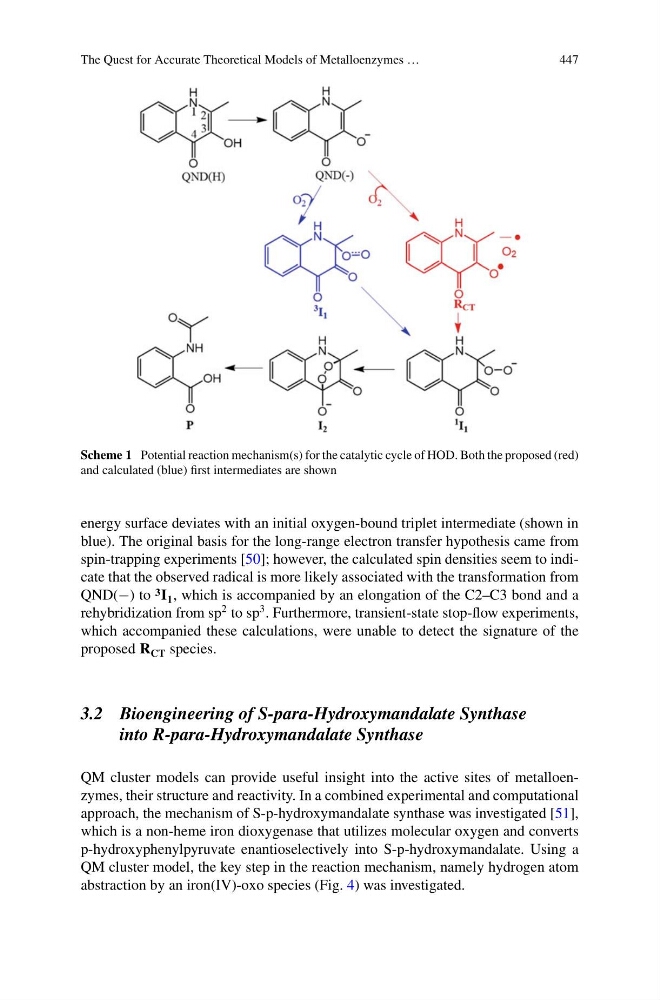
Scheme 1 Potential reaction mechanism(s) for the catalytic cycle of HOD. Both the proposed (red)
and calculated (blue) first intermediates are shown
energy surface deviates with an initial oxygen-bound triplet intermediate (shown in
blue). The original basis for the long-range electron transfer hypothesis came from
spin-trapping experiments [50]; however, the calculated spin densities seem to indicate that the observed radical is more likely associated with the transformation from
QND(−) to 3 I 1 , which is accompanied by an elongation of the C2–C3 bond and a
rehybridization from sp
2 to sp
3 . Furthermore, transient-state stop-flow experiments,
which accompanied these calculations, were unable to detect the signature of the
proposed R CT species.
3.2 Bioengineering of S-para-Hydroxymandalate Synthase
into R-para-Hydroxymandalate Synthase
QM cluster models can provide useful insight into the active sites of metalloenzymes, their structure and reactivity. In a combined experimental and computational
approach, the mechanism of S-p-hydroxymandalate synthase was investigated [51],
which is a non-heme iron dioxygenase that utilizes molecular oxygen and converts
p-hydroxyphenylpyruvate enantioselectively into S-p-hydroxymandalate. Using a
QM cluster model, the key step in the reaction mechanism, namely hydrogen atom
abstraction by an iron(IV)-oxo species (Fig. 4) was investigated.
447
Scheme 1 Potential reaction mechanism(s) for the catalytic cycle of HOD. Both the proposed (red)
and calculated (blue) first intermediates are shown
energy surface deviates with an initial oxygen-bound triplet intermediate (shown in
blue). The original basis for the long-range electron transfer hypothesis came from
spin-trapping experiments [50]; however, the calculated spin densities seem to indicate that the observed radical is more likely associated with the transformation from
QND(−) to 3 I 1 , which is accompanied by an elongation of the C2–C3 bond and a
rehybridization from sp
2 to sp
3 . Furthermore, transient-state stop-flow experiments,
which accompanied these calculations, were unable to detect the signature of the
proposed R CT species.
3.2 Bioengineering of S-para-Hydroxymandalate Synthase
into R-para-Hydroxymandalate Synthase
QM cluster models can provide useful insight into the active sites of metalloenzymes, their structure and reactivity. In a combined experimental and computational
approach, the mechanism of S-p-hydroxymandalate synthase was investigated [51],
which is a non-heme iron dioxygenase that utilizes molecular oxygen and converts
p-hydroxyphenylpyruvate enantioselectively into S-p-hydroxymandalate. Using a
QM cluster model, the key step in the reaction mechanism, namely hydrogen atom
abstraction by an iron(IV)-oxo species (Fig. 4) was investigated.