

448
M. G. Quesne and S. P. de Visser
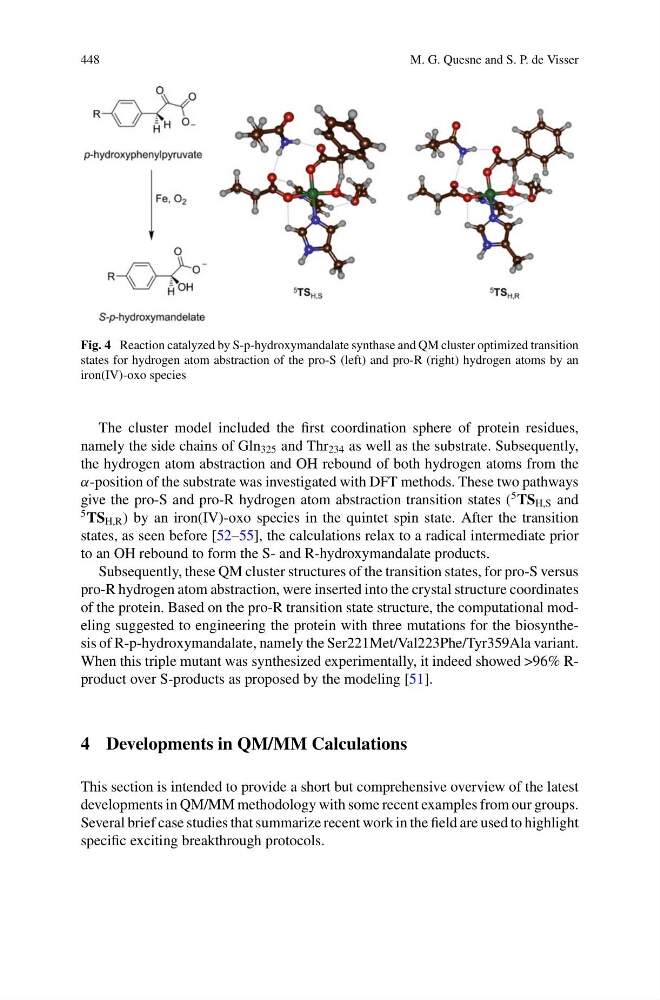
Fig. 4 Reaction catalyzed by S-p-hydroxymandalate synthase and QM cluster optimized transition
states for hydrogen atom abstraction of the pro-S (left) and pro-R (right) hydrogen atoms by an
iron(IV)-oxo species
The cluster model included the first coordination sphere of protein residues,
namely the side chains of Gln 325 and Thr 234 as well as the substrate. Subsequently,
the hydrogen atom abstraction and OH rebound of both hydrogen atoms from the
α-position of the substrate was investigated with DFT methods. These two pathways
give the pro-S and pro-R hydrogen atom abstraction transition states (
5 TS H,S and
5 TS H,R ) by an iron(IV)-oxo species in the quintet spin state. After the transition
states, as seen before [52–55], the calculations relax to a radical intermediate prior
to an OH rebound to form the S- and R-hydroxymandalate products.
Subsequently, these QM cluster structures of the transition states, for pro-S versus
pro-R hydrogen atom abstraction, were inserted into the crystal structure coordinates
of the protein. Based on the pro-R transition state structure, the computational modeling suggested to engineering the protein with three mutations for the biosynthesis of R-p-hydroxymandalate, namely the Ser221Met/Val223Phe/Tyr359Ala variant.
When this triple mutant was synthesized experimentally, it indeed showed >96% Rproduct over S-products as proposed by the modeling [51].
4 Developments in QM/MM Calculations
This section is intended to provide a short but comprehensive overview of the latest
developments in QM/MM methodology with some recent examples from our groups.
Several brief case studies that summarize recent work in the field are used to highlight
specific exciting breakthrough protocols.
M. G. Quesne and S. P. de Visser
Fig. 4 Reaction catalyzed by S-p-hydroxymandalate synthase and QM cluster optimized transition
states for hydrogen atom abstraction of the pro-S (left) and pro-R (right) hydrogen atoms by an
iron(IV)-oxo species
The cluster model included the first coordination sphere of protein residues,
namely the side chains of Gln 325 and Thr 234 as well as the substrate. Subsequently,
the hydrogen atom abstraction and OH rebound of both hydrogen atoms from the
α-position of the substrate was investigated with DFT methods. These two pathways
give the pro-S and pro-R hydrogen atom abstraction transition states (
5 TS H,S and
5 TS H,R ) by an iron(IV)-oxo species in the quintet spin state. After the transition
states, as seen before [52–55], the calculations relax to a radical intermediate prior
to an OH rebound to form the S- and R-hydroxymandalate products.
Subsequently, these QM cluster structures of the transition states, for pro-S versus
pro-R hydrogen atom abstraction, were inserted into the crystal structure coordinates
of the protein. Based on the pro-R transition state structure, the computational modeling suggested to engineering the protein with three mutations for the biosynthesis of R-p-hydroxymandalate, namely the Ser221Met/Val223Phe/Tyr359Ala variant.
When this triple mutant was synthesized experimentally, it indeed showed >96% Rproduct over S-products as proposed by the modeling [51].
4 Developments in QM/MM Calculations
This section is intended to provide a short but comprehensive overview of the latest
developments in QM/MM methodology with some recent examples from our groups.
Several brief case studies that summarize recent work in the field are used to highlight
specific exciting breakthrough protocols.