

446
M. G. Quesne and S. P. de Visser
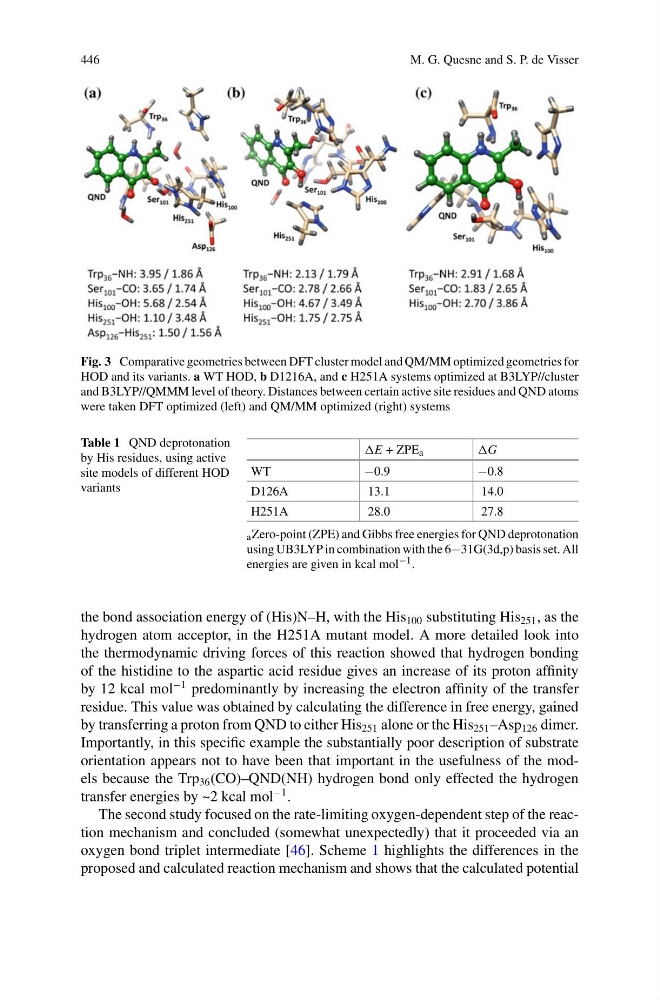
Fig. 3 Comparative geometries between DFT cluster model and QM/MM optimized geometries for
HOD and its variants. a WT HOD, b D1216A, and c H251A systems optimized at B3LYP//cluster
and B3LYP//QMMM level of theory. Distances between certain active site residues and QND atoms
were taken DFT optimized (left) and QM/MM optimized (right) systems
Table 1 QND deprotonation
by His residues, using active
site models of different HOD
variants
E + ZPE a
G
WT
−0.9
−0.8
D126A
13.1
14.0
H251A
28.0
27.8
a Zero-point (ZPE) and Gibbs free energies for QND deprotonation
using UB3LYP in combination with the 6−31G(3d,p) basis set. All
energies are given in kcal mol −1 .
the bond association energy of (His)N–H, with the His 100 substituting His 251 , as the
hydrogen atom acceptor, in the H251A mutant model. A more detailed look into
the thermodynamic driving forces of this reaction showed that hydrogen bonding
of the histidine to the aspartic acid residue gives an increase of its proton affinity
by 12 kcal mol
−1 predominantly by increasing the electron affinity of the transfer
residue. This value was obtained by calculating the difference in free energy, gained
by transferring a proton from QND to either His 251 alone or the His 251 –Asp 126 dimer.
Importantly, in this specific example the substantially poor description of substrate
orientation appears not to have been that important in the usefulness of the models because the Trp 36 (CO)–QND(NH) hydrogen bond only effected the hydrogen
transfer energies by ~2 kcal mol
−1 .
The second study focused on the rate-limiting oxygen-dependent step of the reaction mechanism and concluded (somewhat unexpectedly) that it proceeded via an
oxygen bond triplet intermediate [46]. Scheme 1 highlights the differences in the
proposed and calculated reaction mechanism and shows that the calculated potential
M. G. Quesne and S. P. de Visser
Fig. 3 Comparative geometries between DFT cluster model and QM/MM optimized geometries for
HOD and its variants. a WT HOD, b D1216A, and c H251A systems optimized at B3LYP//cluster
and B3LYP//QMMM level of theory. Distances between certain active site residues and QND atoms
were taken DFT optimized (left) and QM/MM optimized (right) systems
Table 1 QND deprotonation
by His residues, using active
site models of different HOD
variants
E + ZPE a
G
WT
−0.9
−0.8
D126A
13.1
14.0
H251A
28.0
27.8
a Zero-point (ZPE) and Gibbs free energies for QND deprotonation
using UB3LYP in combination with the 6−31G(3d,p) basis set. All
energies are given in kcal mol −1 .
the bond association energy of (His)N–H, with the His 100 substituting His 251 , as the
hydrogen atom acceptor, in the H251A mutant model. A more detailed look into
the thermodynamic driving forces of this reaction showed that hydrogen bonding
of the histidine to the aspartic acid residue gives an increase of its proton affinity
by 12 kcal mol
−1 predominantly by increasing the electron affinity of the transfer
residue. This value was obtained by calculating the difference in free energy, gained
by transferring a proton from QND to either His 251 alone or the His 251 –Asp 126 dimer.
Importantly, in this specific example the substantially poor description of substrate
orientation appears not to have been that important in the usefulness of the models because the Trp 36 (CO)–QND(NH) hydrogen bond only effected the hydrogen
transfer energies by ~2 kcal mol
−1 .
The second study focused on the rate-limiting oxygen-dependent step of the reaction mechanism and concluded (somewhat unexpectedly) that it proceeded via an
oxygen bond triplet intermediate [46]. Scheme 1 highlights the differences in the
proposed and calculated reaction mechanism and shows that the calculated potential