

The Quest for Accurate Theoretical Models of Metalloenzymes …
445
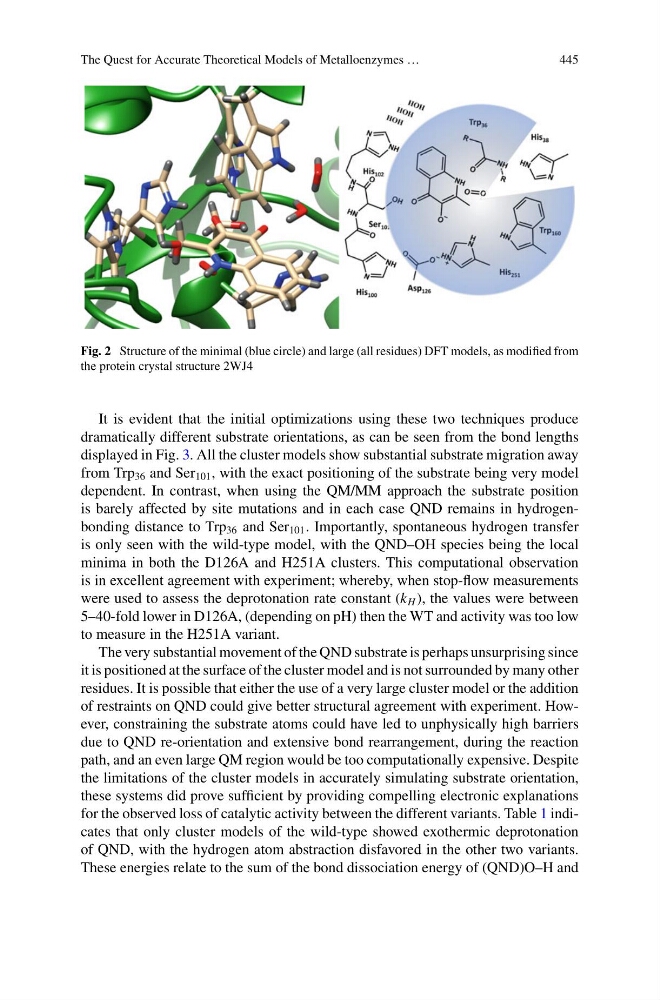
Fig. 2 Structure of the minimal (blue circle) and large (all residues) DFT models, as modified from
the protein crystal structure 2WJ4
It is evident that the initial optimizations using these two techniques produce
dramatically different substrate orientations, as can be seen from the bond lengths
displayed in Fig. 3. All the cluster models show substantial substrate migration away
from Trp 36 and Ser 101 , with the exact positioning of the substrate being very model
dependent. In contrast, when using the QM/MM approach the substrate position
is barely affected by site mutations and in each case QND remains in hydrogenbonding distance to Trp 36 and Ser 101 . Importantly, spontaneous hydrogen transfer
is only seen with the wild-type model, with the QND–OH species being the local
minima in both the D126A and H251A clusters. This computational observation
is in excellent agreement with experiment; whereby, when stop-flow measurements
were used to assess the deprotonation rate constant (k H ), the values were between
5–40-fold lower in D126A, (depending on pH) then the WT and activity was too low
to measure in the H251A variant.
The very substantial movement of the QND substrate is perhaps unsurprising since
it is positioned at the surface of the cluster model and is not surrounded by many other
residues. It is possible that either the use of a very large cluster model or the addition
of restraints on QND could give better structural agreement with experiment. However, constraining the substrate atoms could have led to unphysically high barriers
due to QND re-orientation and extensive bond rearrangement, during the reaction
path, and an even large QM region would be too computationally expensive. Despite
the limitations of the cluster models in accurately simulating substrate orientation,
these systems did prove sufficient by providing compelling electronic explanations
for the observed loss of catalytic activity between the different variants. Table 1 indicates that only cluster models of the wild-type showed exothermic deprotonation
of QND, with the hydrogen atom abstraction disfavored in the other two variants.
These energies relate to the sum of the bond dissociation energy of (QND)O–H and
445
Fig. 2 Structure of the minimal (blue circle) and large (all residues) DFT models, as modified from
the protein crystal structure 2WJ4
It is evident that the initial optimizations using these two techniques produce
dramatically different substrate orientations, as can be seen from the bond lengths
displayed in Fig. 3. All the cluster models show substantial substrate migration away
from Trp 36 and Ser 101 , with the exact positioning of the substrate being very model
dependent. In contrast, when using the QM/MM approach the substrate position
is barely affected by site mutations and in each case QND remains in hydrogenbonding distance to Trp 36 and Ser 101 . Importantly, spontaneous hydrogen transfer
is only seen with the wild-type model, with the QND–OH species being the local
minima in both the D126A and H251A clusters. This computational observation
is in excellent agreement with experiment; whereby, when stop-flow measurements
were used to assess the deprotonation rate constant (k H ), the values were between
5–40-fold lower in D126A, (depending on pH) then the WT and activity was too low
to measure in the H251A variant.
The very substantial movement of the QND substrate is perhaps unsurprising since
it is positioned at the surface of the cluster model and is not surrounded by many other
residues. It is possible that either the use of a very large cluster model or the addition
of restraints on QND could give better structural agreement with experiment. However, constraining the substrate atoms could have led to unphysically high barriers
due to QND re-orientation and extensive bond rearrangement, during the reaction
path, and an even large QM region would be too computationally expensive. Despite
the limitations of the cluster models in accurately simulating substrate orientation,
these systems did prove sufficient by providing compelling electronic explanations
for the observed loss of catalytic activity between the different variants. Table 1 indicates that only cluster models of the wild-type showed exothermic deprotonation
of QND, with the hydrogen atom abstraction disfavored in the other two variants.
These energies relate to the sum of the bond dissociation energy of (QND)O–H and