

430
P. P. Roma´ nczyk and S. S. Kurek
−1.6 V versus Fc, which excellently agrees with the experimental finding that the
catalysis proceeds with complexes having a more cathodic potential than −1.77 V.
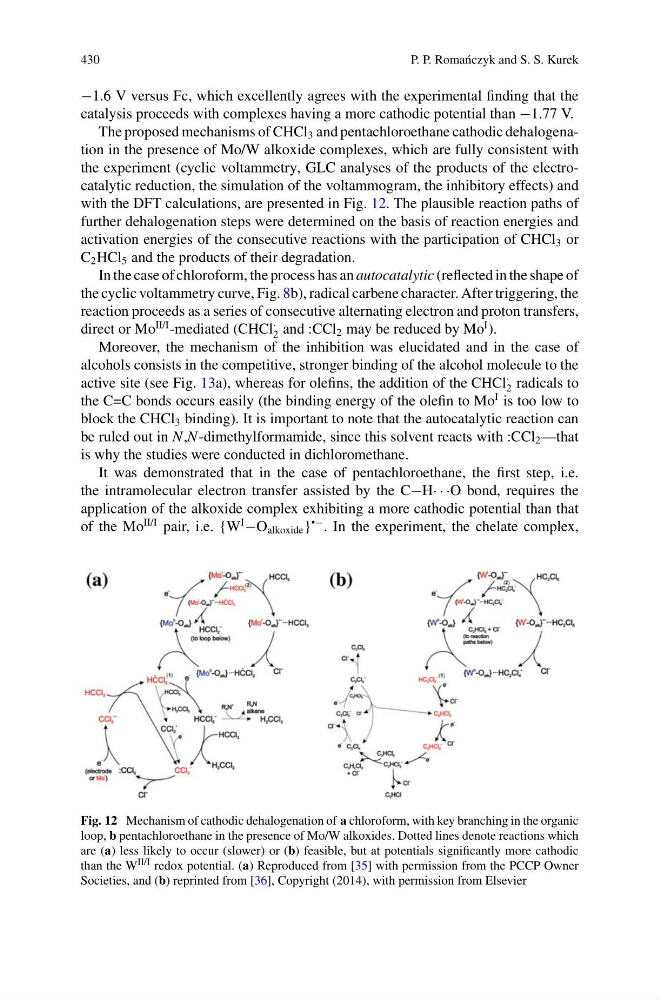
The proposed mechanisms of CHCl 3 and pentachloroethane cathodic dehalogenation in the presence of Mo/W alkoxide complexes, which are fully consistent with
the experiment (cyclic voltammetry, GLC analyses of the products of the electrocatalytic reduction, the simulation of the voltammogram, the inhibitory effects) and
with the DFT calculations, are presented in Fig. 12. The plausible reaction paths of
further dehalogenation steps were determined on the basis of reaction energies and
activation energies of the consecutive reactions with the participation of CHCl 3 or
C 2 HCl 5 and the products of their degradation.
In the case of chloroform, the process has an autocatalytic (reflected in the shape of
the cyclic voltammetry curve, Fig. 8b), radical carbene character. After triggering, the
reaction proceeds as a series of consecutive alternating electron and proton transfers,
direct or Mo
II/I -mediated (CHCl
·
2 and :CCl 2 may be reduced by Mo
I ).
Moreover, the mechanism of the inhibition was elucidated and in the case of
alcohols consists in the competitive, stronger binding of the alcohol molecule to the
active site (see Fig. 13a), whereas for olefins, the addition of the CHCl
·
2 radicals to
the C=C bonds occurs easily (the binding energy of the olefin to Mo
I is too low to
block the CHCl 3 binding). It is important to note that the autocatalytic reaction can
be ruled out in N,N-dimethylformamide, since this solvent reacts with :CCl 2 —that
is why the studies were conducted in dichloromethane.
It was demonstrated that in the case of pentachloroethane, the first step, i.e.
the intramolecular electron transfer assisted by the C−H· · ·O bond, requires the
application of the alkoxide complex exhibiting a more cathodic potential than that
of the Mo
II/I pair, i.e. {W
I
−O alkoxide }
•− . In the experiment, the chelate complex,
Fig. 12 Mechanism of cathodic dehalogenation of a chloroform, with key branching in the organic
loop, b pentachloroethane in the presence of Mo/W alkoxides. Dotted lines denote reactions which
are (a) less likely to occur (slower) or (b) feasible, but at potentials significantly more cathodic
than the W II/I redox potential. (a) Reproduced from [35] with permission from the PCCP Owner
Societies, and (b) reprinted from [36], Copyright (2014), with permission from Elsevier
P. P. Roma´ nczyk and S. S. Kurek
−1.6 V versus Fc, which excellently agrees with the experimental finding that the
catalysis proceeds with complexes having a more cathodic potential than −1.77 V.
The proposed mechanisms of CHCl 3 and pentachloroethane cathodic dehalogenation in the presence of Mo/W alkoxide complexes, which are fully consistent with
the experiment (cyclic voltammetry, GLC analyses of the products of the electrocatalytic reduction, the simulation of the voltammogram, the inhibitory effects) and
with the DFT calculations, are presented in Fig. 12. The plausible reaction paths of
further dehalogenation steps were determined on the basis of reaction energies and
activation energies of the consecutive reactions with the participation of CHCl 3 or
C 2 HCl 5 and the products of their degradation.
In the case of chloroform, the process has an autocatalytic (reflected in the shape of
the cyclic voltammetry curve, Fig. 8b), radical carbene character. After triggering, the
reaction proceeds as a series of consecutive alternating electron and proton transfers,
direct or Mo
II/I -mediated (CHCl
·
2 and :CCl 2 may be reduced by Mo
I ).
Moreover, the mechanism of the inhibition was elucidated and in the case of
alcohols consists in the competitive, stronger binding of the alcohol molecule to the
active site (see Fig. 13a), whereas for olefins, the addition of the CHCl
·
2 radicals to
the C=C bonds occurs easily (the binding energy of the olefin to Mo
I is too low to
block the CHCl 3 binding). It is important to note that the autocatalytic reaction can
be ruled out in N,N-dimethylformamide, since this solvent reacts with :CCl 2 —that
is why the studies were conducted in dichloromethane.
It was demonstrated that in the case of pentachloroethane, the first step, i.e.
the intramolecular electron transfer assisted by the C−H· · ·O bond, requires the
application of the alkoxide complex exhibiting a more cathodic potential than that
of the Mo
II/I pair, i.e. {W
I
−O alkoxide }
•− . In the experiment, the chelate complex,
Fig. 12 Mechanism of cathodic dehalogenation of a chloroform, with key branching in the organic
loop, b pentachloroethane in the presence of Mo/W alkoxides. Dotted lines denote reactions which
are (a) less likely to occur (slower) or (b) feasible, but at potentials significantly more cathodic
than the W II/I redox potential. (a) Reproduced from [35] with permission from the PCCP Owner
Societies, and (b) reprinted from [36], Copyright (2014), with permission from Elsevier