

Molecular Electrochemistry of Coordination Compounds …
431
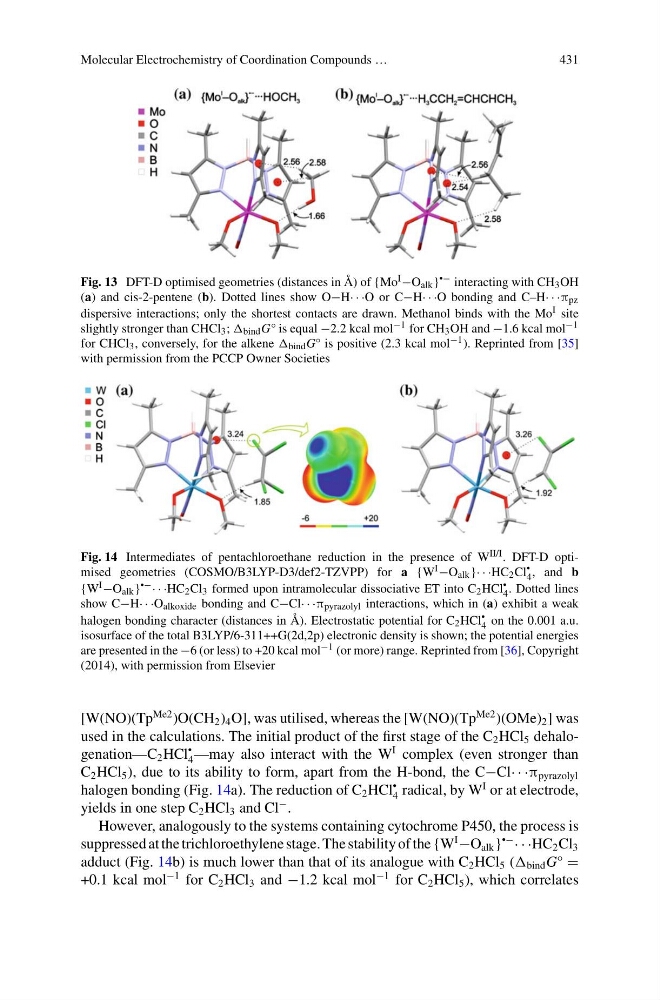
Fig. 13 DFT-D optimised geometries (distances in Å) of {Mo I −O alk } •− interacting with CH 3 OH
(a) and cis-2-pentene (b). Dotted lines show O−H· · ·O or C−H· · ·O bonding and C–H· · ·π pz
dispersive interactions; only the shortest contacts are drawn. Methanol binds with the Mo I site
slightly stronger than CHCl 3 ; bind G° is equal −2.2 kcal mol −1 for CH 3 OH and −1.6 kcal mol −1
for CHCl 3 , conversely, for the alkene bind G° is positive (2.3 kcal mol −1 ). Reprinted from [35]
with permission from the PCCP Owner Societies
Fig. 14 Intermediates of pentachloroethane reduction in the presence of W II/I . DFT-D optimised geometries (COSMO/B3LYP-D3/def2-TZVPP) for a {W I −O alk }· · ·HC 2 Cl •
4 , and b
{W I −O alk } •− · · ·HC 2 Cl 3 formed upon intramolecular dissociative ET into C 2 HCl •
4 . Dotted lines
show C−H· · ·O alkoxide bonding and C−Cl· · ·π pyrazolyl interactions, which in (a) exhibit a weak
halogen bonding character (distances in Å). Electrostatic potential for C 2 HCl •
4 on the 0.001 a.u.
isosurface of the total B3LYP/6-311++G(2d,2p) electronic density is shown; the potential energies
are presented in the −6 (or less) to +20 kcal mol −1 (or more) range. Reprinted from [36], Copyright
(2014), with permission from Elsevier
[W(NO)(Tp
Me2 )O(CH 2 ) 4 O], was utilised, whereas the [W(NO)(Tp
Me2 )(OMe) 2 ] was
used in the calculations. The initial product of the first stage of the C 2 HCl 5 dehalogenation—C 2 HCl
•
4 —may also interact with the W
I complex (even stronger than
C 2 HCl 5 ), due to its ability to form, apart from the H-bond, the C−Cl· · ·π pyrazolyl
halogen bonding (Fig. 14a). The reduction of C 2 HCl
•
4 radical, by W
I or at electrode,
yields in one step C 2 HCl 3 and Cl
− .
However, analogously to the systems containing cytochrome P450, the process is
suppressed at the trichloroethylene stage. The stability of the {W
I
−O alk }
•−
· · ·HC 2 Cl 3
adduct (Fig. 14b) is much lower than that of its analogue with C 2 HCl 5 ( bind G°
+0.1 kcal mol
−1 for C 2 HCl 3 and −1.2 kcal mol
−1 for C 2 HCl 5 ), which correlates
431
Fig. 13 DFT-D optimised geometries (distances in Å) of {Mo I −O alk } •− interacting with CH 3 OH
(a) and cis-2-pentene (b). Dotted lines show O−H· · ·O or C−H· · ·O bonding and C–H· · ·π pz
dispersive interactions; only the shortest contacts are drawn. Methanol binds with the Mo I site
slightly stronger than CHCl 3 ; bind G° is equal −2.2 kcal mol −1 for CH 3 OH and −1.6 kcal mol −1
for CHCl 3 , conversely, for the alkene bind G° is positive (2.3 kcal mol −1 ). Reprinted from [35]
with permission from the PCCP Owner Societies
Fig. 14 Intermediates of pentachloroethane reduction in the presence of W II/I . DFT-D optimised geometries (COSMO/B3LYP-D3/def2-TZVPP) for a {W I −O alk }· · ·HC 2 Cl •
4 , and b
{W I −O alk } •− · · ·HC 2 Cl 3 formed upon intramolecular dissociative ET into C 2 HCl •
4 . Dotted lines
show C−H· · ·O alkoxide bonding and C−Cl· · ·π pyrazolyl interactions, which in (a) exhibit a weak
halogen bonding character (distances in Å). Electrostatic potential for C 2 HCl •
4 on the 0.001 a.u.
isosurface of the total B3LYP/6-311++G(2d,2p) electronic density is shown; the potential energies
are presented in the −6 (or less) to +20 kcal mol −1 (or more) range. Reprinted from [36], Copyright
(2014), with permission from Elsevier
[W(NO)(Tp
Me2 )O(CH 2 ) 4 O], was utilised, whereas the [W(NO)(Tp
Me2 )(OMe) 2 ] was
used in the calculations. The initial product of the first stage of the C 2 HCl 5 dehalogenation—C 2 HCl
•
4 —may also interact with the W
I complex (even stronger than
C 2 HCl 5 ), due to its ability to form, apart from the H-bond, the C−Cl· · ·π pyrazolyl
halogen bonding (Fig. 14a). The reduction of C 2 HCl
•
4 radical, by W
I or at electrode,
yields in one step C 2 HCl 3 and Cl
− .
However, analogously to the systems containing cytochrome P450, the process is
suppressed at the trichloroethylene stage. The stability of the {W
I
−O alk }
•−
· · ·HC 2 Cl 3
adduct (Fig. 14b) is much lower than that of its analogue with C 2 HCl 5 ( bind G°
+0.1 kcal mol
−1 for C 2 HCl 3 and −1.2 kcal mol
−1 for C 2 HCl 5 ), which correlates