

Molecular Electrochemistry of Coordination Compounds …
429
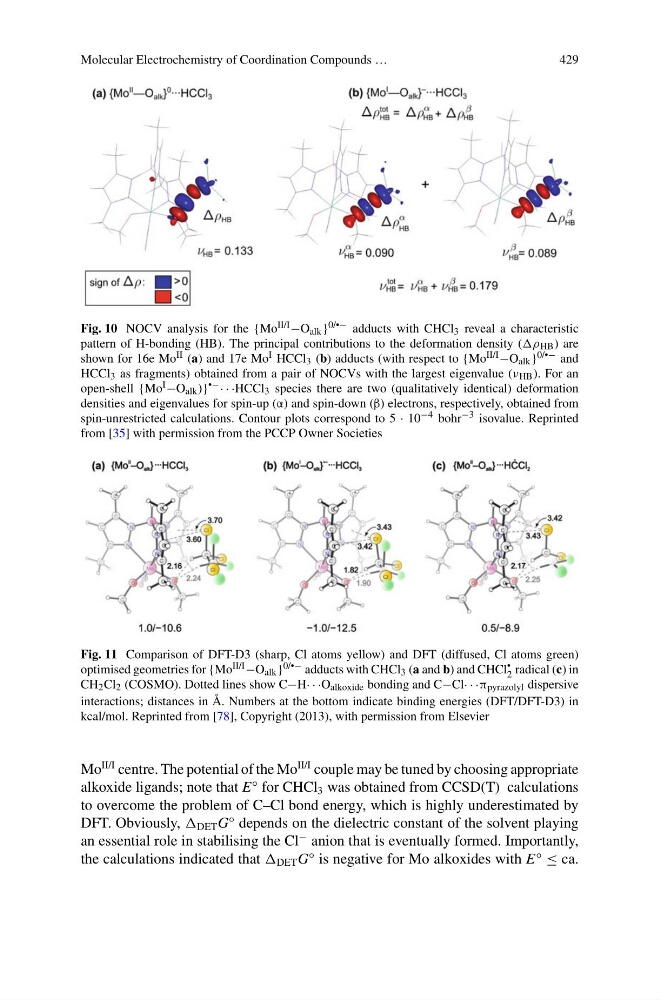
Fig. 10 NOCV analysis for the {Mo II/I −O alk } 0/•− adducts with CHCl 3 reveal a characteristic
pattern of H-bonding (HB). The principal contributions to the deformation density (ρ HB ) are
shown for 16e Mo II (a) and 17e Mo I HCCl 3 (b) adducts (with respect to {Mo II/I −O alk } 0/•− and
HCCl 3 as fragments) obtained from a pair of NOCVs with the largest eigenvalue (ν HB ). For an
open-shell {Mo I −O alk )} •− · · ·HCCl 3 species there are two (qualitatively identical) deformation
densities and eigenvalues for spin-up (α) and spin-down (β) electrons, respectively, obtained from
spin-unrestricted calculations. Contour plots correspond to 5 · 10 −4 bohr −3 isovalue. Reprinted
from [35] with permission from the PCCP Owner Societies
Fig. 11 Comparison of DFT-D3 (sharp, Cl atoms yellow) and DFT (diffused, Cl atoms green)
optimised geometries for {Mo II/I −O alk } 0/•− adducts with CHCl 3 (a and b) and CHCl •
2 radical (c) in
CH 2 Cl 2 (COSMO). Dotted lines show C−H· · ·O alkoxide bonding and C−Cl· · ·π pyrazolyl dispersive
interactions; distances in Å. Numbers at the bottom indicate binding energies (DFT/DFT-D3) in
kcal/mol. Reprinted from [78], Copyright (2013), with permission from Elsevier
Mo
II/I centre. The potential of the Mo
II/I couple may be tuned by choosing appropriate
alkoxide ligands; note that E° for CHCl 3 was obtained from CCSD(T) calculations
to overcome the problem of C–Cl bond energy, which is highly underestimated by
DFT. Obviously, DET G° depends on the dielectric constant of the solvent playing
an essential role in stabilising the Cl
− anion that is eventually formed. Importantly,
the calculations indicated that DET G° is negative for Mo alkoxides with E° ≤ ca.
429
Fig. 10 NOCV analysis for the {Mo II/I −O alk } 0/•− adducts with CHCl 3 reveal a characteristic
pattern of H-bonding (HB). The principal contributions to the deformation density (ρ HB ) are
shown for 16e Mo II (a) and 17e Mo I HCCl 3 (b) adducts (with respect to {Mo II/I −O alk } 0/•− and
HCCl 3 as fragments) obtained from a pair of NOCVs with the largest eigenvalue (ν HB ). For an
open-shell {Mo I −O alk )} •− · · ·HCCl 3 species there are two (qualitatively identical) deformation
densities and eigenvalues for spin-up (α) and spin-down (β) electrons, respectively, obtained from
spin-unrestricted calculations. Contour plots correspond to 5 · 10 −4 bohr −3 isovalue. Reprinted
from [35] with permission from the PCCP Owner Societies
Fig. 11 Comparison of DFT-D3 (sharp, Cl atoms yellow) and DFT (diffused, Cl atoms green)
optimised geometries for {Mo II/I −O alk } 0/•− adducts with CHCl 3 (a and b) and CHCl •
2 radical (c) in
CH 2 Cl 2 (COSMO). Dotted lines show C−H· · ·O alkoxide bonding and C−Cl· · ·π pyrazolyl dispersive
interactions; distances in Å. Numbers at the bottom indicate binding energies (DFT/DFT-D3) in
kcal/mol. Reprinted from [78], Copyright (2013), with permission from Elsevier
Mo
II/I centre. The potential of the Mo
II/I couple may be tuned by choosing appropriate
alkoxide ligands; note that E° for CHCl 3 was obtained from CCSD(T) calculations
to overcome the problem of C–Cl bond energy, which is highly underestimated by
DFT. Obviously, DET G° depends on the dielectric constant of the solvent playing
an essential role in stabilising the Cl
− anion that is eventually formed. Importantly,
the calculations indicated that DET G° is negative for Mo alkoxides with E° ≤ ca.