

428
P. P. Roma´ nczyk and S. S. Kurek
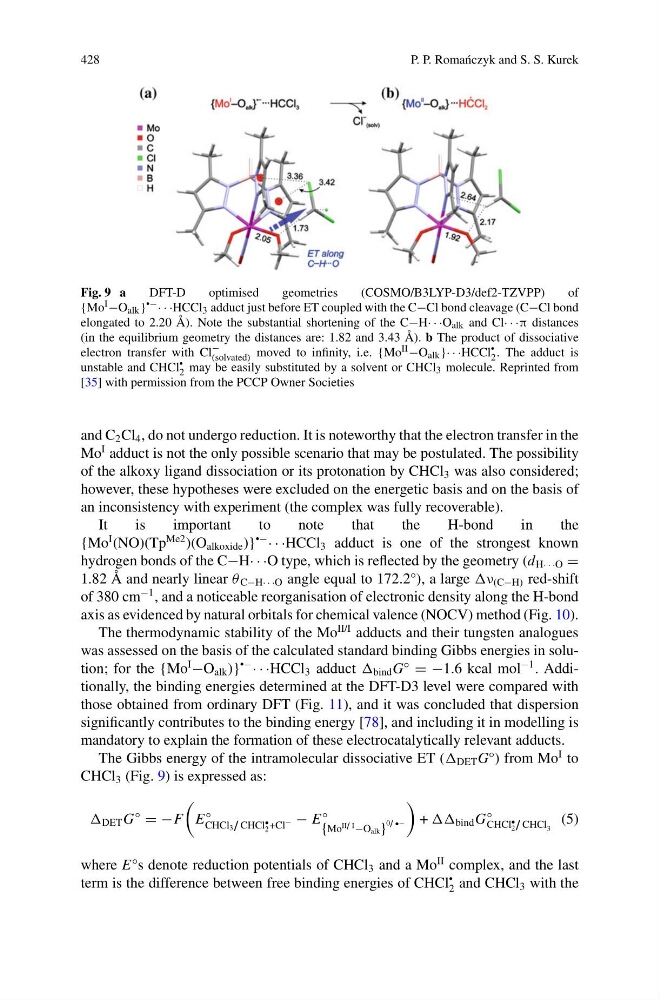
Fig. 9 a
DFT-D
optimised
geometries
(COSMO/B3LYP-D3/def2-TZVPP)
of
{Mo I −O alk } •− · · ·HCCl 3 adduct just before ET coupled with the C−Cl bond cleavage (C−Cl bond
elongated to 2.20 Å). Note the substantial shortening of the C−H· · ·O alk and Cl· · ·π distances
(in the equilibrium geometry the distances are: 1.82 and 3.43 Å). b The product of dissociative
electron transfer with Cl
−
(solvated) moved to infinity, i.e. {Mo II −O alk }· · ·HCCl •
2 . The adduct is
unstable and CHCl •
2 may be easily substituted by a solvent or CHCl 3 molecule. Reprinted from
[35] with permission from the PCCP Owner Societies
and C 2 Cl 4 , do not undergo reduction. It is noteworthy that the electron transfer in the
Mo
I adduct is not the only possible scenario that may be postulated. The possibility
of the alkoxy ligand dissociation or its protonation by CHCl 3 was also considered;
however, these hypotheses were excluded on the energetic basis and on the basis of
an inconsistency with experiment (the complex was fully recoverable).
It
is
important
to
note
that
the
H-bond
in
the
{Mo
I (NO)(Tp
Me2 )(O alkoxide )}
•−
· · ·HCCl 3 adduct is one of the strongest known
hydrogen bonds of the C−H· · ·O type, which is reflected by the geometry (d H· · ·O
1.82 Å and nearly linear θ C−H· · ·O angle equal to 172.2°), a large ν (C−H) red-shift
of 380 cm
−1 , and a noticeable reorganisation of electronic density along the H-bond
axis as evidenced by natural orbitals for chemical valence (NOCV) method (Fig. 10).
The thermodynamic stability of the Mo
II/I adducts and their tungsten analogues
was assessed on the basis of the calculated standard binding Gibbs energies in solution; for the {Mo
I
−O alk )}
•−
· · ·HCCl 3 adduct bind G° −1.6 kcal mol
−1 . Additionally, the binding energies determined at the DFT-D3 level were compared with
those obtained from ordinary DFT (Fig. 11), and it was concluded that dispersion
significantly contributes to the binding energy [78], and including it in modelling is
mandatory to explain the formation of these electrocatalytically relevant adducts.
The Gibbs energy of the intramolecular dissociative ET ( DET G°) from Mo
I to
CHCl 3 (Fig. 9) is expressed as:
DET G
◦
−F
E
◦
CHCl 3/ CHCl
•
2 +Cl
− − E
◦
{Mo
II / I −O alk}
0 / •−
+ bind G
◦
CHCl
•
2 / CHCl 3 (5)
where E°s denote reduction potentials of CHCl 3 and a Mo
II complex, and the last
term is the difference between free binding energies of CHCl
•
2 and CHCl 3 with the
P. P. Roma´ nczyk and S. S. Kurek
Fig. 9 a
DFT-D
optimised
geometries
(COSMO/B3LYP-D3/def2-TZVPP)
of
{Mo I −O alk } •− · · ·HCCl 3 adduct just before ET coupled with the C−Cl bond cleavage (C−Cl bond
elongated to 2.20 Å). Note the substantial shortening of the C−H· · ·O alk and Cl· · ·π distances
(in the equilibrium geometry the distances are: 1.82 and 3.43 Å). b The product of dissociative
electron transfer with Cl
−
(solvated) moved to infinity, i.e. {Mo II −O alk }· · ·HCCl •
2 . The adduct is
unstable and CHCl •
2 may be easily substituted by a solvent or CHCl 3 molecule. Reprinted from
[35] with permission from the PCCP Owner Societies
and C 2 Cl 4 , do not undergo reduction. It is noteworthy that the electron transfer in the
Mo
I adduct is not the only possible scenario that may be postulated. The possibility
of the alkoxy ligand dissociation or its protonation by CHCl 3 was also considered;
however, these hypotheses were excluded on the energetic basis and on the basis of
an inconsistency with experiment (the complex was fully recoverable).
It
is
important
to
note
that
the
H-bond
in
the
{Mo
I (NO)(Tp
Me2 )(O alkoxide )}
•−
· · ·HCCl 3 adduct is one of the strongest known
hydrogen bonds of the C−H· · ·O type, which is reflected by the geometry (d H· · ·O
1.82 Å and nearly linear θ C−H· · ·O angle equal to 172.2°), a large ν (C−H) red-shift
of 380 cm
−1 , and a noticeable reorganisation of electronic density along the H-bond
axis as evidenced by natural orbitals for chemical valence (NOCV) method (Fig. 10).
The thermodynamic stability of the Mo
II/I adducts and their tungsten analogues
was assessed on the basis of the calculated standard binding Gibbs energies in solution; for the {Mo
I
−O alk )}
•−
· · ·HCCl 3 adduct bind G° −1.6 kcal mol
−1 . Additionally, the binding energies determined at the DFT-D3 level were compared with
those obtained from ordinary DFT (Fig. 11), and it was concluded that dispersion
significantly contributes to the binding energy [78], and including it in modelling is
mandatory to explain the formation of these electrocatalytically relevant adducts.
The Gibbs energy of the intramolecular dissociative ET ( DET G°) from Mo
I to
CHCl 3 (Fig. 9) is expressed as:
DET G
◦
−F
E
◦
CHCl 3/ CHCl
•
2 +Cl
− − E
◦
{Mo
II / I −O alk}
0 / •−
+ bind G
◦
CHCl
•
2 / CHCl 3 (5)
where E°s denote reduction potentials of CHCl 3 and a Mo
II complex, and the last
term is the difference between free binding energies of CHCl
•
2 and CHCl 3 with the