

Molecular Electrochemistry of Coordination Compounds …
427
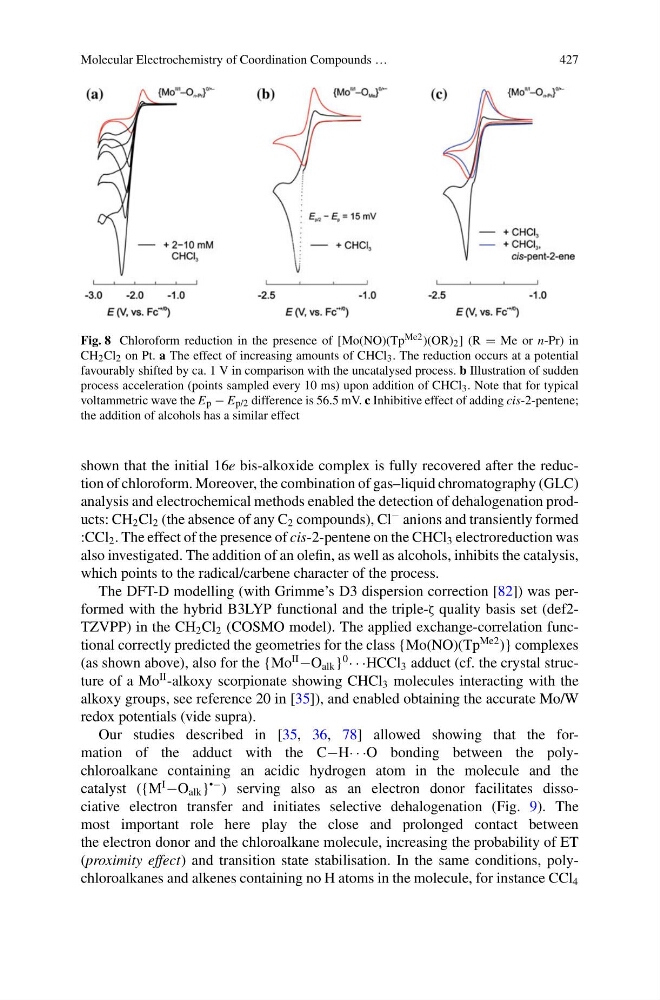
Fig. 8 Chloroform reduction in the presence of [Mo(NO)(Tp Me2 )(OR) 2 ] (R Me or n-Pr) in
CH 2 Cl 2 on Pt. a The effect of increasing amounts of CHCl 3 . The reduction occurs at a potential
favourably shifted by ca. 1 V in comparison with the uncatalysed process. b Illustration of sudden
process acceleration (points sampled every 10 ms) upon addition of CHCl 3 . Note that for typical
voltammetric wave the E p − E p/2 difference is 56.5 mV. c Inhibitive effect of adding cis-2-pentene;
the addition of alcohols has a similar effect
shown that the initial 16e bis-alkoxide complex is fully recovered after the reduction of chloroform. Moreover, the combination of gas–liquid chromatography (GLC)
analysis and electrochemical methods enabled the detection of dehalogenation products: CH 2 Cl 2 (the absence of any C 2 compounds), Cl
− anions and transiently formed
:CCl 2 . The effect of the presence of cis-2-pentene on the CHCl 3 electroreduction was
also investigated. The addition of an olefin, as well as alcohols, inhibits the catalysis,
which points to the radical/carbene character of the process.
The DFT-D modelling (with Grimme’s D3 dispersion correction [82]) was performed with the hybrid B3LYP functional and the triple-ζ quality basis set (def2TZVPP) in the CH 2 Cl 2 (COSMO model). The applied exchange-correlation functional correctly predicted the geometries for the class {Mo(NO)(Tp
Me2 )} complexes
(as shown above), also for the {Mo
II
−O alk }
0
· · ·HCCl 3 adduct (cf. the crystal structure of a Mo
II -alkoxy scorpionate showing CHCl 3 molecules interacting with the
alkoxy groups, see reference 20 in [35]), and enabled obtaining the accurate Mo/W
redox potentials (vide supra).
Our studies described in [35, 36, 78] allowed showing that the formation of the adduct with the C−H· · ·O bonding between the polychloroalkane containing an acidic hydrogen atom in the molecule and the
catalyst ({M
I
−O alk }
•− ) serving also as an electron donor facilitates dissociative electron transfer and initiates selective dehalogenation (Fig. 9). The
most important role here play the close and prolonged contact between
the electron donor and the chloroalkane molecule, increasing the probability of ET
(proximity effect) and transition state stabilisation. In the same conditions, polychloroalkanes and alkenes containing no H atoms in the molecule, for instance CCl 4
427
Fig. 8 Chloroform reduction in the presence of [Mo(NO)(Tp Me2 )(OR) 2 ] (R Me or n-Pr) in
CH 2 Cl 2 on Pt. a The effect of increasing amounts of CHCl 3 . The reduction occurs at a potential
favourably shifted by ca. 1 V in comparison with the uncatalysed process. b Illustration of sudden
process acceleration (points sampled every 10 ms) upon addition of CHCl 3 . Note that for typical
voltammetric wave the E p − E p/2 difference is 56.5 mV. c Inhibitive effect of adding cis-2-pentene;
the addition of alcohols has a similar effect
shown that the initial 16e bis-alkoxide complex is fully recovered after the reduction of chloroform. Moreover, the combination of gas–liquid chromatography (GLC)
analysis and electrochemical methods enabled the detection of dehalogenation products: CH 2 Cl 2 (the absence of any C 2 compounds), Cl
− anions and transiently formed
:CCl 2 . The effect of the presence of cis-2-pentene on the CHCl 3 electroreduction was
also investigated. The addition of an olefin, as well as alcohols, inhibits the catalysis,
which points to the radical/carbene character of the process.
The DFT-D modelling (with Grimme’s D3 dispersion correction [82]) was performed with the hybrid B3LYP functional and the triple-ζ quality basis set (def2TZVPP) in the CH 2 Cl 2 (COSMO model). The applied exchange-correlation functional correctly predicted the geometries for the class {Mo(NO)(Tp
Me2 )} complexes
(as shown above), also for the {Mo
II
−O alk }
0
· · ·HCCl 3 adduct (cf. the crystal structure of a Mo
II -alkoxy scorpionate showing CHCl 3 molecules interacting with the
alkoxy groups, see reference 20 in [35]), and enabled obtaining the accurate Mo/W
redox potentials (vide supra).
Our studies described in [35, 36, 78] allowed showing that the formation of the adduct with the C−H· · ·O bonding between the polychloroalkane containing an acidic hydrogen atom in the molecule and the
catalyst ({M
I
−O alk }
•− ) serving also as an electron donor facilitates dissociative electron transfer and initiates selective dehalogenation (Fig. 9). The
most important role here play the close and prolonged contact between
the electron donor and the chloroalkane molecule, increasing the probability of ET
(proximity effect) and transition state stabilisation. In the same conditions, polychloroalkanes and alkenes containing no H atoms in the molecule, for instance CCl 4