

424
P. P. Roma´ nczyk and S. S. Kurek
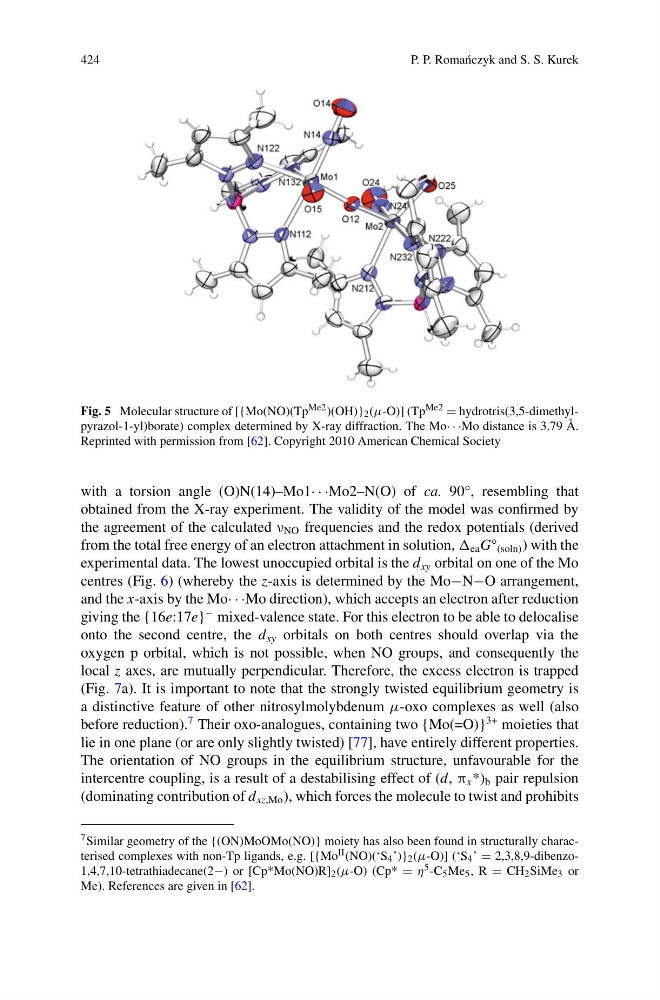
Fig. 5 Molecular structure of [{Mo(NO)(Tp Me2 )(OH)} 2 (μ-O)] (Tp Me2 hydrotris(3,5-dimethylpyrazol-1-yl)borate) complex determined by X-ray diffraction. The Mo· · ·Mo distance is 3.79 Å.
Reprinted with permission from [62]. Copyright 2010 American Chemical Society
with a torsion angle (O)N(14)–Mo1· · ·Mo2–N(O) of ca. 90°, resembling that
obtained from the X-ray experiment. The validity of the model was confirmed by
the agreement of the calculated ν NO frequencies and the redox potentials (derived
from the total free energy of an electron attachment in solution, ea G° (soln) ) with the
experimental data. The lowest unoccupied orbital is the d xy orbital on one of the Mo
centres (Fig. 6) (whereby the z-axis is determined by the Mo−N−O arrangement,
and the x-axis by the Mo· · ·Mo direction), which accepts an electron after reduction
giving the {16e:17e}
− mixed-valence state. For this electron to be able to delocalise
onto the second centre, the d xy orbitals on both centres should overlap via the
oxygen p orbital, which is not possible, when NO groups, and consequently the
local z axes, are mutually perpendicular. Therefore, the excess electron is trapped
(Fig. 7a). It is important to note that the strongly twisted equilibrium geometry is
a distinctive feature of other nitrosylmolybdenum μ-oxo complexes as well (also
before reduction).
7 Their oxo-analogues, containing two {Mo(=O)}
3+ moieties that
lie in one plane (or are only slightly twisted) [77], have entirely different properties.
The orientation of NO groups in the equilibrium structure, unfavourable for the
intercentre coupling, is a result of a destabilising effect of (d, π x *) b pair repulsion
(dominating contribution of d xz,Mo ), which forces the molecule to twist and prohibits
7 Similar geometry of the {(ON)MoOMo(NO)} moiety has also been found in structurally characterised complexes with non-Tp ligands, e.g. [{Mo II (NO)(‘S 4 ’)} 2 (μ-O)] (‘S 4 ’ 2,3,8,9-dibenzo1,4,7,10-tetrathiadecane(2−) or [Cp*Mo(NO)R] 2 (μ-O) (Cp* η 5 -C 5 Me 5 , R CH 2 SiMe 3 or
Me). References are given in [62].
P. P. Roma´ nczyk and S. S. Kurek
Fig. 5 Molecular structure of [{Mo(NO)(Tp Me2 )(OH)} 2 (μ-O)] (Tp Me2 hydrotris(3,5-dimethylpyrazol-1-yl)borate) complex determined by X-ray diffraction. The Mo· · ·Mo distance is 3.79 Å.
Reprinted with permission from [62]. Copyright 2010 American Chemical Society
with a torsion angle (O)N(14)–Mo1· · ·Mo2–N(O) of ca. 90°, resembling that
obtained from the X-ray experiment. The validity of the model was confirmed by
the agreement of the calculated ν NO frequencies and the redox potentials (derived
from the total free energy of an electron attachment in solution, ea G° (soln) ) with the
experimental data. The lowest unoccupied orbital is the d xy orbital on one of the Mo
centres (Fig. 6) (whereby the z-axis is determined by the Mo−N−O arrangement,
and the x-axis by the Mo· · ·Mo direction), which accepts an electron after reduction
giving the {16e:17e}
− mixed-valence state. For this electron to be able to delocalise
onto the second centre, the d xy orbitals on both centres should overlap via the
oxygen p orbital, which is not possible, when NO groups, and consequently the
local z axes, are mutually perpendicular. Therefore, the excess electron is trapped
(Fig. 7a). It is important to note that the strongly twisted equilibrium geometry is
a distinctive feature of other nitrosylmolybdenum μ-oxo complexes as well (also
before reduction).
7 Their oxo-analogues, containing two {Mo(=O)}
3+ moieties that
lie in one plane (or are only slightly twisted) [77], have entirely different properties.
The orientation of NO groups in the equilibrium structure, unfavourable for the
intercentre coupling, is a result of a destabilising effect of (d, π x *) b pair repulsion
(dominating contribution of d xz,Mo ), which forces the molecule to twist and prohibits
7 Similar geometry of the {(ON)MoOMo(NO)} moiety has also been found in structurally characterised complexes with non-Tp ligands, e.g. [{Mo II (NO)(‘S 4 ’)} 2 (μ-O)] (‘S 4 ’ 2,3,8,9-dibenzo1,4,7,10-tetrathiadecane(2−) or [Cp*Mo(NO)R] 2 (μ-O) (Cp* η 5 -C 5 Me 5 , R CH 2 SiMe 3 or
Me). References are given in [62].