

Molecular Electrochemistry of Coordination Compounds …
423
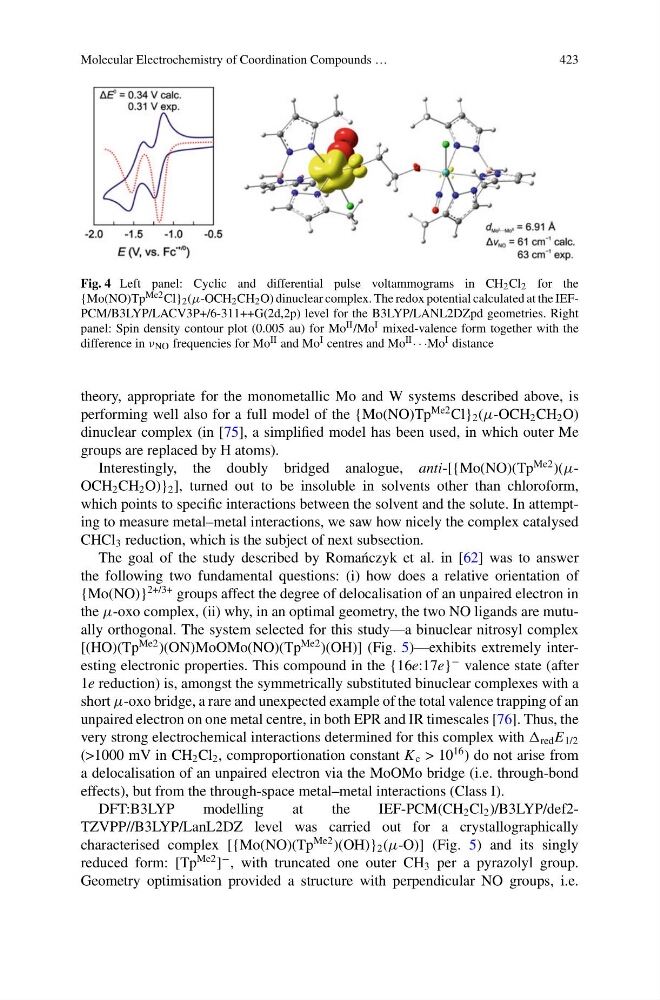
Fig. 4 Left panel: Cyclic and differential pulse voltammograms in CH 2 Cl 2 for the
{Mo(NO)Tp Me2 Cl} 2 (μ-OCH 2 CH 2 O) dinuclear complex. The redox potential calculated at the IEFPCM/B3LYP/LACV3P+/6-311++G(2d,2p) level for the B3LYP/LANL2DZpd geometries. Right
panel: Spin density contour plot (0.005 au) for Mo II /Mo I mixed-valence form together with the
difference in ν NO frequencies for Mo II and Mo I centres and Mo II · · ·Mo I distance
theory, appropriate for the monometallic Mo and W systems described above, is
performing well also for a full model of the {Mo(NO)Tp
Me2 Cl} 2 (μ-OCH 2 CH 2 O)
dinuclear complex (in [75], a simplified model has been used, in which outer Me
groups are replaced by H atoms).
Interestingly, the doubly bridged analogue, anti-[{Mo(NO)(Tp
Me2 )(μOCH 2 CH 2 O)} 2 ], turned out to be insoluble in solvents other than chloroform,
which points to specific interactions between the solvent and the solute. In attempting to measure metal–metal interactions, we saw how nicely the complex catalysed
CHCl 3 reduction, which is the subject of next subsection.
The goal of the study described by Roma´ nczyk et al. in [62] was to answer
the following two fundamental questions: (i) how does a relative orientation of
{Mo(NO)}
2+/3+ groups affect the degree of delocalisation of an unpaired electron in
the μ-oxo complex, (ii) why, in an optimal geometry, the two NO ligands are mutually orthogonal. The system selected for this study—a binuclear nitrosyl complex
[(HO)(Tp
Me2 )(ON)MoOMo(NO)(Tp
Me2 )(OH)] (Fig. 5)—exhibits extremely interesting electronic properties. This compound in the {16e:17e}
− valence state (after
1e reduction) is, amongst the symmetrically substituted binuclear complexes with a
short μ-oxo bridge, a rare and unexpected example of the total valence trapping of an
unpaired electron on one metal centre, in both EPR and IR timescales [76]. Thus, the
very strong electrochemical interactions determined for this complex with red E 1/2
(>1000 mV in CH 2 Cl 2 , comproportionation constant K c > 10
16 ) do not arise from
a delocalisation of an unpaired electron via the MoOMo bridge (i.e. through-bond
effects), but from the through-space metal–metal interactions (Class I).
DFT:B3LYP
modelling
at
the
IEF-PCM(CH 2 Cl 2 )/B3LYP/def2TZVPP//B3LYP/LanL2DZ level was carried out for a crystallographically
characterised complex [{Mo(NO)(Tp
Me2 )(OH)} 2 (μ-O)] (Fig. 5) and its singly
reduced form: [Tp
Me2 ]
− , with truncated one outer CH 3 per a pyrazolyl group.
Geometry optimisation provided a structure with perpendicular NO groups, i.e.
423
Fig. 4 Left panel: Cyclic and differential pulse voltammograms in CH 2 Cl 2 for the
{Mo(NO)Tp Me2 Cl} 2 (μ-OCH 2 CH 2 O) dinuclear complex. The redox potential calculated at the IEFPCM/B3LYP/LACV3P+/6-311++G(2d,2p) level for the B3LYP/LANL2DZpd geometries. Right
panel: Spin density contour plot (0.005 au) for Mo II /Mo I mixed-valence form together with the
difference in ν NO frequencies for Mo II and Mo I centres and Mo II · · ·Mo I distance
theory, appropriate for the monometallic Mo and W systems described above, is
performing well also for a full model of the {Mo(NO)Tp
Me2 Cl} 2 (μ-OCH 2 CH 2 O)
dinuclear complex (in [75], a simplified model has been used, in which outer Me
groups are replaced by H atoms).
Interestingly, the doubly bridged analogue, anti-[{Mo(NO)(Tp
Me2 )(μOCH 2 CH 2 O)} 2 ], turned out to be insoluble in solvents other than chloroform,
which points to specific interactions between the solvent and the solute. In attempting to measure metal–metal interactions, we saw how nicely the complex catalysed
CHCl 3 reduction, which is the subject of next subsection.
The goal of the study described by Roma´ nczyk et al. in [62] was to answer
the following two fundamental questions: (i) how does a relative orientation of
{Mo(NO)}
2+/3+ groups affect the degree of delocalisation of an unpaired electron in
the μ-oxo complex, (ii) why, in an optimal geometry, the two NO ligands are mutually orthogonal. The system selected for this study—a binuclear nitrosyl complex
[(HO)(Tp
Me2 )(ON)MoOMo(NO)(Tp
Me2 )(OH)] (Fig. 5)—exhibits extremely interesting electronic properties. This compound in the {16e:17e}
− valence state (after
1e reduction) is, amongst the symmetrically substituted binuclear complexes with a
short μ-oxo bridge, a rare and unexpected example of the total valence trapping of an
unpaired electron on one metal centre, in both EPR and IR timescales [76]. Thus, the
very strong electrochemical interactions determined for this complex with red E 1/2
(>1000 mV in CH 2 Cl 2 , comproportionation constant K c > 10
16 ) do not arise from
a delocalisation of an unpaired electron via the MoOMo bridge (i.e. through-bond
effects), but from the through-space metal–metal interactions (Class I).
DFT:B3LYP
modelling
at
the
IEF-PCM(CH 2 Cl 2 )/B3LYP/def2TZVPP//B3LYP/LanL2DZ level was carried out for a crystallographically
characterised complex [{Mo(NO)(Tp
Me2 )(OH)} 2 (μ-O)] (Fig. 5) and its singly
reduced form: [Tp
Me2 ]
− , with truncated one outer CH 3 per a pyrazolyl group.
Geometry optimisation provided a structure with perpendicular NO groups, i.e.