

Molecular Electrochemistry of Coordination Compounds …
425
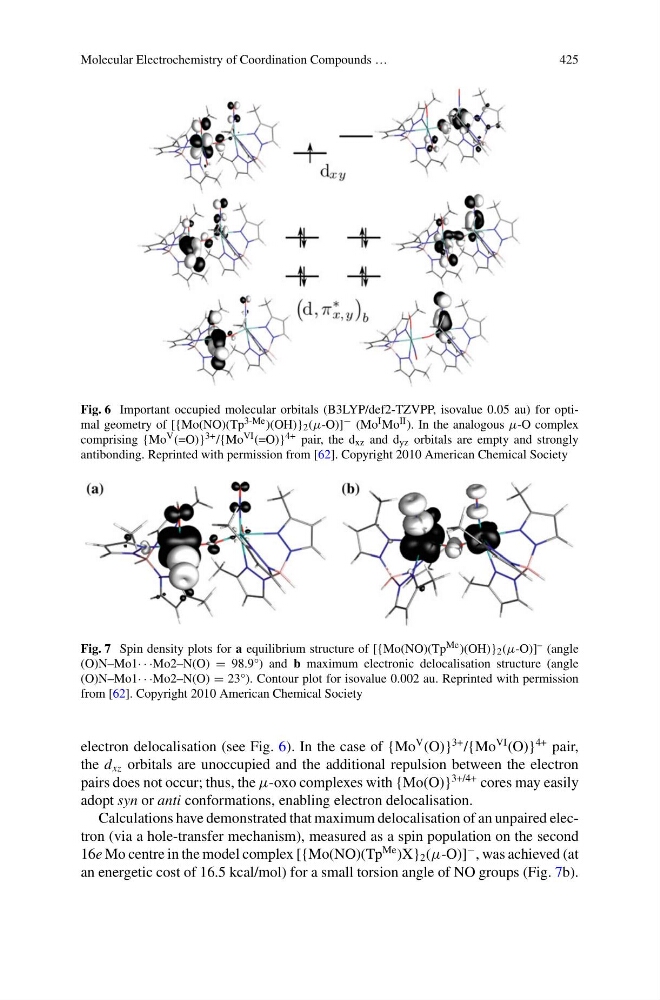
Fig. 6 Important occupied molecular orbitals (B3LYP/def2-TZVPP, isovalue 0.05 au) for optimal geometry of [{Mo(NO)(Tp 3-Me )(OH)} 2 (μ-O)] − (Mo I Mo II ). In the analogous μ-O complex
comprising {Mo V (=O)} 3+ /{Mo VI (=O)} 4+ pair, the d xz and d yz orbitals are empty and strongly
antibonding. Reprinted with permission from [62]. Copyright 2010 American Chemical Society
Fig. 7 Spin density plots for a equilibrium structure of [{Mo(NO)(Tp Me )(OH)} 2 (μ-O)] – (angle
(O)N–Mo1· · ·Mo2–N(O) 98.9°) and b maximum electronic delocalisation structure (angle
(O)N–Mo1· · ·Mo2–N(O) 23°). Contour plot for isovalue 0.002 au. Reprinted with permission
from [62]. Copyright 2010 American Chemical Society
electron delocalisation (see Fig. 6). In the case of {Mo
V (O)}
3+ /{Mo
VI (O)}
4+ pair,
the d xz orbitals are unoccupied and the additional repulsion between the electron
pairs does not occur; thus, the μ-oxo complexes with {Mo(O)}
3+/4+ cores may easily
adopt syn or anti conformations, enabling electron delocalisation.
Calculations have demonstrated that maximum delocalisation of an unpaired electron (via a hole-transfer mechanism), measured as a spin population on the second
16e Mo centre in the model complex [{Mo(NO)(Tp
Me )X} 2 (μ-O)]
− , was achieved (at
an energetic cost of 16.5 kcal/mol) for a small torsion angle of NO groups (Fig. 7b).
425
Fig. 6 Important occupied molecular orbitals (B3LYP/def2-TZVPP, isovalue 0.05 au) for optimal geometry of [{Mo(NO)(Tp 3-Me )(OH)} 2 (μ-O)] − (Mo I Mo II ). In the analogous μ-O complex
comprising {Mo V (=O)} 3+ /{Mo VI (=O)} 4+ pair, the d xz and d yz orbitals are empty and strongly
antibonding. Reprinted with permission from [62]. Copyright 2010 American Chemical Society
Fig. 7 Spin density plots for a equilibrium structure of [{Mo(NO)(Tp Me )(OH)} 2 (μ-O)] – (angle
(O)N–Mo1· · ·Mo2–N(O) 98.9°) and b maximum electronic delocalisation structure (angle
(O)N–Mo1· · ·Mo2–N(O) 23°). Contour plot for isovalue 0.002 au. Reprinted with permission
from [62]. Copyright 2010 American Chemical Society
electron delocalisation (see Fig. 6). In the case of {Mo
V (O)}
3+ /{Mo
VI (O)}
4+ pair,
the d xz orbitals are unoccupied and the additional repulsion between the electron
pairs does not occur; thus, the μ-oxo complexes with {Mo(O)}
3+/4+ cores may easily
adopt syn or anti conformations, enabling electron delocalisation.
Calculations have demonstrated that maximum delocalisation of an unpaired electron (via a hole-transfer mechanism), measured as a spin population on the second
16e Mo centre in the model complex [{Mo(NO)(Tp
Me )X} 2 (μ-O)]
− , was achieved (at
an energetic cost of 16.5 kcal/mol) for a small torsion angle of NO groups (Fig. 7b).