

370
W. Piskorz and F. Zasada
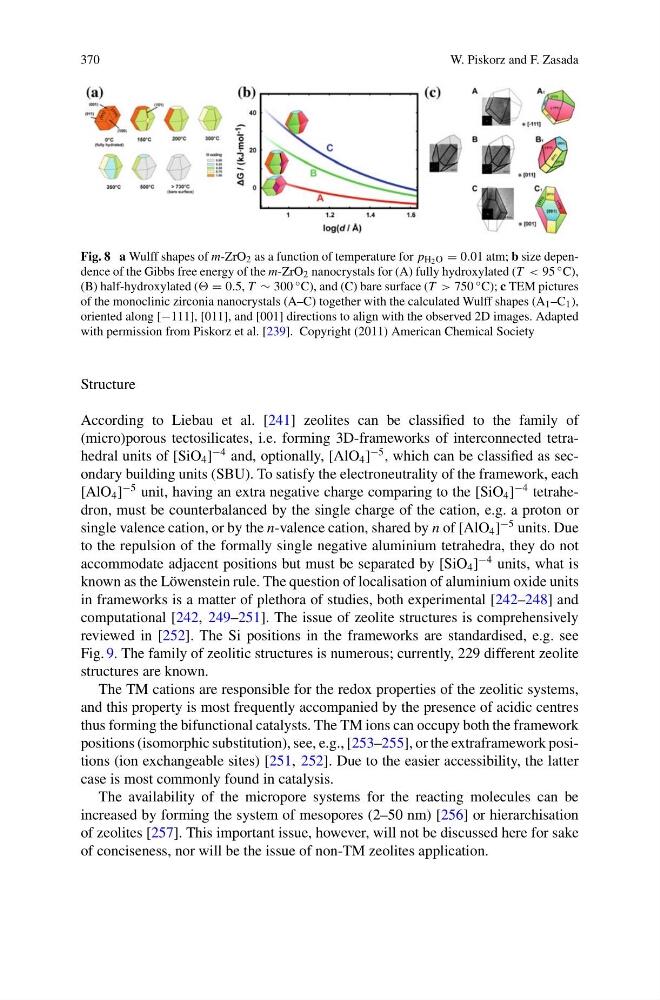
Fig. 8 a Wulff shapes of m-ZrO 2 as a function of temperature for p H2O = 0.01 atm; b size dependence of the Gibbs free energy of the m-ZrO 2 nanocrystals for (A) fully hydroxylated (T < 95 ◦ C),
(B) half-hydroxylated ( = 0.5, T ∼ 300 ◦ C), and (C) bare surface (T > 750 ◦ C); c TEM pictures
of the monoclinic zirconia nanocrystals (A–C) together with the calculated Wulff shapes (A 1 –C 1 ),
oriented along [−111], [011], and [001] directions to align with the observed 2D images. Adapted
with permission from Piskorz et al. [239]. Copyright (2011) American Chemical Society
Structure
According to Liebau et al. [241] zeolites can be classified to the family of
(micro)porous tectosilicates, i.e. forming 3D-frameworks of interconnected tetrahedral units of [SiO 4 ]
−4 and, optionally, [AlO 4 ]
−5 , which can be classified as secondary building units (SBU). To satisfy the electroneutrality of the framework, each
[AlO 4 ]
−5 unit, having an extra negative charge comparing to the [SiO 4 ]
−4 tetrahedron, must be counterbalanced by the single charge of the cation, e.g. a proton or
single valence cation, or by the n-valence cation, shared by n of [AlO 4 ]
−5 units. Due
to the repulsion of the formally single negative aluminium tetrahedra, they do not
accommodate adjacent positions but must be separated by [SiO 4 ]
−4 units, what is
known as the Löwenstein rule. The question of localisation of aluminium oxide units
in frameworks is a matter of plethora of studies, both experimental [242–248] and
computational [242, 249–251]. The issue of zeolite structures is comprehensively
reviewed in [252]. The Si positions in the frameworks are standardised, e.g. see
Fig. 9. The family of zeolitic structures is numerous; currently, 229 different zeolite
structures are known.
The TM cations are responsible for the redox properties of the zeolitic systems,
and this property is most frequently accompanied by the presence of acidic centres
thus forming the bifunctional catalysts. The TM ions can occupy both the framework
positions (isomorphic substitution), see, e.g., [253–255], or the extraframework positions (ion exchangeable sites) [251, 252]. Due to the easier accessibility, the latter
case is most commonly found in catalysis.
The availability of the micropore systems for the reacting molecules can be
increased by forming the system of mesopores (2–50 nm) [256] or hierarchisation
of zeolites [257]. This important issue, however, will not be discussed here for sake
of conciseness, nor will be the issue of non-TM zeolites application.
W. Piskorz and F. Zasada
Fig. 8 a Wulff shapes of m-ZrO 2 as a function of temperature for p H2O = 0.01 atm; b size dependence of the Gibbs free energy of the m-ZrO 2 nanocrystals for (A) fully hydroxylated (T < 95 ◦ C),
(B) half-hydroxylated ( = 0.5, T ∼ 300 ◦ C), and (C) bare surface (T > 750 ◦ C); c TEM pictures
of the monoclinic zirconia nanocrystals (A–C) together with the calculated Wulff shapes (A 1 –C 1 ),
oriented along [−111], [011], and [001] directions to align with the observed 2D images. Adapted
with permission from Piskorz et al. [239]. Copyright (2011) American Chemical Society
Structure
According to Liebau et al. [241] zeolites can be classified to the family of
(micro)porous tectosilicates, i.e. forming 3D-frameworks of interconnected tetrahedral units of [SiO 4 ]
−4 and, optionally, [AlO 4 ]
−5 , which can be classified as secondary building units (SBU). To satisfy the electroneutrality of the framework, each
[AlO 4 ]
−5 unit, having an extra negative charge comparing to the [SiO 4 ]
−4 tetrahedron, must be counterbalanced by the single charge of the cation, e.g. a proton or
single valence cation, or by the n-valence cation, shared by n of [AlO 4 ]
−5 units. Due
to the repulsion of the formally single negative aluminium tetrahedra, they do not
accommodate adjacent positions but must be separated by [SiO 4 ]
−4 units, what is
known as the Löwenstein rule. The question of localisation of aluminium oxide units
in frameworks is a matter of plethora of studies, both experimental [242–248] and
computational [242, 249–251]. The issue of zeolite structures is comprehensively
reviewed in [252]. The Si positions in the frameworks are standardised, e.g. see
Fig. 9. The family of zeolitic structures is numerous; currently, 229 different zeolite
structures are known.
The TM cations are responsible for the redox properties of the zeolitic systems,
and this property is most frequently accompanied by the presence of acidic centres
thus forming the bifunctional catalysts. The TM ions can occupy both the framework
positions (isomorphic substitution), see, e.g., [253–255], or the extraframework positions (ion exchangeable sites) [251, 252]. Due to the easier accessibility, the latter
case is most commonly found in catalysis.
The availability of the micropore systems for the reacting molecules can be
increased by forming the system of mesopores (2–50 nm) [256] or hierarchisation
of zeolites [257]. This important issue, however, will not be discussed here for sake
of conciseness, nor will be the issue of non-TM zeolites application.