

Catalytic Properties of Selected Transition Metal Oxides—Computational Studies
371
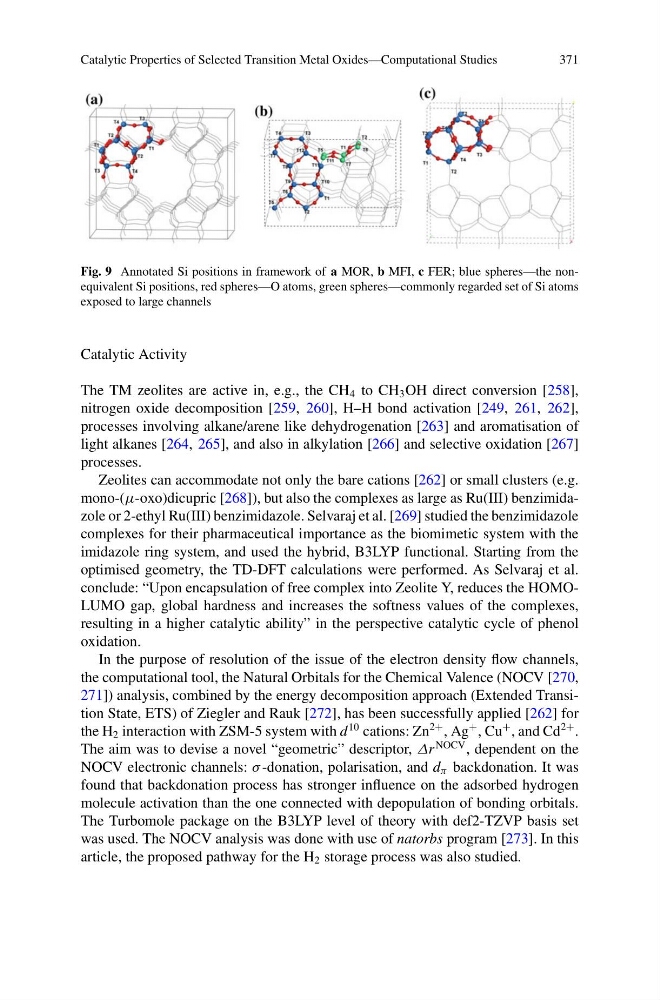
Fig. 9 Annotated Si positions in framework of a MOR, b MFI, c FER; blue spheres—the nonequivalent Si positions, red spheres—O atoms, green spheres—commonly regarded set of Si atoms
exposed to large channels
Catalytic Activity
The TM zeolites are active in, e.g., the CH 4 to CH 3 OH direct conversion [258],
nitrogen oxide decomposition [259, 260], H–H bond activation [249, 261, 262],
processes involving alkane/arene like dehydrogenation [263] and aromatisation of
light alkanes [264, 265], and also in alkylation [266] and selective oxidation [267]
processes.
Zeolites can accommodate not only the bare cations [262] or small clusters (e.g.
mono-(μ-oxo)dicupric [268]), but also the complexes as large as Ru(III) benzimidazole or 2-ethyl Ru(III) benzimidazole. Selvaraj et al. [269] studied the benzimidazole
complexes for their pharmaceutical importance as the biomimetic system with the
imidazole ring system, and used the hybrid, B3LYP functional. Starting from the
optimised geometry, the TD-DFT calculations were performed. As Selvaraj et al.
conclude: “Upon encapsulation of free complex into Zeolite Y, reduces the HOMOLUMO gap, global hardness and increases the softness values of the complexes,
resulting in a higher catalytic ability” in the perspective catalytic cycle of phenol
oxidation.
In the purpose of resolution of the issue of the electron density flow channels,
the computational tool, the Natural Orbitals for the Chemical Valence (NOCV [270,
271]) analysis, combined by the energy decomposition approach (Extended Transition State, ETS) of Ziegler and Rauk [272], has been successfully applied [262] for
the H 2 interaction with ZSM-5 system with d
10 cations: Zn
2+ , Ag
+ , Cu
+ , and Cd
2+ .
The aim was to devise a novel “geometric” descriptor, Δr
NOCV , dependent on the
NOCV electronic channels: σ -donation, polarisation, and d π backdonation. It was
found that backdonation process has stronger influence on the adsorbed hydrogen
molecule activation than the one connected with depopulation of bonding orbitals.
The Turbomole package on the B3LYP level of theory with def2-TZVP basis set
was used. The NOCV analysis was done with use of natorbs program [273]. In this
article, the proposed pathway for the H 2 storage process was also studied.
371
Fig. 9 Annotated Si positions in framework of a MOR, b MFI, c FER; blue spheres—the nonequivalent Si positions, red spheres—O atoms, green spheres—commonly regarded set of Si atoms
exposed to large channels
Catalytic Activity
The TM zeolites are active in, e.g., the CH 4 to CH 3 OH direct conversion [258],
nitrogen oxide decomposition [259, 260], H–H bond activation [249, 261, 262],
processes involving alkane/arene like dehydrogenation [263] and aromatisation of
light alkanes [264, 265], and also in alkylation [266] and selective oxidation [267]
processes.
Zeolites can accommodate not only the bare cations [262] or small clusters (e.g.
mono-(μ-oxo)dicupric [268]), but also the complexes as large as Ru(III) benzimidazole or 2-ethyl Ru(III) benzimidazole. Selvaraj et al. [269] studied the benzimidazole
complexes for their pharmaceutical importance as the biomimetic system with the
imidazole ring system, and used the hybrid, B3LYP functional. Starting from the
optimised geometry, the TD-DFT calculations were performed. As Selvaraj et al.
conclude: “Upon encapsulation of free complex into Zeolite Y, reduces the HOMOLUMO gap, global hardness and increases the softness values of the complexes,
resulting in a higher catalytic ability” in the perspective catalytic cycle of phenol
oxidation.
In the purpose of resolution of the issue of the electron density flow channels,
the computational tool, the Natural Orbitals for the Chemical Valence (NOCV [270,
271]) analysis, combined by the energy decomposition approach (Extended Transition State, ETS) of Ziegler and Rauk [272], has been successfully applied [262] for
the H 2 interaction with ZSM-5 system with d
10 cations: Zn
2+ , Ag
+ , Cu
+ , and Cd
2+ .
The aim was to devise a novel “geometric” descriptor, Δr
NOCV , dependent on the
NOCV electronic channels: σ -donation, polarisation, and d π backdonation. It was
found that backdonation process has stronger influence on the adsorbed hydrogen
molecule activation than the one connected with depopulation of bonding orbitals.
The Turbomole package on the B3LYP level of theory with def2-TZVP basis set
was used. The NOCV analysis was done with use of natorbs program [273]. In this
article, the proposed pathway for the H 2 storage process was also studied.